Confucius - The Five Classics
Здесь есть возможность читать онлайн «Confucius - The Five Classics» — ознакомительный отрывок электронной книги совершенно бесплатно, а после прочтения отрывка купить полную версию. В некоторых случаях можно слушать аудио, скачать через торрент в формате fb2 и присутствует краткое содержание. Жанр: unrecognised, на английском языке. Описание произведения, (предисловие) а так же отзывы посетителей доступны на портале библиотеки ЛибКат.
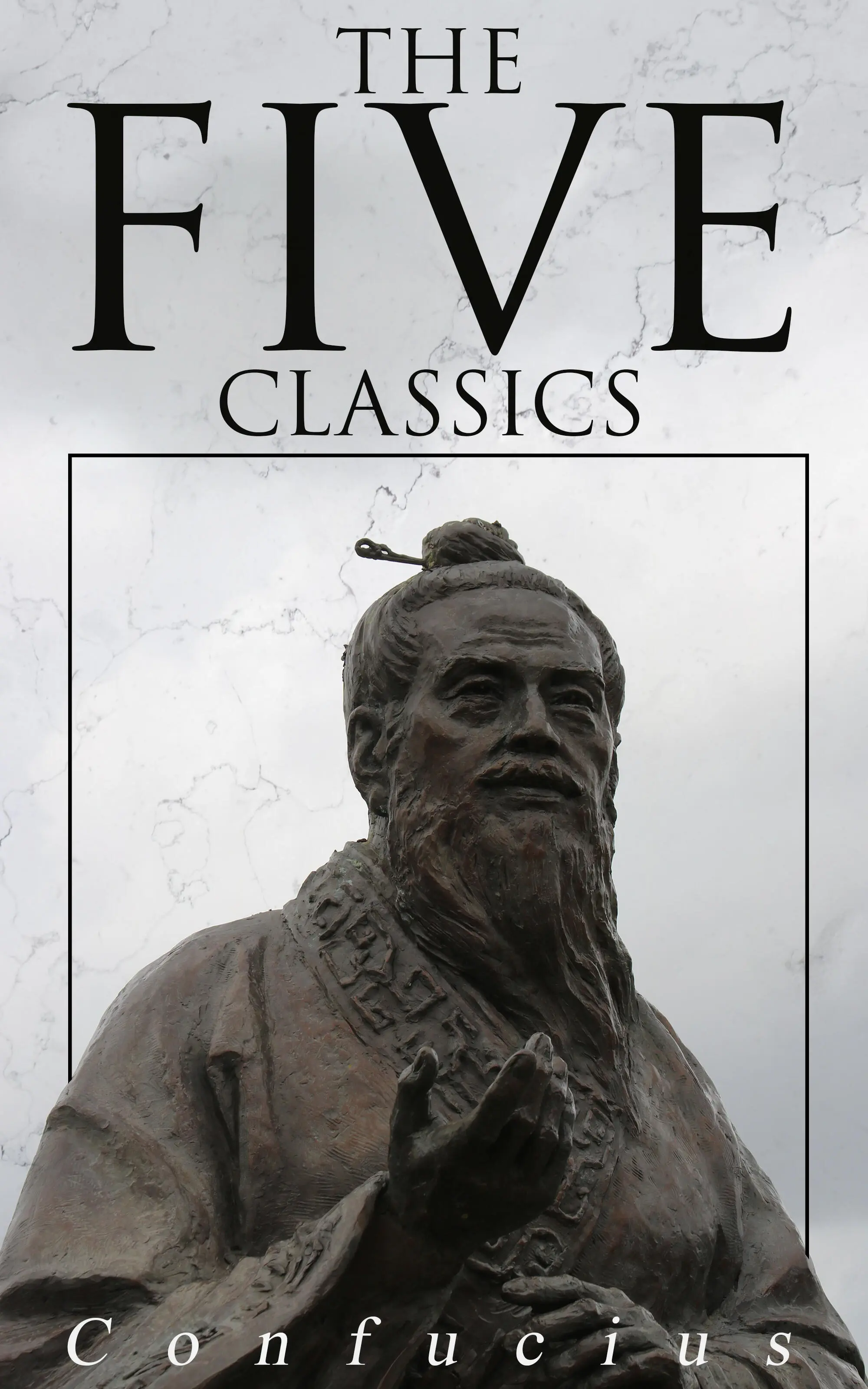
- Название:The Five Classics
- Автор:
- Жанр:
- Год:неизвестен
- ISBN:нет данных
- Рейтинг книги:5 / 5. Голосов: 1
-
Избранное:Добавить в избранное
- Отзывы:
-
Ваша оценка:
The Five Classics: краткое содержание, описание и аннотация
Предлагаем к чтению аннотацию, описание, краткое содержание или предисловие (зависит от того, что написал сам автор книги «The Five Classics»). Если вы не нашли необходимую информацию о книге — напишите в комментариях, мы постараемся отыскать её.
I Ching – The book contains a divination system comparable to Western geomancy or the West African Ifá system. In Western cultures and modern East Asia, it is still widely used for this purpose.
Shu King – A collection of documents and speeches alleged to have been written by rulers and officials of the early Zhou period and before. It is possibly the oldest Chinese narrative, and may date from the 6th century BC. It includes examples of early Chinese prose.
The Shih King – A collection of 305 poems divided into 160 folk songs, 105 festal songs sung at court ceremonies, and 40 hymns and eulogies sung at sacrifices to heroes and ancestral spirits of the royal house.
The Li Ki – Describes ancient rites, social forms and court ceremonies. The version studied today is a re-worked version compiled by scholars in the third century BC rather than the original text, which is said to have been edited by Confucius himself.
Spring and Autumn Annals – A historical record of the State of Lu, Confucius's native state, 722–481 BC.
The Five Classics — читать онлайн ознакомительный отрывок
Ниже представлен текст книги, разбитый по страницам. Система сохранения места последней прочитанной страницы, позволяет с удобством читать онлайн бесплатно книгу «The Five Classics», без необходимости каждый раз заново искать на чём Вы остановились. Поставьте закладку, и сможете в любой момент перейти на страницу, на которой закончили чтение.
Интервал:
Закладка:
'Desinit in piscem mulier formosa superne.'
In reviewing the second of these Appendixes, I was led to speak of the original significance of the trigrams, in opposition to the views of some Chinese who pretend that they can find in them the physical truths discovered by the researches of western science. May I not say now, after viewing the phase of them presented in these paragraphs, that they were devised simply as aids to divination, and partook of the unreasonableness and uncertainty belonging to that?
9. The sixth Appendix is the Treatise on the Sequence of the Hexagrams, to which allusion has been made more than once. It is not necessary to dwell on it at length. King Wăn, it has been seen, gave a name to each hexagram, expressive of the idea--some moral, social, or political truth--which he wished to set forth by means of it; and this name enters very closely into its interpretation. The author of this treatise endeavours to explain the meaning of the name, and also the sequence of the figures, or how it is that the idea of the one leads on to that of the next. Yet the reader must not expect to find in the 64 a chain 'of linked sweetness long drawn out.' The connexion between any two is generally sufficiently close; but on the whole the essays, which I have said they form, resemble 'a heap of orient pearls at random strung.' The changeableness of human affairs is a topic never long absent from the writer's mind. He is firmly persuaded that 'the fashion of the world passeth away.' Union is sure to give place to separation, and by and by that separation will issue in re-union.
There is nothing in the treatise to suggest anything about its authorship; and as the reader will see from the notes, we are perplexed occasionally by meanings given to the names that differ from the meanings in the Text.
10. The last and least Appendix is the seventh, called Ȝâ Kwâ K wan, or 'Treatise on the Lineal Figures taken promiscuously,'--not with regard to any sequence, but as they approximate, or are opposed, to one another in meaning. It is in rhyme, moreover, and this, as much as the meaning, determined, no doubt, the grouping of the hexagrams. The student will learn nothing of value from it; it is more a 'jeu d'esprit' than anything else.
Footnotes
1.Regis' Y-King, vol. ii, p 576.
2.See K âo Yî's Hâi Yü Ȝhung Khâo, Book I, art. 3 (1790).
3.See the 'Collected Comments' on hexagram 55 in the Khang-hsî edition of the Yî (App. I). 'The traces of making and transformation' mean the ever changing phenomena of growth and decay. Our phrase 'Vestiges of Creation' might be used to translate the Chinese characters. See the remarks of the late Dr. Medhurst on the hexagrams 15 and 55 in his 'Dissertation on the Theology of the Chinese,' pp. 107-112. In hexagram 15, Canon McClatchie for kwei-shăn gives gods and demons;' in hexagram 55, the Demon-gods.'
4.  =
=  , the sun, placed over
  , a form of the old
  (=
(=  ), the moon.
5.III, i, 29 (chap. 5. 6).
6.III, i, 20 (chap. 4. 1).
7.III, i, 22.
8.III, i, 38 (chap. 8. 1).
9.Doctrine of the Mean, chap. xxii.
10.The Shû II, ii, 18.
11.The Shû V, iv, 20, 31.
12.See Williams' Syllabic Dictionary on the character  .
.
13.Canon McClatchie (first paragraph of his Introduction) says:--'The Yî is regarded by the Chinese with peculiar veneration . . . . as containing a mine of p. 41. knowledge, which, if it were possible to fathom it thoroughly, would, in their estimation, enable the fortunate possessor to foretell all future events.' This misstatement does not surprise me so much as that Morrison, generally accurate on such points, should say (Dictionary, Part II, i, p. 1020, on the character  ):--
):--
'Of the odd and even numbers, the kwâ or lines of Fû-hsî are the visible signs; and it being assumed that these signs answer to the things signified, and from a knowledge of all the various combinations of numbers, a knowledge of all possible occurrences in nature may be previously known.' The whole article from which I take this sentence is inaccurately written. The language of the Appendix on the knowledge of the future given by the use of the Yî is often incautious, and a cursory reader may be misled; to a careful student, however, the meaning is plain. The second passage of the Shû, referred to above, treats of 'the Examination of Doubts,' and concludes thus:--'When the tortoise-shell and the stalks are both opposed to the views of men, there will be good fortune in stillness, and active operations will be unlucky.'
14.A remarkable instance is given by Lîu K î (of the Ming dynasty, in the fifteenth century) in a story about Shâo Phing, who had been marquis of Tung-ling in the time of Ȝhin, but was degraded tinder Han. Having gone once to Sze-mâ Ki- k û, one of the most skilful diviners of the country, and wishing to know whether there would be a brighter future for him, Sze-mâ said, 'Ah! is it the way of Heaven to love any (partially)? Heaven loves only the virtuous. What intelligence is possessed by spirits? They are intelligent (only) by their connexion with men. The divining stalks are so much withered grass; the tortoise-shell is a withered bone. They are but things, and man is more intelligent than things. Why not listen to yourself instead of seeking (to learn) from things?' The whole piece is in many of the collections of Kû Wăn, or Elegant Writing.
15.These numbers are commonly derived from the River Scheme, in the outer sides of which are the corresponding marks:--  , opposite to
  ;
;  ,opposite to
  ;
;  opposite to
  ; and
; and  , opposite to
  . Hence the number 6 is assigned to
  , 7 to
  , 8 to
  , and 9 to
  . Hence also, in connexion with the formation of the figures by manipulation of the stalks, 9 becomes the number symbolical of the undivided line, as representing Khien
  and 6 of the divided line, as representing Khwăn
  But the late delineation of the map, as given on p. 15, renders all this uncertain, so far as the scheme is concerned. The numbers of the hsiang, however, may have been fixed, must have been fixed indeed, at an early period.
Интервал:
Закладка:
Похожие книги на «The Five Classics»
Представляем Вашему вниманию похожие книги на «The Five Classics» списком для выбора. Мы отобрали схожую по названию и смыслу литературу в надежде предоставить читателям больше вариантов отыскать новые, интересные, ещё непрочитанные произведения.






Обсуждение, отзывы о книге «The Five Classics» и просто собственные мнения читателей. Оставьте ваши комментарии, напишите, что Вы думаете о произведении, его смысле или главных героях. Укажите что конкретно понравилось, а что нет, и почему Вы так считаете.