Confucius - The Five Classics
Здесь есть возможность читать онлайн «Confucius - The Five Classics» — ознакомительный отрывок электронной книги совершенно бесплатно, а после прочтения отрывка купить полную версию. В некоторых случаях можно слушать аудио, скачать через торрент в формате fb2 и присутствует краткое содержание. Жанр: unrecognised, на английском языке. Описание произведения, (предисловие) а так же отзывы посетителей доступны на портале библиотеки ЛибКат.
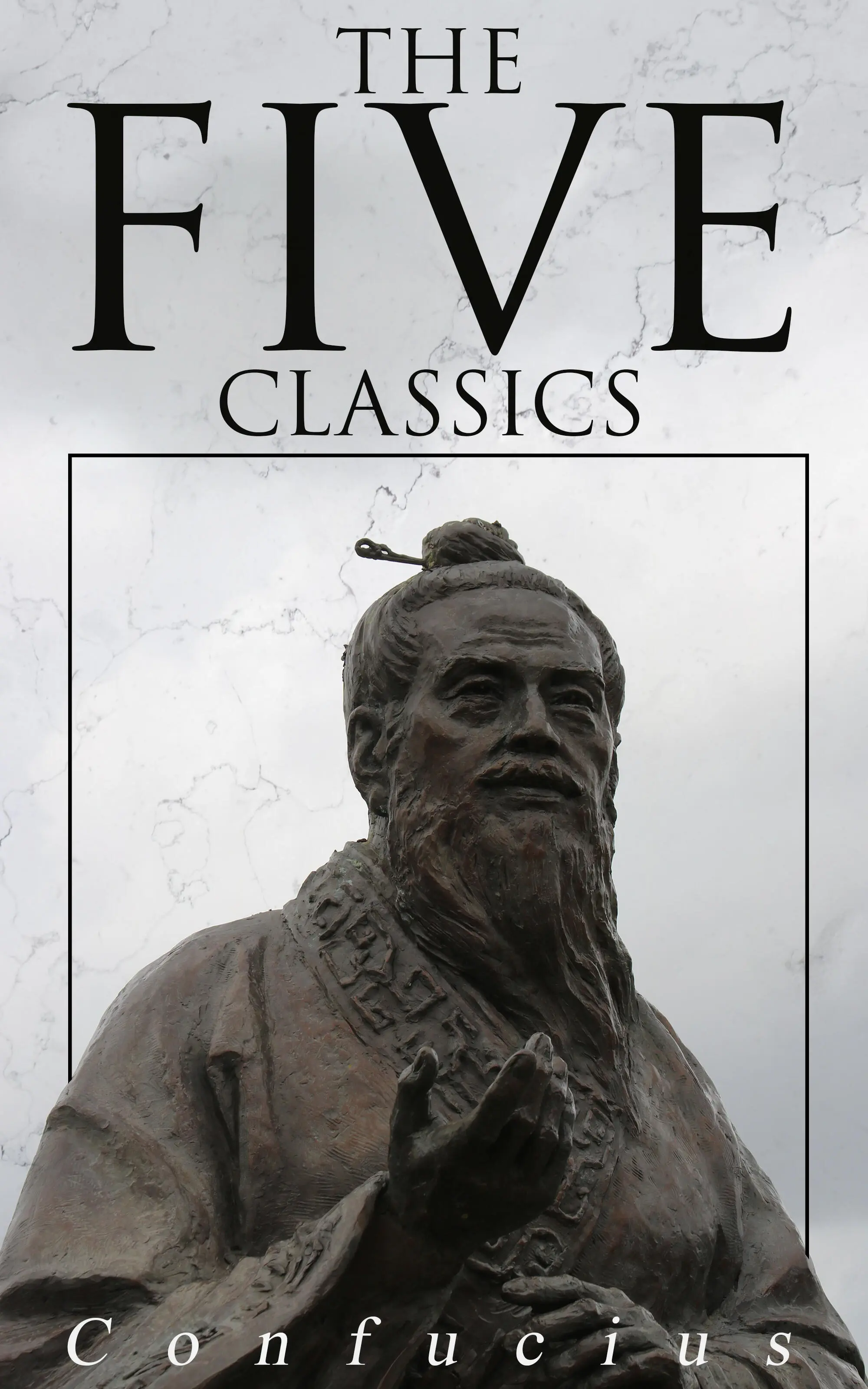
- Название:The Five Classics
- Автор:
- Жанр:
- Год:неизвестен
- ISBN:нет данных
- Рейтинг книги:5 / 5. Голосов: 1
-
Избранное:Добавить в избранное
- Отзывы:
-
Ваша оценка:
The Five Classics: краткое содержание, описание и аннотация
Предлагаем к чтению аннотацию, описание, краткое содержание или предисловие (зависит от того, что написал сам автор книги «The Five Classics»). Если вы не нашли необходимую информацию о книге — напишите в комментариях, мы постараемся отыскать её.
I Ching – The book contains a divination system comparable to Western geomancy or the West African Ifá system. In Western cultures and modern East Asia, it is still widely used for this purpose.
Shu King – A collection of documents and speeches alleged to have been written by rulers and officials of the early Zhou period and before. It is possibly the oldest Chinese narrative, and may date from the 6th century BC. It includes examples of early Chinese prose.
The Shih King – A collection of 305 poems divided into 160 folk songs, 105 festal songs sung at court ceremonies, and 40 hymns and eulogies sung at sacrifices to heroes and ancestral spirits of the royal house.
The Li Ki – Describes ancient rites, social forms and court ceremonies. The version studied today is a re-worked version compiled by scholars in the third century BC rather than the original text, which is said to have been edited by Confucius himself.
Spring and Autumn Annals – A historical record of the State of Lu, Confucius's native state, 722–481 BC.
The Five Classics — читать онлайн ознакомительный отрывок
Ниже представлен текст книги, разбитый по страницам. Система сохранения места последней прочитанной страницы, позволяет с удобством читать онлайн бесплатно книгу «The Five Classics», без необходимости каждый раз заново искать на чём Вы остановились. Поставьте закладку, и сможете в любой момент перейти на страницу, на которой закончили чтение.
Интервал:
Закладка:
Footnotes
1.The Text under each hexagram consists of one paragraph by king Wăn, explaining the figure as a whole, and of six (in the case of hexagrams 1 and 2, of seven) paragraphs by the duke of K âu, explaining the individual lines. The explanatory notices introduced above to this effect will not be repeated. A double space will be used to mark off the portion of king Wăn from that of his son.
Each hexagram consists of two of the trigrams of Fû-hsî, the lower being called 'the inner,' and the one above 'the outer.' The lines, however, are numbered from one to six, commencing with the lowest. To denote the number of it and of the sixth line, the terms for commencing' and 'topmost' are used. The intermediate lines are simply 'second,' 'third,' &c. As the lines must be either whole or divided, technically called strong and weak, yang and yin, this distinction is indicated by the application to them of the numbers nine and six. All whole lines are nine, all divided lines, six.
Two explanations have been proposed of this application of these numbers. The Kh ien trigram, it is said, contains 3 strokes (  ), and the Kh wăn 6 (
  ). But the yang contains the yin in itself, and its representative number will be 3 + 6 = 9, while the yin, not containing the yang, will only have its own number or 6. This explanation, entirely arbitrary, is new deservedly abandoned. The other is based on the use of the 'four Hsiang,' or emblematic figures (
  the great or old yang,
  the young yang,
  the old yin, and
  the young yin). To these are assigned (by what process is unimportant for our present purpose) the numbers 9, 8, 7, 6. They were 'the old yang,' represented by 9, and 'the old yin,' represented by 6, that, in the manipulation of the stalks to form new diagrams, determined the changes of figure; and so 9 and 6 came to be used as the p. 59 names of a yang line and a yin line respectively. This explanation is now universally acquiesced in. The nomenclature of first nine, nine two, &c., or first six, six two, &c., however, is merely a jargon; and I have preferred to use, instead of it, in the translation, in order to describe the lines, the names 'undivided' and 'divided.'
I. Does king Wăn ascribe four attributes here to Kh ien, or only two? According to Appendix IV, always by Chinese writers assigned to Confucius, he assigns four, corresponding to the principles of benevolence, righteousness, propriety, and knowledge in man's nature. K û Hsî held that he assigned only two, and that we should translate, 'greatly penetrating,' and 'requires to be correct and firm,' two responses in divination. Up and down throughout the Text of the 64 hexagrams, we often find the characters thus coupled together. Both interpretations are possible. I have followed what is accepted as the view of Confucius. It would take pages to give a tithe of what has been written in justification of it, and to reconcile it with the other.
'The dragon' is the symbol employed by the duke of K âu to represent 'the superior man' and especially 'the great man,' exhibiting the virtues or attributes characteristic of heaven. The creature's. proper home is in the water, but it can disport itself on the land, and also fly and soar aloft. It has been from the earliest time the emblem with the Chinese of the highest dignity and wisdom, of sovereignty and sagehood, the combination of which constitutes 'the great man.' One emblem runs through the lines of many of the hexagrams as here.
But the dragon appears in the sixth line as going beyond the proper limits. The ruling-sage has gone through all the sphere in which he is called on to display his attributes; it is time for him to relax. The line should not be always pulled tight; the bow should not be always kept drawn. The unchanging use p. 60 of force will give occasion for repentance. The moral meaning found in the line is that 'the high shall be abased.'
The meaning given to the supernumerary paragraph is the opposite of that of paragraph 6. The 'host of dragons without their heads' would give us the next hexagram, or Khwăn, made up of six divided lines. Force would have given place to submission, and haughtiness to humility; and the result would be good fortune. Such at least is the interpretation of the paragraph given in a narrative of the Ȝo- K wan under B. C. 513. For further explanation of the duke of K âu's meaning, see Appendixes II and IV.
Hexagram II. 2Khwăn
Table of Contents

Khwăn (represents) what is great and originating, penetrating, advantageous, correct and having the firmness of a mare. When the superior man (here intended) has to make any movement, if he take the initiative, he will go astray; if he follow, he will find his (proper) lord. The advantageousness will be seen in his getting friends in the south-west, and losing friends in the north-east. If he rest in correctness and firmness, there will be good fortune.
1. In the first line, divided, (we see its subject) treading on hoarfrost. The strong ice will come (by and by).
2. The second line, divided, (shows the attribute of) being straight, square, and great. (Its operation), without repeated efforts, will be in every respect advantageous.
3. The third line, divided, (shows its subject) keeping his excellence under restraint, but firmly maintaining it. If he should have occasion to engage in the king's service, though he will not claim the success (for himself), he will bring affairs to a good issue.
4. The fourth line, divided, (shows the symbol of) a sack tied up. There will be no ground for blame or for praise.
5. The fifth line, divided, (shows) the yellow lower garment. There will be great good fortune.
6. The sixth line, divided (shows) dragons fighting in the wild. Their blood is purple and yellow.
7. (The lines of this hexagram are all weak and divided, as appears from) the use of the number six. If those (who are thus represented) be perpetually correct and firm, advantage will arise.
Footnotes
2.The same attributes are here ascribed to Khwăn, as in the former hexagram to Kh ien;--but with a difference. The figure, made up of six divided lines, expresses the ideal of subordination and docility. The superior man, represented by it, must not take the initiative; and by following he will find his lord,--the subject, that is of Kh ien. Again, the correctness and firmness is defined to be that of 'a mare,' 'docile and strong,' but a creature for the service of man. That it is not the sex of the animal which the writer has chiefly in mind is plain from the immediate mention of the superior man, and his lord.
That superior man will seek to bring his friends along with himself to serve his ruler. But according to the arrangement of the trigrams by king Wăn, the place of Khwăn is in the south-west, while the opposite quarter is occupied by the yang trigram Kăn, as in Figure 2, Plate III. All that this portion of the Thwan says is an instruction to the subject of the hexagram to seek for others of the same principles and tendencies with himself to serve their common lord. But in quietness and firmness will be his strength.
Читать дальшеИнтервал:
Закладка:
Похожие книги на «The Five Classics»
Представляем Вашему вниманию похожие книги на «The Five Classics» списком для выбора. Мы отобрали схожую по названию и смыслу литературу в надежде предоставить читателям больше вариантов отыскать новые, интересные, ещё непрочитанные произведения.






Обсуждение, отзывы о книге «The Five Classics» и просто собственные мнения читателей. Оставьте ваши комментарии, напишите, что Вы думаете о произведении, его смысле или главных героях. Укажите что конкретно понравилось, а что нет, и почему Вы так считаете.