Confucius - The Five Classics
Здесь есть возможность читать онлайн «Confucius - The Five Classics» — ознакомительный отрывок электронной книги совершенно бесплатно, а после прочтения отрывка купить полную версию. В некоторых случаях можно слушать аудио, скачать через торрент в формате fb2 и присутствует краткое содержание. Жанр: unrecognised, на английском языке. Описание произведения, (предисловие) а так же отзывы посетителей доступны на портале библиотеки ЛибКат.
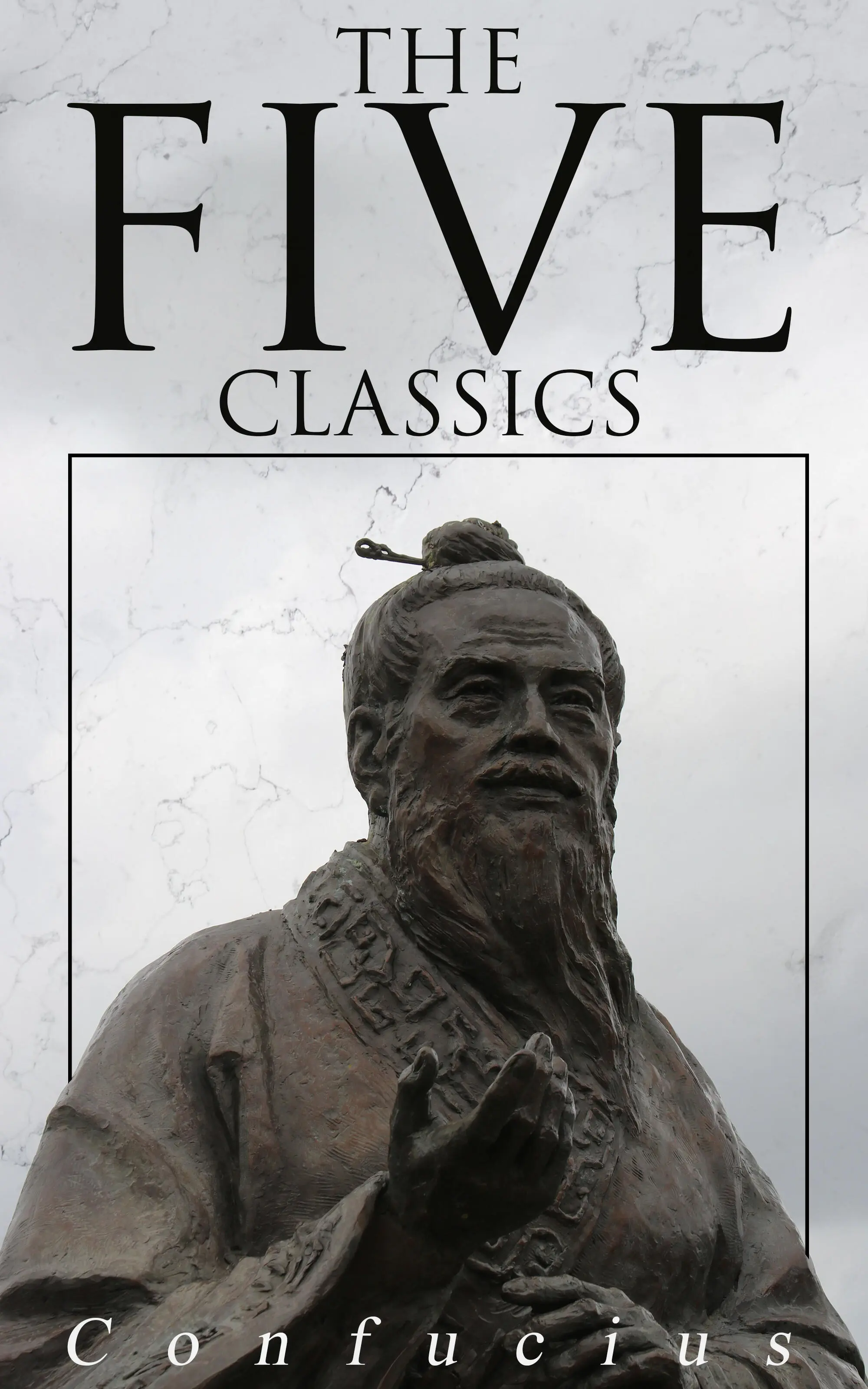
- Название:The Five Classics
- Автор:
- Жанр:
- Год:неизвестен
- ISBN:нет данных
- Рейтинг книги:5 / 5. Голосов: 1
-
Избранное:Добавить в избранное
- Отзывы:
-
Ваша оценка:
The Five Classics: краткое содержание, описание и аннотация
Предлагаем к чтению аннотацию, описание, краткое содержание или предисловие (зависит от того, что написал сам автор книги «The Five Classics»). Если вы не нашли необходимую информацию о книге — напишите в комментариях, мы постараемся отыскать её.
I Ching – The book contains a divination system comparable to Western geomancy or the West African Ifá system. In Western cultures and modern East Asia, it is still widely used for this purpose.
Shu King – A collection of documents and speeches alleged to have been written by rulers and officials of the early Zhou period and before. It is possibly the oldest Chinese narrative, and may date from the 6th century BC. It includes examples of early Chinese prose.
The Shih King – A collection of 305 poems divided into 160 folk songs, 105 festal songs sung at court ceremonies, and 40 hymns and eulogies sung at sacrifices to heroes and ancestral spirits of the royal house.
The Li Ki – Describes ancient rites, social forms and court ceremonies. The version studied today is a re-worked version compiled by scholars in the third century BC rather than the original text, which is said to have been edited by Confucius himself.
Spring and Autumn Annals – A historical record of the State of Lu, Confucius's native state, 722–481 BC.
The Five Classics — читать онлайн ознакомительный отрывок
Ниже представлен текст книги, разбитый по страницам. Система сохранения места последней прочитанной страницы, позволяет с удобством читать онлайн бесплатно книгу «The Five Classics», без необходимости каждый раз заново искать на чём Вы остановились. Поставьте закладку, и сможете в любой момент перейти на страницу, на которой закончили чтение.
Интервал:
Закладка:
3. The third line, divided, (seems to say) that one should not marry a woman whose emblem it might be, for that, when she sees a man of wealth, she will not keep her person from him, and in no wise will advantage come from her.
4. The fourth line, divided, (shows its subject as if) bound in chains of ignorance. There will be occasion for regret.
5. The fifth line, divided, shows its subject as a simple lad without experience. There will be good fortune.
6. In the topmost line, undivided, we see one smiting the ignorant (youth). But no advantage will come from doing him an injury. Advantage would come from warding off injury from him.
Footnotes
4.As K un shows us plants struggling from beneath the surface, Măng suggests to us the small and. undeveloped appearance which they then present; and hence it came to be the symbol of youthful inexperience and ignorance. The object of the hexagram is to show how such a condition should be dealt with by the parent and ruler, whose authority and duty are represented by the second and sixth, the two undivided lines. All between the first and last sentences of the Thwan must be taken as an oracular response received by the party divining on the subject of enlightening the youthful ignorant. This accounts for its being more than usually enigmatical, and for its being partly rhythmical. See Appendix I, in loc.
The subject of the first line, weak, and at the bottom of the figure, is in the grossest ignorance. Let him be punished. If punishment avail to loosen the shackles and manacles from the mind, well; if not, and punishment be persevered with, the effect will be had.
On the subject of the second line, strong, and in the central place, devolves the task of enlightening the ignorant; and we have him discharging it with forbearance and humility. In proof of his generosity, it is said that 'he receives,' or learns from, even weak and ignorant women. He appears also as 'a son' taking the place of his father.
The third line is weak, and occupies an odd place belonging properly to an undivided line; nor is its place in the centre. All these things give the subject of it so bad a character.
The fourth line is far from both the second and sixth, and can get no help from its correlate,--the first line, weak as itself. What good can be done with or by the subject of it?
The fifth line is in the place of honour, and has for its correlate the strong line in the second place. Being weak in itself, it is taken as the symbol of a simple lad, willing to be taught.
The topmost line is strong, and in the highest place. It is natural, but unwise, in him to use violence in carrying on his educational measures. A better course is suggested to him.
Hexagram V. 5Hsü
Table of Contents

Hsü intimates that, with the sincerity which is declared in it, there will be brilliant success. With firmness there will be good fortune; and it will be advantageous to cross the great stream.
1. The first line, undivided, shows its subject waiting in the distant border. It will be well for him constantly to maintain (the purpose thus shown), in which case there will be no error.
2. The second line, undivided, shows its subject waiting on the sand (of the mountain stream). He will (suffer) the small (injury of) being spoken (against), but in the end there will be good fortune.
3. The third line, undivided, shows its subject in the mud (close by the stream). He thereby invites the approach of injury.
4. The fourth line, divided, shows its subject waiting in (the place of) blood. But he will get out of the cavern.
5. The fifth line, undivided, shows its subject waiting amidst the appliances of a feast. Through his firmness and correctness there will be good fortune.
6. The topmost line, divided, shows its subject entered into the cavern. (But) there are three guests coming, without being urged, (to his help).
If he receive them respectfully, there will be good fortune in the end.
Footnotes
5.Hsü means waiting. Strength confronted by peril might be expected to advance boldly and at once to struggle with it; but it takes the wiser plan of waiting till success is sure. This is the lesson of the hexagram. That 'sincerity is declared in it' is proved from the fifth line in the position of honour and authority, central, itself undivided and in an odd place. In such a case, nothing but firm correctness is necessary to great success.
'Going through a great stream,' an expression frequent in the Yî, may mean undertaking hazardous enterprises, or encountering great difficulties, without any special reference; but more natural is it to understand by the great stream' the Yellow river, which the lords of K âu must cross in a revolutionary movement against the dynasty of Yin and its tyrant. The passage of it by king Wû, the son of Wăn in B. C. 1122, was certainly one of the greatest deeds in the history of China. It was preceded also by long waiting,' till the time of assured success came.
'The border' under line 1 means the frontier territory of the state. There seems no necessity for such a symbolism. 'The sand' and 'the mud' are appropriate with reference to the watery defile; but it is different with 'the border.' The subject of the line appears at work in his distant fields, not thinking of anything but his daily work; and he is advised to abide in that state and mind.
'The sand' of paragraph 2 suggests a nearer approach to the defile, but its subject is still self-restrained and waiting. I do not see what suggests the idea of his suffering from 'the strife of tongues.'
In paragraph 3 the subject is on the brink of the stream. His advance to that position has provoked resistance, which may result in his injury.
Line 4 has passed from the inner to the upper trigram, and entered on the scene of danger and strife;--'into the place of blood.' Its subject is 'weak and in the correct place for him;' he therefore retreats and escapes from the cavern, where he was engaged with his enemy.
Line 5 is strong and central, and in its correct place, being that of honour. All good qualities therefore belong to the subject of it, who has triumphed, and with firmness will triumph still more.
Line 6 is weak, and has entered deeply into the defile and its caverns. What will become of its subject? His correlate is the p. 69 strong line 3 below, which comes with its two companions to his help. If they are respectfully received, that help will prove effectual. P. Regis tries to find out a reference in these 'three guests' to three princes who distinguished themselves by taking part with K âu in its struggle with Yin or Shang; see vol. i, pp. 279-282. I dare not be so confident of any historical reference.
Hexagram VI. 6Sung
Table of Contents

Sung intimates how, though there is sincerity in one's contention, he will yet meet with opposition and obstruction; but if he cherish an apprehensive caution, there will be good fortune, while, if he must prosecute the contention to the (bitter) end, there will be evil. It will be advantageous to see the great man; it will not be advantageous to cross the great stream.
1. The first line, divided, shows its subject not perpetuating the matter about which (the contention is). He will suffer the small (injury) of being spoken against, but the end will be fortunate.
2. The second line, undivided, shows its subject unequal to the contention. If he retire and keep concealed (where) the inhabitants of his city are (only) three hundred families, he will fall into no mistake.
Читать дальшеИнтервал:
Закладка:
Похожие книги на «The Five Classics»
Представляем Вашему вниманию похожие книги на «The Five Classics» списком для выбора. Мы отобрали схожую по названию и смыслу литературу в надежде предоставить читателям больше вариантов отыскать новые, интересные, ещё непрочитанные произведения.






Обсуждение, отзывы о книге «The Five Classics» и просто собственные мнения читателей. Оставьте ваши комментарии, напишите, что Вы думаете о произведении, его смысле или главных героях. Укажите что конкретно понравилось, а что нет, и почему Вы так считаете.