Confucius - The Five Classics
Здесь есть возможность читать онлайн «Confucius - The Five Classics» — ознакомительный отрывок электронной книги совершенно бесплатно, а после прочтения отрывка купить полную версию. В некоторых случаях можно слушать аудио, скачать через торрент в формате fb2 и присутствует краткое содержание. Жанр: unrecognised, на английском языке. Описание произведения, (предисловие) а так же отзывы посетителей доступны на портале библиотеки ЛибКат.
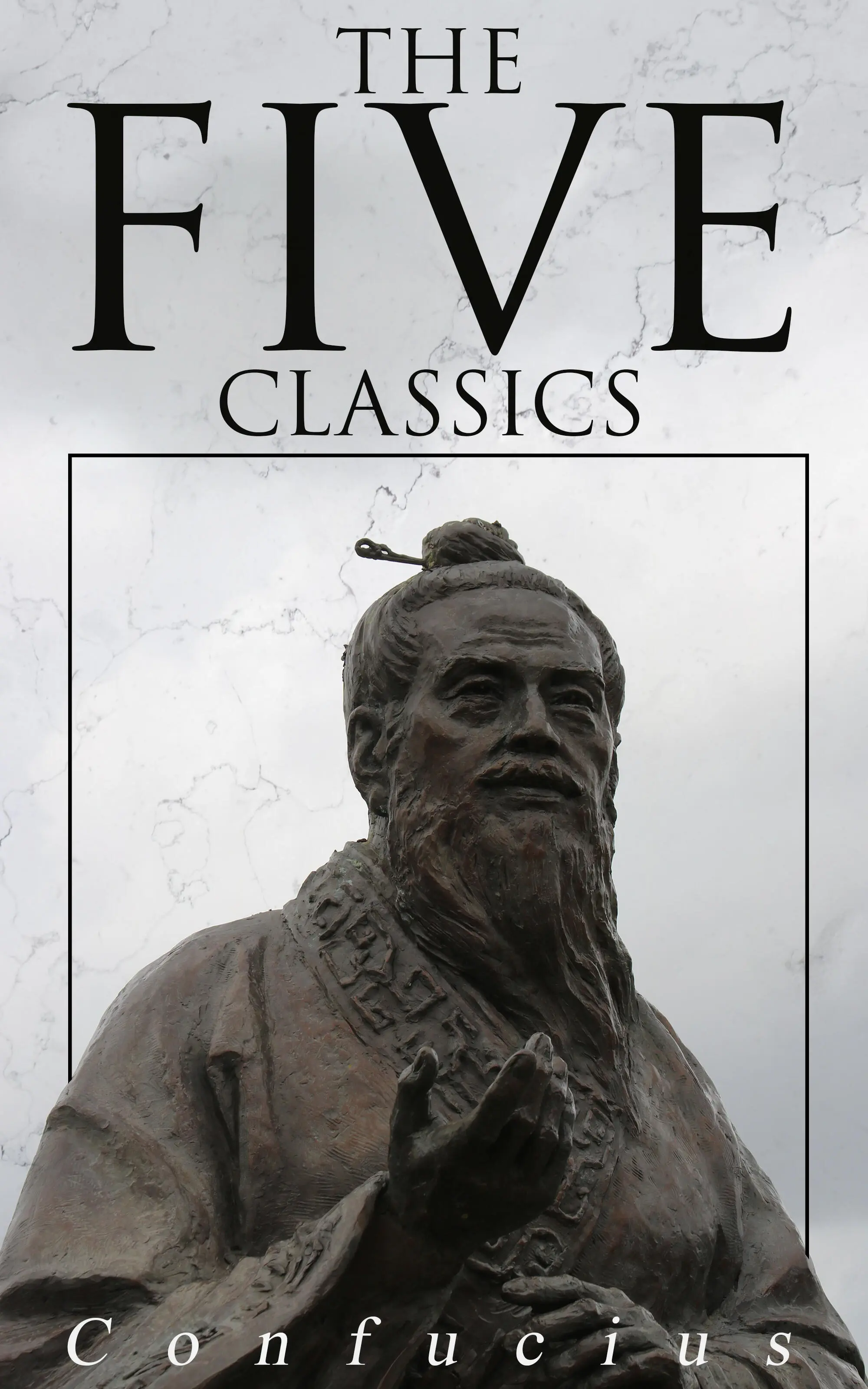
- Название:The Five Classics
- Автор:
- Жанр:
- Год:неизвестен
- ISBN:нет данных
- Рейтинг книги:5 / 5. Голосов: 1
-
Избранное:Добавить в избранное
- Отзывы:
-
Ваша оценка:
The Five Classics: краткое содержание, описание и аннотация
Предлагаем к чтению аннотацию, описание, краткое содержание или предисловие (зависит от того, что написал сам автор книги «The Five Classics»). Если вы не нашли необходимую информацию о книге — напишите в комментариях, мы постараемся отыскать её.
I Ching – The book contains a divination system comparable to Western geomancy or the West African Ifá system. In Western cultures and modern East Asia, it is still widely used for this purpose.
Shu King – A collection of documents and speeches alleged to have been written by rulers and officials of the early Zhou period and before. It is possibly the oldest Chinese narrative, and may date from the 6th century BC. It includes examples of early Chinese prose.
The Shih King – A collection of 305 poems divided into 160 folk songs, 105 festal songs sung at court ceremonies, and 40 hymns and eulogies sung at sacrifices to heroes and ancestral spirits of the royal house.
The Li Ki – Describes ancient rites, social forms and court ceremonies. The version studied today is a re-worked version compiled by scholars in the third century BC rather than the original text, which is said to have been edited by Confucius himself.
Spring and Autumn Annals – A historical record of the State of Lu, Confucius's native state, 722–481 BC.
The Five Classics — читать онлайн ознакомительный отрывок
Ниже представлен текст книги, разбитый по страницам. Система сохранения места последней прочитанной страницы, позволяет с удобством читать онлайн бесплатно книгу «The Five Classics», без необходимости каждый раз заново искать на чём Вы остановились. Поставьте закладку, и сможете в любой момент перейти на страницу, на которой закончили чтение.
Интервал:
Закладка:
The second sentence of the Thwan contains indications of the place, time, and personality of the writer which it seems possible to ascertain. The fief of K âu was the western portion of the p. 78 kingdom of Yin or Shang, the China of the twelfth century B. C., the era of king Wăn. Rain coming and moistening the ground is the cause of the beauty and luxuriance of the vegetable world, and the emblem of the blessings flowing from good training and good government. Here therefore in the west, the hereditary territory of the house of K âu, are blessings which might enrich the whole kingdom; but they are somehow restrained. The dense clouds do not empty their stores.
P. Regis says:--'To declare openly that no rain fell from the heavens long covered with dense clouds over the great tract of country, which stretched from the western border to the court and on to the eastern sea, was nothing else but leaving it to all thoughtful minds to draw the conclusion that the family of Wan was as worthy of the supreme seat as that of Shâu, the tyrant, however ancient, was unworthy of it (vol. i, p. 356).' The intimation is not put in the Text, however, so clearly as by P. Regis.
Line 1 is undivided, the first line of Kh ien, occupying its proper place. Its subject, therefore, notwithstanding the check of line 4, resumes his movement, and will act according to his strong nature, and go forward.
Line 2 is also strong, and though an even place is not appropriate to it, that place being central, its subject will make common cause with the subject of line 1; and there will be good fortune.
Line 3, though strong, and in a proper place, yet not being in the centre, is supposed to be less able to resist the restraint of line 4; and hence it has the ill omens that are given.
The subject of line 4, one weak line against all the strong lines of the hexagram, might well expect wounds, and feel apprehension in trying to restrain the others; but it is in its proper place; it is the first line also of Sun, whose attribute is docile flexibility. p. 79 The strong lines are moved to sympathy and help, and 'there is no mistake.'
Line 5 occupies the central place of Sun, and converts, by the sincerity, of its subject, 4 and 6 into its neighbours, who suffer themselves to be used by it, and effect their common object.
In line 6, the idea of the hexagram has run its course. The harmony of nature is restored. The rain falls, and the onward march of the strong lines should now stop. But weakness that has achieved such a result, if it plume itself on it, will be in a position of peril; and like the full moon, which must henceforth wane. Let the superior man, when he has attained his end, remain in quiet.
Hexagram X. 10Lî
Table of Contents

(Lî suggests the idea of) one treading on the tail of a tiger, which does not bite him. There will be progress and success.
1. The first line, undivided, shows its subject treading his accustomed path. If he go forward, there will be no error.
2. The second line, undivided, shows its subject treading the path that is level and easy;--a quiet and solitary man, to whom, if he be firm and correct, there will be good fortune.
3. The third line, divided, shows a one-eyed man (who thinks he) can see; a lame man (who thinks he) can walk well; one who treads on the tail of a tiger and is bitten. (All this indicates) ill fortune. We have a (mere) bravo acting the part of a great ruler.
4. The fourth line, undivided, shows its subject treading on the tail of a tiger. He becomes full of apprehensive caution, and in the end there will be good fortune.
5. The fifth line, undivided, shows the resolute tread of its subject. Though he be firm and correct, there will be peril.
6. The sixth line, undivided, tells us to look at (the whole course) that is trodden, and examine the presage which that gives. If it be complete and without failure, there will be great good fortune.
Footnotes
10.The character giving its name to the hexagram plays an important part also in the symbolism; and this may be the reason why it does not, as the name, occupy the first place in the Thwan. Looking at the figure, we see it is made up of the trigrams Tui, representing a marsh, and Kh ien, representing the sky. Tui is a yin trigram, and its top line is divided. Below Kh ien, the great symbol of strength, it may readily suggest the idea of treading on a tiger's tail, which was an old way of expressing what was hazardous (Shû V, XXV, 2). But what suggests the statement that 'the tiger does not bite the treader?' The attribute of Tui is pleased satisfaction. of course such an attribute could not be predicated of one who was in the fangs of a tiger. The coming scatheless out of such danger further suggests the idea of 'progress and success' in the course which king Wăn had in his mind. And according to Appendix VI, that course was 'propriety,' the observance of all the rules of courtesy. On these, as so many stepping-stones, one may tread safely amid scenes of disorder and peril.
Line 1 is an undivided line in an odd place; giving us the ideas of activity, firmness, and correctness. One so characterised will act rightly.
Line 2 occupies the middle place of the trigram, which is supposed to symbolise a path cut straight and level along the hill-side, or over difficult ground. Line, is not a proper correlate, and hence the idea of the subject of 2 being 'a quiet and solitary man.'
Line 3 is neither central nor in an even place, which would be proper to it. But with the strength of will which the occupant of an odd place should possess, he goes forward with the evil results so variously emblemed. The editors of the imperial edition, in illustration of the closing sentence, refer to Analects VII, x.
Line 4 is in contiguity with 5, whose subject is in the place of authority; but he occupies the place proper to a weak or divided line, and hence he bethinks himself, and goes softly.
Beneath the symbolism under line 5, lies the principle that the most excellent thing in 'propriety' is humility. And the subject of the line, which is strong and central, will not be lacking in this, but bear in mind that the higher he is exalted, the greater may be his fall.
What is said on line 6 is good, but is only a truism. The whole course has been shown; if every step has been right and appropriate, the issue will be very good.
Hexagram XI. 11Thâi
Table of Contents

In Thâi (we see) the little gone and the great come. (It indicates that) there will be good fortune, with progress and success.
1. The first line, undivided, suggests the idea of grass pulled up, and bringing with it other stalks with whose roots it is connected. Advance (on the part of its subject) will be fortunate.
2. The second line, undivided, shows one who can bear with the uncultivated, will cross the Ho without a boat, does not forget the distant, and has no (selfish) friendships. Thus does he prove himself acting in accordance with the course of the due Mean.
3. The third line, undivided, shows that, while there is no state of peace that is not liable to be disturbed, and no departure (of evil men) so that they shall not return, yet when one is firm and correct, as he realises the distresses that may arise, he will commit no error. There is no occasion for sadness at the certainty (of such recurring changes); and in this mood the happiness (of the present) may be (long) enjoyed.
Читать дальшеИнтервал:
Закладка:
Похожие книги на «The Five Classics»
Представляем Вашему вниманию похожие книги на «The Five Classics» списком для выбора. Мы отобрали схожую по названию и смыслу литературу в надежде предоставить читателям больше вариантов отыскать новые, интересные, ещё непрочитанные произведения.






Обсуждение, отзывы о книге «The Five Classics» и просто собственные мнения читателей. Оставьте ваши комментарии, напишите, что Вы думаете о произведении, его смысле или главных героях. Укажите что конкретно понравилось, а что нет, и почему Вы так считаете.