Confucius - The Five Classics
Здесь есть возможность читать онлайн «Confucius - The Five Classics» — ознакомительный отрывок электронной книги совершенно бесплатно, а после прочтения отрывка купить полную версию. В некоторых случаях можно слушать аудио, скачать через торрент в формате fb2 и присутствует краткое содержание. Жанр: unrecognised, на английском языке. Описание произведения, (предисловие) а так же отзывы посетителей доступны на портале библиотеки ЛибКат.
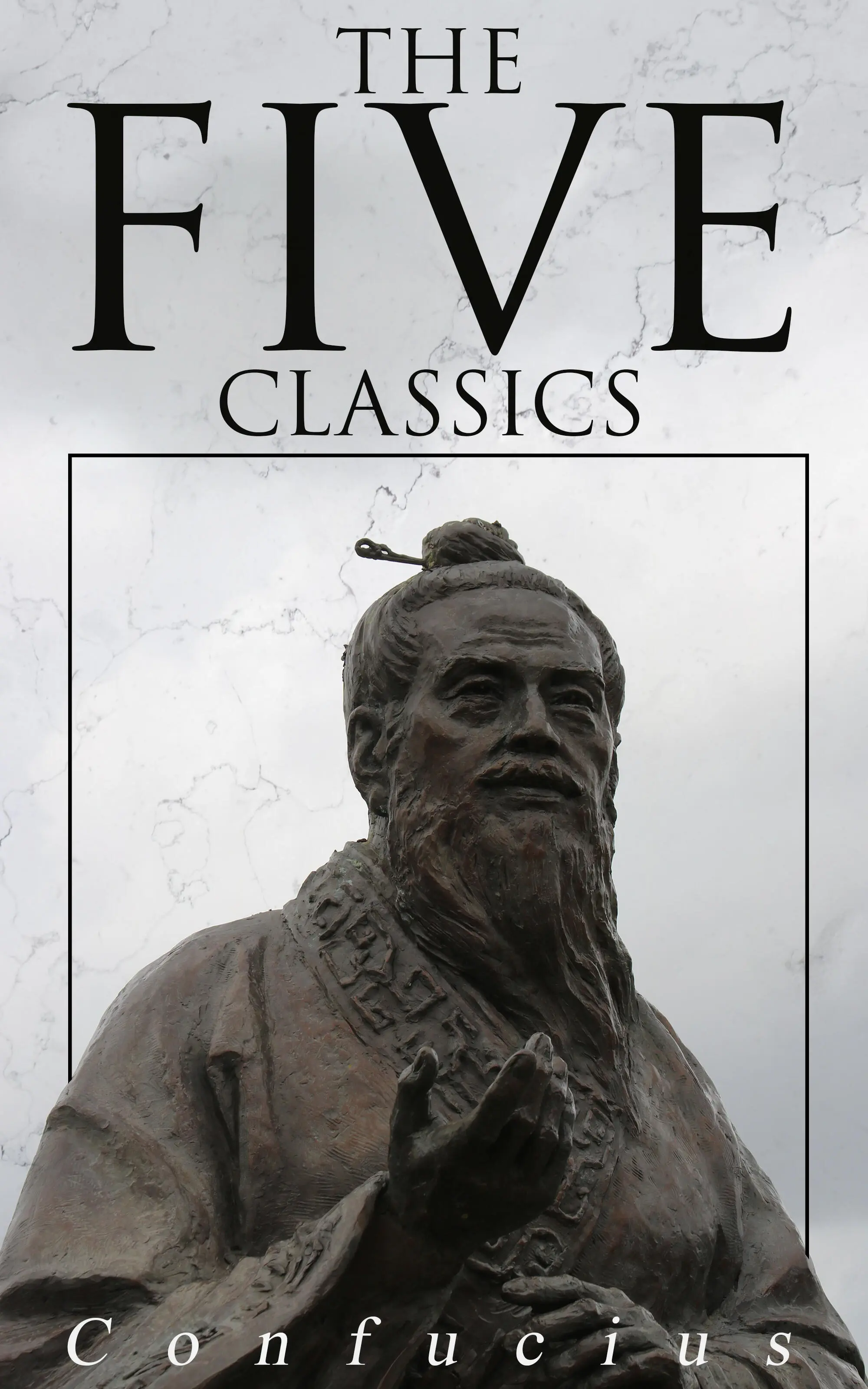
- Название:The Five Classics
- Автор:
- Жанр:
- Год:неизвестен
- ISBN:нет данных
- Рейтинг книги:5 / 5. Голосов: 1
-
Избранное:Добавить в избранное
- Отзывы:
-
Ваша оценка:
The Five Classics: краткое содержание, описание и аннотация
Предлагаем к чтению аннотацию, описание, краткое содержание или предисловие (зависит от того, что написал сам автор книги «The Five Classics»). Если вы не нашли необходимую информацию о книге — напишите в комментариях, мы постараемся отыскать её.
I Ching – The book contains a divination system comparable to Western geomancy or the West African Ifá system. In Western cultures and modern East Asia, it is still widely used for this purpose.
Shu King – A collection of documents and speeches alleged to have been written by rulers and officials of the early Zhou period and before. It is possibly the oldest Chinese narrative, and may date from the 6th century BC. It includes examples of early Chinese prose.
The Shih King – A collection of 305 poems divided into 160 folk songs, 105 festal songs sung at court ceremonies, and 40 hymns and eulogies sung at sacrifices to heroes and ancestral spirits of the royal house.
The Li Ki – Describes ancient rites, social forms and court ceremonies. The version studied today is a re-worked version compiled by scholars in the third century BC rather than the original text, which is said to have been edited by Confucius himself.
Spring and Autumn Annals – A historical record of the State of Lu, Confucius's native state, 722–481 BC.
The Five Classics — читать онлайн ознакомительный отрывок
Ниже представлен текст книги, разбитый по страницам. Система сохранения места последней прочитанной страницы, позволяет с удобством читать онлайн бесплатно книгу «The Five Classics», без необходимости каждый раз заново искать на чём Вы остановились. Поставьте закладку, и сможете в любой момент перейти на страницу, на которой закончили чтение.
Интервал:
Закладка:
Line 2 is weak. Its proper correlate is the strong 5; but it prefers to cleave to the line below, instead of waiting to follow 5. Hence the symbolism of the text, the bad omen of which needs not to be mentioned.
Line 3 is also weak, but it follows the strong line above it and leaves line 1, reversing the course of 2;--with a different issue. It is weak, however, and 4 is not its proper correlate; hence the conclusion of the paragraph is equivalent to a caution.
Line 4 is strong, and in the place of a great minister next the ruler in 5. But his having adherents may be injurious to the supreme and sole authority of that ruler, and only a sincere loyalty will save him from. error and misfortune.
Line 5 is strong, and in its correct place, with 2 as its proper correlate; thus producing the auspicious symbolism.
The issue of the hexagram is seen in line 6; which represents the ideal of following, directed by the most sincere adherence to p. 95 what is right. This influence not only extends to men, but also to spiritual beings. 'The western hill' is mount Kh î, at the foot of which was the original settlement of the house of K âu, in B. C. 1325. The use of the name 'king' here brings us down from Wăn into the time of king Wû at least.
Hexagram XVIII. 18Kû
Table of Contents

Kû indicates great progress and success (to him who deals properly with the condition represented by it). There will be advantage in (efforts like that of) crossing the great stream. (He should weigh well, however, the events of) three days before the turning point, and those (to be done) three days after it.
1. The first line, divided, shows (a son) dealing with the troubles caused by his father. If he be an (able) son, the father will escape the blame of having erred. The position is perilous, but there will be good fortune in the end.
2. The second line, undivided, shows (a son) dealing with the troubles caused by his mother. He should not (carry) his firm correctness (to the utmost).
3. The third line, undivided, shows (a son) dealing with the troubles caused by his father. There may be some small occasion for repentance, but there will not be any great error.
4. The fourth line, divided, shows (a son) viewing indulgently the troubles caused by his father. If he go forward, he will find cause to regret it.
5. The fifth line, divided, shows (a son) dealing with the troubles caused by his father. He obtains the praise of using (the fit instrument for his work).
6. The sixth line, undivided, shows us one who does not serve either king or feudal lord, but in a lofty spirit prefers (to attend to) his own affairs.
Footnotes
18.In the 6th Appendix it is said, They who follow another are sure to have services (to perform), and hence Sui is followed by Kû.' But Kû means the having painful or troublesome services to do. It denotes here a state in which things are going to ruin, as if through poison or venomous worms; and the figure is supposed to describe the arrest of the decay and the restoration to soundness and vigour, so as to justify its auspice of great progress and success. To realise such a result, however, great efforts will be required, as in crossing the great stream; and a careful consideration of the events that have brought on the state of decay, and the measures to be taken to remedy it is also necessary. See Appendix I on the 'three days.'
The subject of line 1, and of all the other lines, excepting perhaps 6, appears as a son. Yet the line itself is of the yin nature, and the trigram in which it plays the principal part is also yin. Line 2 is strong, and of the yang nature, with the yin line 5 as its proper correlate. In line 2, 5 appears as the mother; but its subject there is again a son, and the upper trigram altogether is yang. I am unable to account for these things. As is said in the note of Regis on line 2:--'Haec matris filiique denominatio ad has lineas mere translatitia est, et, ut ait commentarius vulgaris, ad explicationem sententiarum eas pro matre et filio supponere dicendum est. Nec ratio reddetur si quis in utroque hoc nomine mysterium quaerat. Cur enim aliis in figuris lineae nunc regem, nunc vasallum, jam imperii administrum, mox summum armorum praefectum referre dicantur? Accommodantur scilicet lineae ad verba sententiae et verba sententiae ad sensum, queniadmodum faciendum de methodis libri Shih King docet Mencius, V, i, ode 4.2.'
We must leave this difficulty. Line 1 is weak, and its correlate 4 is also weak. What can its subject do to remedy the state of decay? But the line is the first of the figure, and the decay is not p. 97 yet great. By giving heed to the cautions in the Text, he will accomplish what is promised.
The ruler in line 5 is represented by a weak line, while 2 is strong. Thus the symbolism takes the form of a son dealing with the prevailing decay induced somehow by his mother. But a son must be very gentle in all his intercourse with his mother, and especially so, when constrained by a sense of duty to oppose her course. I do not think there is anything more or better to be said here. The historical interpretation adopted by Regis and his friends, that the father here is king Wăn, the mother Thâi-sze, and the son king Wû, cannot be maintained. I have searched, but in vain, for the slightest Chinese sanction of it, and it would give to Kû the meaning of misfortunes endured, instead of troubles caused.
Line 3 is strong, and not central, so that its subject might well go to excess in his efforts. But this tendency is counteracted by the line's place in the trigram Sun, often denoting lowly submission.
Line 4 is weak, and in an even place, which intensifies that weakness. Hence comes the caution against going forward.
The weak line 5, as has been said, is the seat of the ruler; but its proper correlate is the strong 2, the strong siding champion minister, to whom the work of the hexagram is delegated.
Line 6 is strong, and has no proper correlate below. Hence it suggests the idea of one outside the sphere of action, and taking no part in public affairs, but occupied with the culture of himself.
Hexagram XIX. 19Lin
Table of Contents

Lin (indicates that under the conditions supposed in it) there will be great progress and success, while it will be advantageous to be firmly correct. In the eighth month there will be evil.
1. The first line, undivided, shows its subject advancing in company (with the subject of the second line). Through his firm correctness there will be good fortune.
2. The second line, undivided, shows its subject advancing in company (with the subject of the first line). There will be good fortune; (advancing) will be in every way advantageous.
3. The third line, divided, shows one well pleased (indeed) to advance, (but whose action) will be in no way advantageous. If he become anxious about it (however), there will be no error.
4. The fourth line, divided, shows one advancing in the highest mode. There will be no error.
5. The fifth line, divided, shows the advance of wisdom, such as befits the great ruler. There will be good fortune.
6. The sixth line, divided, shows the advance of honesty and generosity. There will be good fortune, and no error.
Footnotes
19.In Appendix VI Lin is explained as meaning 'great.' The writer, having misunderstood the meaning of the previous Kû, subjoins--'He who performs such services may become "great."' But Lin denotes the approach of authority,--to inspect, to comfort, or to rule. When we look at the figure, we see two strong undivided lines advancing on the four weak lines above them, and thence follows the assurance that their action will be powerful and successful. That action must be governed by rectitude, however, and by caution grounded on the changing character of all conditions and events. The meaning of the concluding sentence is given in Appendix I as simply being--that, 'the advancing power will decay in no long time.' Lû K ăn- kh î (Ming dynasty) says:--'The sun (or the day) is the symbol of what is Yang; and the moon is the symbol of what is Yin. Eight is the number of the second of the four emblematic figures (the smaller Yin), and seven is the number of the third of them (the smaller Yang). Hence to indicate the period of the coming of what is Yin, we use the phrase, "the eighth month;" and to indicate the period of the coming of what is p. 99 Yang, we use the phrase, "the seventh day."' The Khang-hsî editors say that this is the best explanation of the language of the Text that can be given:--'The Yang numbers culminate in 9, the influence then receding and producing the 8 of the smaller Yin. The Yin numbers culminate in 6, and the next advance produces the 7 of the smaller Yang; so that 7 and 8 are the numbers indicating the first birth of what is Yin and what is Yang.' 'If we go to seek,' they add, 'any other explanation of the phraseology of the Text, and such expressions as "3 days," "3 years," "10 years," &c., we make them unintelligible.' Lin is the hexagram of the twelfth month.
Читать дальшеИнтервал:
Закладка:
Похожие книги на «The Five Classics»
Представляем Вашему вниманию похожие книги на «The Five Classics» списком для выбора. Мы отобрали схожую по названию и смыслу литературу в надежде предоставить читателям больше вариантов отыскать новые, интересные, ещё непрочитанные произведения.





Обсуждение, отзывы о книге «The Five Classics» и просто собственные мнения читателей. Оставьте ваши комментарии, напишите, что Вы думаете о произведении, его смысле или главных героях. Укажите что конкретно понравилось, а что нет, и почему Вы так считаете.