Confucius - The Five Classics
Здесь есть возможность читать онлайн «Confucius - The Five Classics» — ознакомительный отрывок электронной книги совершенно бесплатно, а после прочтения отрывка купить полную версию. В некоторых случаях можно слушать аудио, скачать через торрент в формате fb2 и присутствует краткое содержание. Жанр: unrecognised, на английском языке. Описание произведения, (предисловие) а так же отзывы посетителей доступны на портале библиотеки ЛибКат.
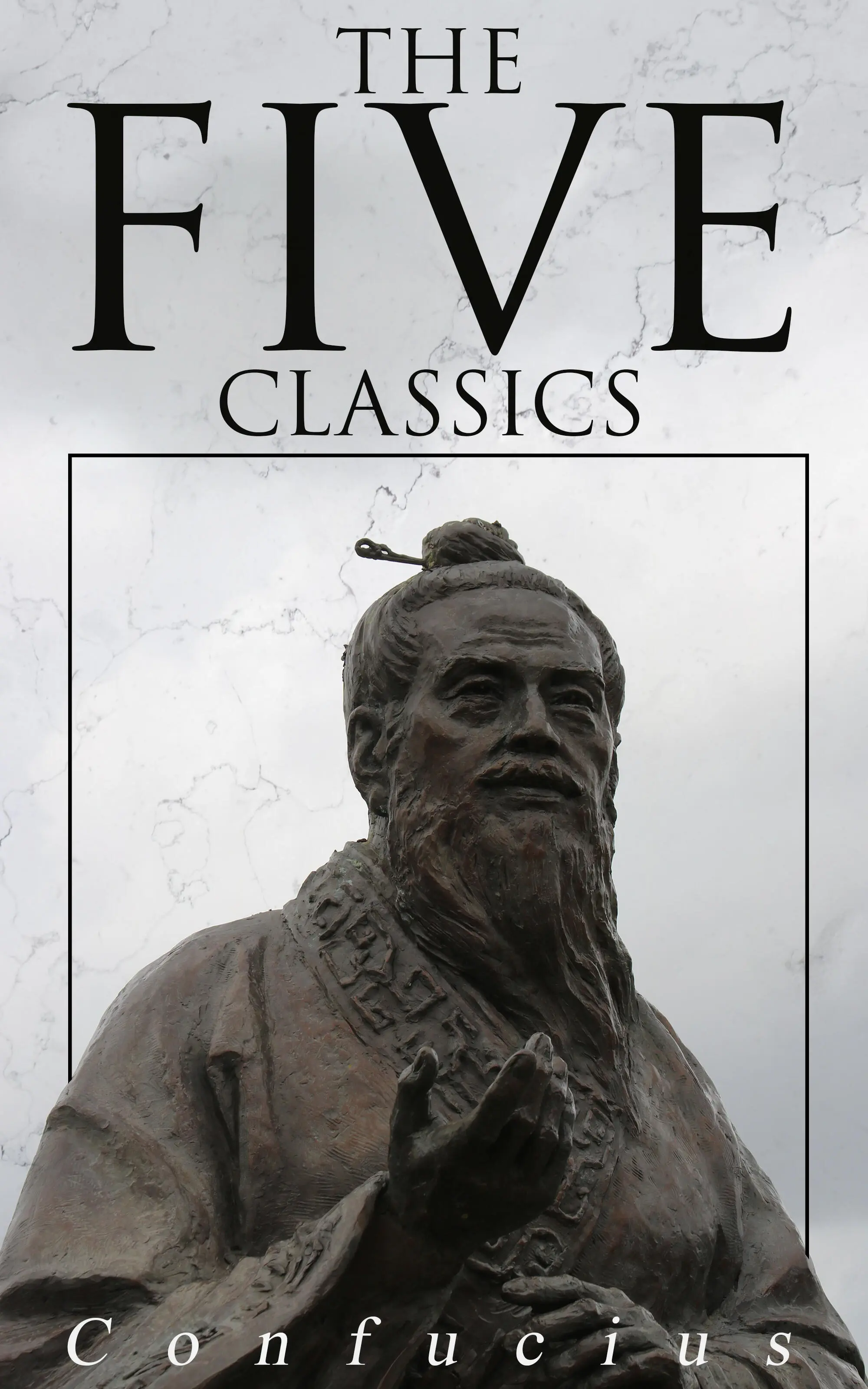
- Название:The Five Classics
- Автор:
- Жанр:
- Год:неизвестен
- ISBN:нет данных
- Рейтинг книги:5 / 5. Голосов: 1
-
Избранное:Добавить в избранное
- Отзывы:
-
Ваша оценка:
The Five Classics: краткое содержание, описание и аннотация
Предлагаем к чтению аннотацию, описание, краткое содержание или предисловие (зависит от того, что написал сам автор книги «The Five Classics»). Если вы не нашли необходимую информацию о книге — напишите в комментариях, мы постараемся отыскать её.
I Ching – The book contains a divination system comparable to Western geomancy or the West African Ifá system. In Western cultures and modern East Asia, it is still widely used for this purpose.
Shu King – A collection of documents and speeches alleged to have been written by rulers and officials of the early Zhou period and before. It is possibly the oldest Chinese narrative, and may date from the 6th century BC. It includes examples of early Chinese prose.
The Shih King – A collection of 305 poems divided into 160 folk songs, 105 festal songs sung at court ceremonies, and 40 hymns and eulogies sung at sacrifices to heroes and ancestral spirits of the royal house.
The Li Ki – Describes ancient rites, social forms and court ceremonies. The version studied today is a re-worked version compiled by scholars in the third century BC rather than the original text, which is said to have been edited by Confucius himself.
Spring and Autumn Annals – A historical record of the State of Lu, Confucius's native state, 722–481 BC.
The Five Classics — читать онлайн ознакомительный отрывок
Ниже представлен текст книги, разбитый по страницам. Система сохранения места последней прочитанной страницы, позволяет с удобством читать онлайн бесплатно книгу «The Five Classics», без необходимости каждый раз заново искать на чём Вы остановились. Поставьте закладку, и сможете в любой момент перейти на страницу, на которой закончили чтение.
Интервал:
Закладка:
Of old, in a civil case, both parties, before they were heard, brought to the court an arrow (or a bundle of arrows), in testimony of their rectitude, after which they were heard; in a criminal case, they in the same way deposited each thirty pounds of gold, or some other metal. See the Official Book of K au, 27. 14, 15. The subject of the fourth line's getting those pledges indicates his exercising his judicial functions; and what he gnaws through indicates their difficulty. Moreover, though the line is strong, it is in an even place; and hence comes the lesson of caution.
The fifth line represents 'the lord of judgment.' As it is a weak line, he will be disposed to leniency; and his judgments will be correct. This is declared by his finding the 'yellow metal;' for yellow is one of the five 'correct' colours. The position is in the centre and that of rule; but the line being weak, a caution is given, as under the previous line.
The action of the figure has passed, and still we have, in the subject of line 6, one persisting in wrong, a strong criminal, wearing the cangue, and deaf to counsel. of course the auspice is evil.
Hexagram XXII. 22Pî
Table of Contents

Pî indicates that there should be free course (in what it denotes). There will be little advantage (however) if it be allowed to advance (and take the lead).
1. The first line, undivided, shows one adorning (the way of) his feet. He can discard a carriage and walk on foot.
2. The second line, divided, shows one adorning his beard.
3. The third line, undivided, shows its subject with the appearance of being adorned and bedewed (with rich favours). But let him ever maintain his firm correctness, and there will be good fortune.
4. The fourth line, divided, shows one looking as if adorned, but only in white. As if (mounted on) a white horse, and furnished with wings, (he seeks union with the subject of the first line), while (the intervening third pursues), not as a robber, but intent on a matrimonial alliance.
5. The fifth line, divided, shows its subject adorned by (the occupants of) the heights and gardens. He bears his roll of silk, small and slight. He may appear stingy; but there will be good fortune in the end.
6. The sixth line, undivided, shows one with white as his (only) ornament. There will be no error.
Footnotes
22.The character Pî is the symbol of what is ornamental and of the act of adorning. As there is ornament in nature, so should there be in society; but its place is secondary to that of what is substantial. This is the view of king Wăn in his Thwan. The symbolism of the separate lines is sometimes fantastic.
Line 1 is strong, and in an odd place. It is at the very bottom of the hexagram, and is the first line of Lî, the trigram. for fire or light, and suggesting what is elegant and bright. Its subject has nothing to do but to attend to himself. Thus he cultivates--adorns--himself in his humble position; but if need be, righteousness requiring it, he can give up every luxury and indulgence.
Line 2 is weak and in its proper place, but with no proper correlate above. The strong line 3 is similarly situated. These two lines therefore keep together, and are as the beard and the chin. Line 1 follows 2. What is substantial commands and rules what is merely ornamental.
Line 3 is strong, and between two weak lines, which adorn it, and bestow their favours on it. But this happy condition is from the accident of place. The subject of the line must be always correct and firm to ensure its continuance.
Line 4 has its proper correlate in 1, from whose strength it should receive ornament, but 2 and the strong 3 intervene and keep them apart, so that the ornament is only white, and of no bright colour. Line 4, however, is faithful to 1, and earnest for their union. And finally line 3 appears in a good character, and not with the purpose to injure, so that the union of 1 and 4 takes place. All this is intended to indicate how ornament recognises the superiority of solidity. Compare the symbolism of the second line of Kun (3), and that of the topmost line of Khwei (38).
Line .5 is in the place of honour, and has no proper correlate in 2. It therefore associates with the strong 6, which is symbolised by the heights and gardens round a city, and serving both to protect and to beautify it. Thus the subject of the line receives adorning from without, and does not of itself try to manifest it. Moreover, in his weakness, his offerings of ceremony are poor and mean. But, as Confucius said, 'In ceremonies it is better to be sparing than extravagant.' Hence that stinginess does not prevent a good auspice.
Line 6 is at the top of the hexagram. Ornament has had its course, and here there is a return to pure, 'white,' simplicity. Substantiality is better than ornament.
Hexagram XXIII. 23Po
Table of Contents

Po indicates that (in the state which it symbolises) it will not be advantageous to make a movement in any direction whatever.
1. The first line, divided, shows one overturning the couch by injuring its legs. (The injury will go on to) the destruction of (all) firm correctness, and there will be evil.
2. The second line, divided, shows one overthrowing the couch by injuring its frame. (The injury will go on to) the destruction of (all) firm correctness, and there will be evil.
3. The third line, divided, shows its subject among the overthrowers; but there will be no error.
4. The fourth line, divided, shows its subject having overthrown the couch, and (going to injure) the skin (of him who lies on it). There will be evil.
5. The fifth line, divided, shows (its subject leading on the others like) a string of fishes, and (obtaining for them) the favour that lights on the inmates of the palace. There will be advantage in every way.
6. The topmost line, undivided, shows its subject (as) a great fruit which has not been eaten. The superior man finds (the people again) as a chariot carrying him. The small men (by their course) overthrow their own dwellings.
Footnotes
23.Po is the symbol of falling or of causing to fall, and may be applied, both in the natural and political world, to the process of decay, or that of overthrow. The figure consists of five divided lines, and one undivided, which last thus becomes the prominent and principal line in the figure. Decay or overthrow has begun at the bottom of it, and crept up to the top. The hexagram is that of the ninth month, when the beauty and glory of summer have disappeared, and the year is ready to fall into the arms of sterile winter. In the political world, small men have gradually displaced good men and great, till but one remains; and the lesson for him is to wait. The power operating against him is p. 107 too strong; but the fashion of political life passes away. If he wait, a change for the better will shortly appear.
The lesser symbolism is chiefly that of a bed or couch with its occupant. The idea of the hexagram requires this occupant to be overthrown, or at least that an attempt be made to overthrow him. Accordingly the attempt in line 1 is made by commencing with the legs of the couch. The symbolism goes on to explain itself. The object of the evil worker is the overthrow of all firm correctness. of course there will be evil.
Line 2 is to the same effect as 1; only the foe has advanced from the legs to the frame of the couch.
Line 3 also represents an overthrower; but it differs from the others in being the correlate of 6. The subject of it will take part with him. His association is with the subject of 6, and not, as in the other weak lines, with one of its own kind.
Читать дальшеИнтервал:
Закладка:
Похожие книги на «The Five Classics»
Представляем Вашему вниманию похожие книги на «The Five Classics» списком для выбора. Мы отобрали схожую по названию и смыслу литературу в надежде предоставить читателям больше вариантов отыскать новые, интересные, ещё непрочитанные произведения.






Обсуждение, отзывы о книге «The Five Classics» и просто собственные мнения читателей. Оставьте ваши комментарии, напишите, что Вы думаете о произведении, его смысле или главных героях. Укажите что конкретно понравилось, а что нет, и почему Вы так считаете.