Confucius - The Five Classics
Здесь есть возможность читать онлайн «Confucius - The Five Classics» — ознакомительный отрывок электронной книги совершенно бесплатно, а после прочтения отрывка купить полную версию. В некоторых случаях можно слушать аудио, скачать через торрент в формате fb2 и присутствует краткое содержание. Жанр: unrecognised, на английском языке. Описание произведения, (предисловие) а так же отзывы посетителей доступны на портале библиотеки ЛибКат.
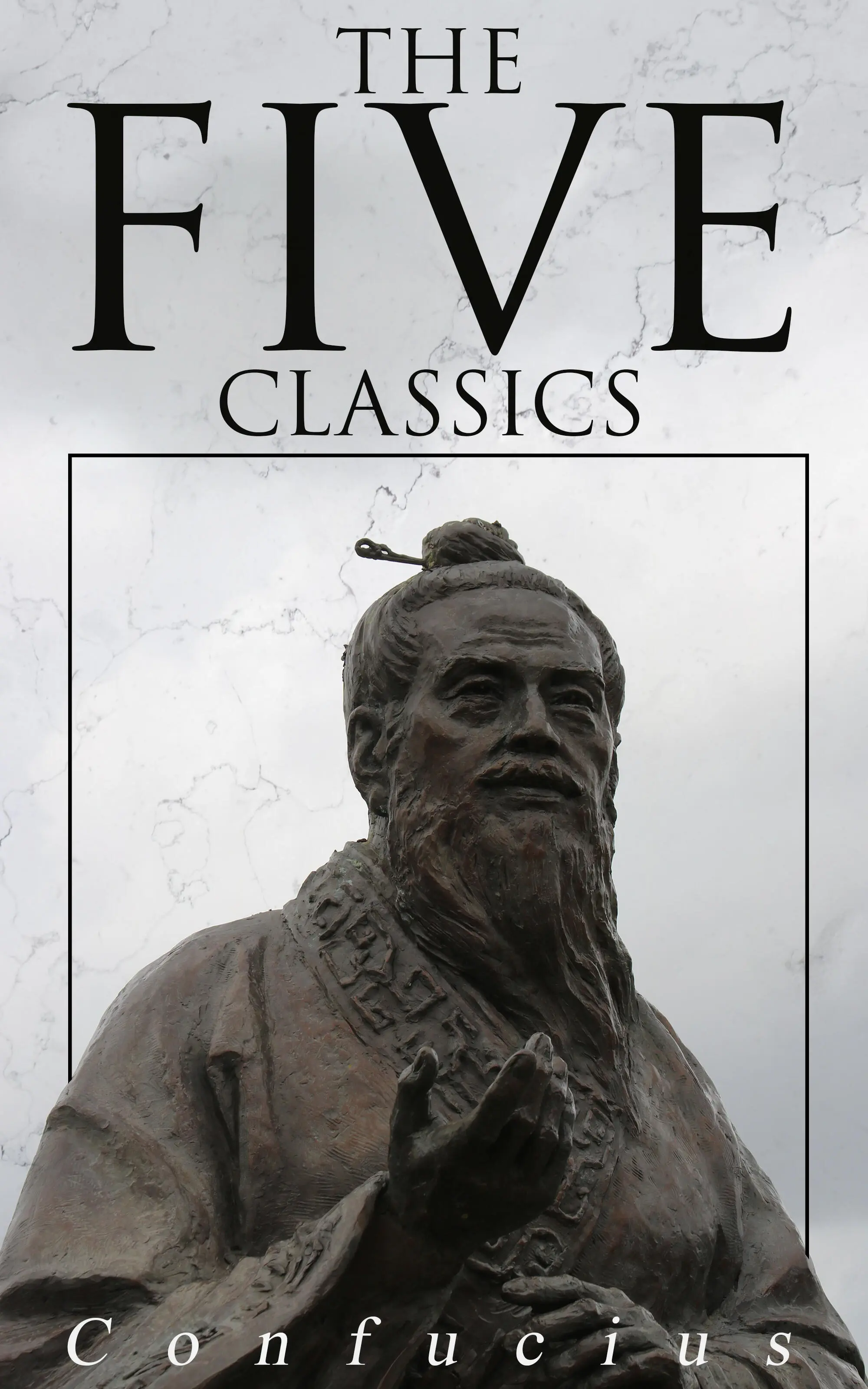
- Название:The Five Classics
- Автор:
- Жанр:
- Год:неизвестен
- ISBN:нет данных
- Рейтинг книги:5 / 5. Голосов: 1
-
Избранное:Добавить в избранное
- Отзывы:
-
Ваша оценка:
The Five Classics: краткое содержание, описание и аннотация
Предлагаем к чтению аннотацию, описание, краткое содержание или предисловие (зависит от того, что написал сам автор книги «The Five Classics»). Если вы не нашли необходимую информацию о книге — напишите в комментариях, мы постараемся отыскать её.
I Ching – The book contains a divination system comparable to Western geomancy or the West African Ifá system. In Western cultures and modern East Asia, it is still widely used for this purpose.
Shu King – A collection of documents and speeches alleged to have been written by rulers and officials of the early Zhou period and before. It is possibly the oldest Chinese narrative, and may date from the 6th century BC. It includes examples of early Chinese prose.
The Shih King – A collection of 305 poems divided into 160 folk songs, 105 festal songs sung at court ceremonies, and 40 hymns and eulogies sung at sacrifices to heroes and ancestral spirits of the royal house.
The Li Ki – Describes ancient rites, social forms and court ceremonies. The version studied today is a re-worked version compiled by scholars in the third century BC rather than the original text, which is said to have been edited by Confucius himself.
Spring and Autumn Annals – A historical record of the State of Lu, Confucius's native state, 722–481 BC.
The Five Classics — читать онлайн ознакомительный отрывок
Ниже представлен текст книги, разбитый по страницам. Система сохранения места последней прочитанной страницы, позволяет с удобством читать онлайн бесплатно книгу «The Five Classics», без необходимости каждый раз заново искать на чём Вы остановились. Поставьте закладку, и сможете в любой момент перейти на страницу, на которой закончили чтение.
Интервал:
Закладка:
Line 3 is weak, and occupies the place of a strong line. Its subject is in an evil case.
Line 4 is weak, and will get no help from its correlate in 1. Its subject is not one who can avert the danger threatening himself and others. But his position is close to that of the ruler in 5, whose intimacy he cultivates with an unostentatious sincerity, symbolled by the appointments of the simple feast, and whose intelligence he cautiously enlightens. In consequence, there will be no error.
The subject of line 5 is on the eve of extrication and deliverance. The waters of the defile will ere long have free vent and disappear, and the ground will be levelled and made smooth. The line is strong, in a proper place, and in the place of honour.
The case of the subject of line 6 is hopeless. When danger has reached its highest point, there he is, represented by a weak line, and with no proper correlate below. The 'thicket of thorns' is taken as a metaphor for a prison; but if the expression has a history, I have been unable to find it.
Hexagram XXX. 30Lî
Table of Contents

Lî indicates that, (in regard to what it denotes), it will be advantageous to be firm and correct, and that thus there will be free course and success. Let (its subject) also nourish (a docility like that of) the cow, and there will be good fortune.
1. The first line, undivided, shows one ready to move with confused steps. But he treads at the same time reverently, and there will be no mistake.
2. The second line, divided, shows its subject in his place in yellow. There will be great good fortune.
3. The third line, undivided, shows its subject in a position like that of the declining sun. Instead of playing on his instrument of earthenware, and singing to it, he utters the groans of an old man of eighty. There will be evil.
4. The fourth line, undivided, shows the manner of its subject's coming. How abrupt it is, as with fire, with death, to be rejected (by all)!
5. The fifth line, divided, shows its subject as one with tears flowing in torrents, and groaning in sorrow. There will be good fortune.
6. The topmost line, undivided, shows the king employing its subject in his punitive expeditions. Achieving admirable (merit), he breaks (only) the chiefs (of the rebels). Where his prisoners were not their associates, he does not punish. There will be no error.
Footnotes
30.p. 121 Lî is the name of the trigram representing fire and light, and the sun as the source of both of these. Its virtue or attribute is brightness, and by a natural metaphor intelligence. But Lî has also the meaning of inhering in, or adhering to, being attached to. Both these significations occur in connexion with the hexagram, and make it difficult to determine what was the subject of it in the minds of the authors. If we take the whole figure as expressing the subject, we have, as in the treatise on the Thwan, 'a double brightness,' a phrase which is understood to denominate the ruler. If we take the two central lines as indicating the subject, we have weakness, dwelling with strength above and below. In either case there are required from the subject a strict adherence to what is correct, and a docile humility. On the second member of the Thwan Khăng-ȝze says:--'The nature of the ox is docile, and that of the cow is much more so. The subject of the hexagram adhering closely to p. 122 what is correct, he must be able to act in obedience to it, as docile as a cow, and then there will be good fortune.'
Line 1 is strong, and at the bottom of the trigram for fire, the nature of which is to ascend. Its subject therefore will move upwards, and is in danger of doing so coarsely and vehemently. But the lowest line has hardly entered into the action of the figure, and this consideration operates to make him reverently careful of his movements; and there is no error.
Line 2 is weak, and occupies the centre. Yellow is one of the five correct colours, and here symbolises the correct course to which the subject of the line adheres.
Line 3 is at the top of the lower trigram, whose light may be considered exhausted, and suggests the symbol of the declining sun. The subject of the line should accept the position, and resign himself to the ordinary amusements which are mentioned, but he groans and mourns instead. His strength interferes with the lowly contentment which he should cherish.
The. strength of line 4, and its being in an even place, make its subject appear in this unseemly manner, disastrous to himself.
Line 5 is in the place of honour, and central. But it is weak; as is its correlate. Its position between the strong 4 and 6 fills its subject with anxiety and apprehension, that express themselves as is described. But such demonstrations are a proof of his inward adherence to right and his humility. There will be good fortune.
Line 6, strong and at the top of the figure, has the intelligence denoted by its trigrams in the highest degree, and his own proper vigour. Through these his achievements are great, but his generous consideration is equally conspicuous, and he falls into no error.
SECTION II
Table of Contents
Hexagram XXXI. 31Hsien
Table of Contents

Hsien indicates that, (on the fulfilment of the conditions implied in it), there will be free course and success. Its advantageousness will depend on the being firm and correct, (as) in marrying a young lady. There will be good fortune.
1. The first six, divided, shows one moving his great toes.
2. The second line, divided, shows one moving the calves of his leg. There will be evil. If he abide (quiet in his place), there will be good fortune.
3. The third line, undivided, shows one moving his thighs, and keeping close hold of those whom he follows. Going forward (in this way) will cause regret.
4. The fourth line, undivided, shows that firm correctness whi.ch will lead to good fortune, and prevent all occasion for repentance. If its subject be unsettled in his movements, (only) his friends will follow his purpose.
5. The fifth line, undivided, shows one moving the flesh along the spine above the heart. There will be no occasion for repentance.
6. The sixth six, divided, shows one moving his jaws and tongue.
Footnotes
31.With the 31st hexagram commences the Second Section of the Text. It is difficult to say why any division of the hexagrams should be made here, for the student tries in vain to discover any continuity in the thoughts of the author that is now broken. The First Section does not contain a class of subjects different from those which we find in the Second. That the division was made, however, at a very early time, appears from the sixth Appendix on the Sequence of the Hexagrams, where the writer sets forth an analogy between the first and second figures, representing heaven and earth, as the originators of all things, and this figure and the next, representing (each of them) husband and wife, as the originators of all the social relations. This, however, is far from carrying conviction to my mind. The division of the Text of the Yî into two sections is a fact of which I am unable to give a satisfactory account.
Hsien, as explained in the treatise on the Thwan, has here the meaning of mutual influence, and the duke of Kâu, on the various lines, always uses Kan for it in the sense of 'moving' or 'influencing to movement or action.' This is to my mind the subject of the hexagram considered as an essay,--'Influence; the different ways of bringing it to bear, and their issues.'
Читать дальшеИнтервал:
Закладка:
Похожие книги на «The Five Classics»
Представляем Вашему вниманию похожие книги на «The Five Classics» списком для выбора. Мы отобрали схожую по названию и смыслу литературу в надежде предоставить читателям больше вариантов отыскать новые, интересные, ещё непрочитанные произведения.






Обсуждение, отзывы о книге «The Five Classics» и просто собственные мнения читателей. Оставьте ваши комментарии, напишите, что Вы думаете о произведении, его смысле или главных героях. Укажите что конкретно понравилось, а что нет, и почему Вы так считаете.