Confucius - The Five Classics
Здесь есть возможность читать онлайн «Confucius - The Five Classics» — ознакомительный отрывок электронной книги совершенно бесплатно, а после прочтения отрывка купить полную версию. В некоторых случаях можно слушать аудио, скачать через торрент в формате fb2 и присутствует краткое содержание. Жанр: unrecognised, на английском языке. Описание произведения, (предисловие) а так же отзывы посетителей доступны на портале библиотеки ЛибКат.
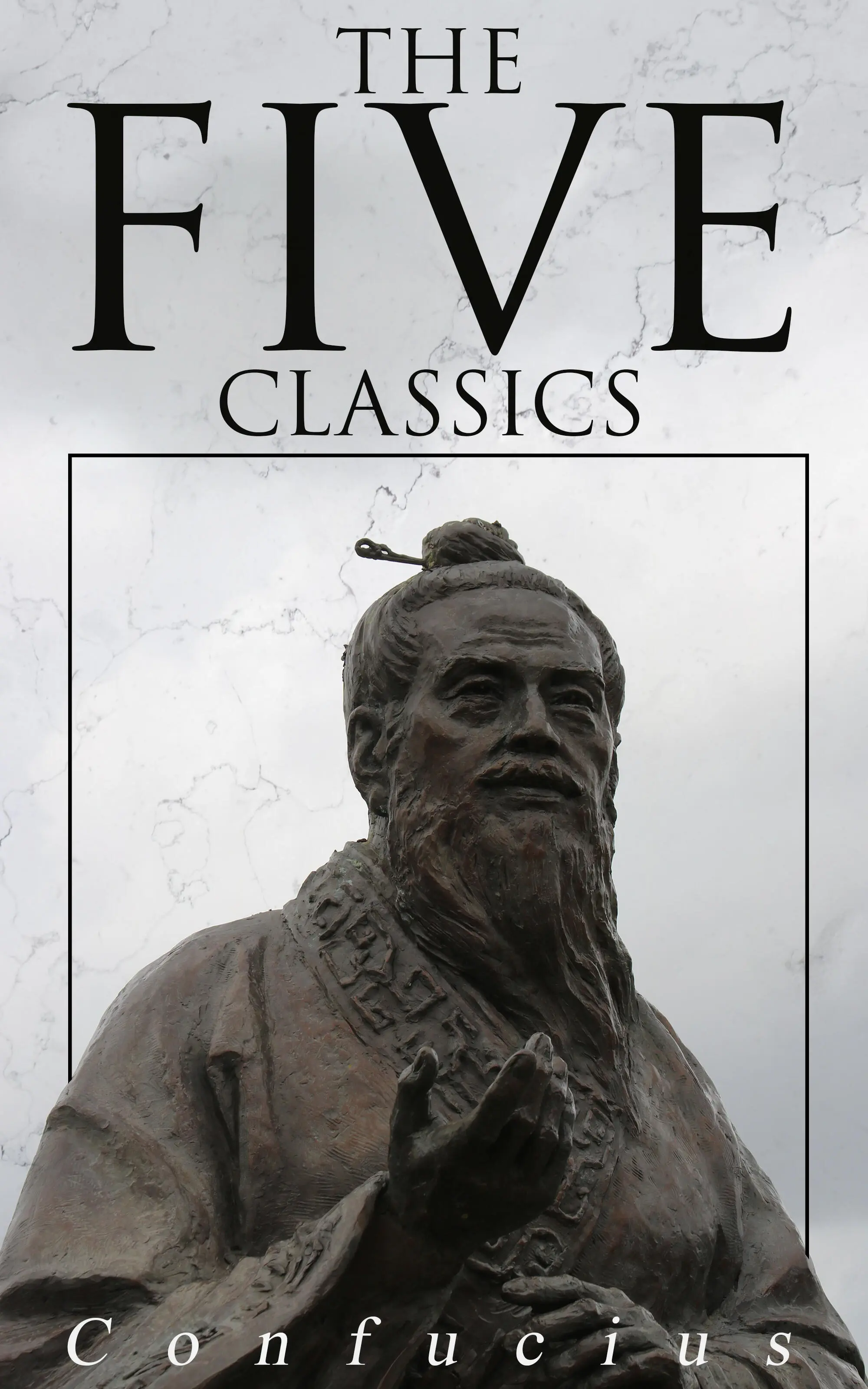
- Название:The Five Classics
- Автор:
- Жанр:
- Год:неизвестен
- ISBN:нет данных
- Рейтинг книги:5 / 5. Голосов: 1
-
Избранное:Добавить в избранное
- Отзывы:
-
Ваша оценка:
The Five Classics: краткое содержание, описание и аннотация
Предлагаем к чтению аннотацию, описание, краткое содержание или предисловие (зависит от того, что написал сам автор книги «The Five Classics»). Если вы не нашли необходимую информацию о книге — напишите в комментариях, мы постараемся отыскать её.
I Ching – The book contains a divination system comparable to Western geomancy or the West African Ifá system. In Western cultures and modern East Asia, it is still widely used for this purpose.
Shu King – A collection of documents and speeches alleged to have been written by rulers and officials of the early Zhou period and before. It is possibly the oldest Chinese narrative, and may date from the 6th century BC. It includes examples of early Chinese prose.
The Shih King – A collection of 305 poems divided into 160 folk songs, 105 festal songs sung at court ceremonies, and 40 hymns and eulogies sung at sacrifices to heroes and ancestral spirits of the royal house.
The Li Ki – Describes ancient rites, social forms and court ceremonies. The version studied today is a re-worked version compiled by scholars in the third century BC rather than the original text, which is said to have been edited by Confucius himself.
Spring and Autumn Annals – A historical record of the State of Lu, Confucius's native state, 722–481 BC.
The Five Classics — читать онлайн ознакомительный отрывок
Ниже представлен текст книги, разбитый по страницам. Система сохранения места последней прочитанной страницы, позволяет с удобством читать онлайн бесплатно книгу «The Five Classics», без необходимости каждый раз заново искать на чём Вы остановились. Поставьте закладку, и сможете в любой момент перейти на страницу, на которой закончили чтение.
Интервал:
Закладка:
The weak 5th line responds to the strong 2nd, and may be supposed to represent a wife conscious of her weakness, and docilely submissive; which is good. A husband, however, and a man generally, has to assert himself, and lay down the rule of what is right.
In line 6 the principle of perseverance has run its course; the motive power of K ăn is exhausted. The line itself is weak. The violent efforts of its subject can only lead to evil.
Hexagram XXXIII. 33Thun
Table of Contents

Thun indicates successful progress (in its circumstances). To a small extent it will (still) be advantageous to be firm and correct.
1. The first line, divided, shows a retiring tail. The position is perilous. No movement in any direction should be made.
2. The second line, divided, shows its subject holding (his purpose) fast as if by a (thong made from the) hide of a yellow ox, which cannot be broken.
3. The third line, undivided, shows one retiring but bound,--to his distress and peril. (If he were to deal with his binders as in) nourishing a servant or concubine, it would be fortunate for him.
4. The fourth line, undivided, shows its subject retiring notwithstanding his likings. In a superior man this will lead to good fortune; a small man cannot attain to this.
5. The fifth line, undivided, shows its subject retiring in an admirable way. With firm correctness there will be good fortune.
6. The sixth line, undivided, shows its subject retiring in a noble way. It will be advantageous in every respect.
Footnotes
33.Thun is the hexagram of the sixth month; the yin influence is represented by two weak lines, and has made good its footing in the year. The figure thus suggested to king Wăn the growth of small and unprincipled men in the state, before whose advance superior men were obliged to retire. This is the theme of his essay,--how, I when small men multiply and increase in power, p. 129 the necessity of the time requires superior men to withdraw before them.' Yet the auspice of Thun is not all bad. By firm correctness the threatened evil may be arrested to a small extent.
'A retiring tail' seems to suggest the idea of the subject of the lines hurrying away, which would only aggravate the evil and danger of the time.
'His purpose' in line 2 is the purpose to withdraw. The weak 2 responds correctly to the strong 5, and both are central. The purpose therefore is symbolled as in the text. The 'yellow' colour of the ox is introduced because of its being 'correct,' and of a piece with the central place of the line.
Line 3 has no proper correlate in 6 and its subject allows himself to be entangled and impeded by the subjects of 1 and 2. He is too familiar with them, and they presume, and fetter his movements;--compare Analects, 17. 25. He should keep them at a distance.
Line 4 has a correlate in 1, and is free to exercise the decision belonging to its subject. The line is the first in Khien, symbolic of strength.
In the Shû IV, v, Section 2. 9, the worthy Î Yin is made to say, 'The minister will not for favour or gain continue in an office whose work is done;' and the Khang-hsî editors refer to his words as an illustration of what is said on line 5. It has its correlate in 2, and its subject carries out the purpose to retire 'in an admirable way.'
Line 6 is strong, and with no correlate to detain it in 3. Its subject vigorously and happily carries out the idea of the hexagram.
Hexagram XXXIV. 34Tâ Kwang
Table of Contents

Tâ K wang indicates that (under the conditions which it symbolises) it will be advantageous to be firm and correct.
1. The first line, undivided, shows its subject manifesting his strength in his toes. But advance will lead to evil,--most certainly.
2. The second line, undivided, shows that with firm correctness there will be good fortune.
3. The third line, undivided, shows, in the case of a small man, one using all his strength; and in the case of a superior man, one whose rule is not to do so. Even with firm correctness the position would be perilous. (The exercise of strength in it might be compared to the case of) a ram butting against a fence, and getting his horns entangled.
4. The fourth line, undivided, shows (a case in which) firm correctness leads to good fortune, and occasion for repentance disappears. (We see) the fence opened without the horns being entangled. The strength is like that in the wheel-spokes of a large waggon.
5. The fifth line, divided, shows one who loses his ram(-like strength) in the ease of his position. (But) there will be no occasion for repentance.
6. The sixth line, divided, shows (one who may be compared to) the ram butting against the fence, and unable either to retreat, or to advance as he would fain do. There will not be advantage in any respect; but if he realise the difficulty (of his position), there will be good fortune.
Footnotes
34.The strong lines predominate in Tâ K wang. It suggested to king Wăn a state or condition of things in which there was abundance of strength and vigour. Was strength alone enough for the conduct of affairs? No. He saw also in the figure that which suggested to him that strength should be held in subordination to the idea of right, and exerted only in harmony with it.
This is the lesson of the hexagram, as sententiously expressed in the Thwan.
Line 1 is strong, in its correct place, and also the first line in Kh ien, the hexagram of strength, and the first line in Tâ Kwang. The idea of the figure might seem to be concentrated in it; and hence we have it symbolised by 'strength in the toes,' or 'advancing.' But such a measure is too bold to be undertaken by one in the lowest place, and moreover there is no proper correlate in 4. Hence comes the evil auspice.
Line 2 is strong, but the strength is tempered by its being in an even place, instead of being excited by it, as might be feared. Then the place is that in the centre. With firm correctness there will be good fortune.
Line 3 is strong, and in its proper place. It is at the top moreover of Kh ien. A small man so symbolled will use his strength to the utmost; but not so the superior man. For him the position is beyond the safe middle, and he will be cautious; and not injure himself, like the ram, by exerting his strength.
Line 4 is still strong, but in the place of a weak line; and this gives occasion to the cautions with which the symbolism commences. The subject of the line going forward thus cautiously, his strength will produce good effects, such as are described.
Line 5 is weak, and occupies a central place. Its subject will cease therefore to exert his strength; but this hexagram does not forbid the employment of strength, but would only control and p. 132 direct it. All that is said about him is that he will give no occasion for repentance.
Line 6 being at the top of K ăn, the symbol of movement, and at the top of Tâ K wang, its subject may be expected to be active in exerting his strength; and through his weakness, the result would be as described. But he becomes conscious of his weakness, reflects and rests, and good fortune results, as he desists from the prosecution of his unwise efforts.
Hexagram XXXV. 35Ȝin
Table of Contents

In Ȝin we see a prince who secures the tranquillity (of the people) presented on that account with numerous horses (by the king), and three times in a day received at interviews.
Читать дальшеИнтервал:
Закладка:
Похожие книги на «The Five Classics»
Представляем Вашему вниманию похожие книги на «The Five Classics» списком для выбора. Мы отобрали схожую по названию и смыслу литературу в надежде предоставить читателям больше вариантов отыскать новые, интересные, ещё непрочитанные произведения.





Обсуждение, отзывы о книге «The Five Classics» и просто собственные мнения читателей. Оставьте ваши комментарии, напишите, что Вы думаете о произведении, его смысле или главных героях. Укажите что конкретно понравилось, а что нет, и почему Вы так считаете.