Confucius - The Five Classics
Здесь есть возможность читать онлайн «Confucius - The Five Classics» — ознакомительный отрывок электронной книги совершенно бесплатно, а после прочтения отрывка купить полную версию. В некоторых случаях можно слушать аудио, скачать через торрент в формате fb2 и присутствует краткое содержание. Жанр: unrecognised, на английском языке. Описание произведения, (предисловие) а так же отзывы посетителей доступны на портале библиотеки ЛибКат.
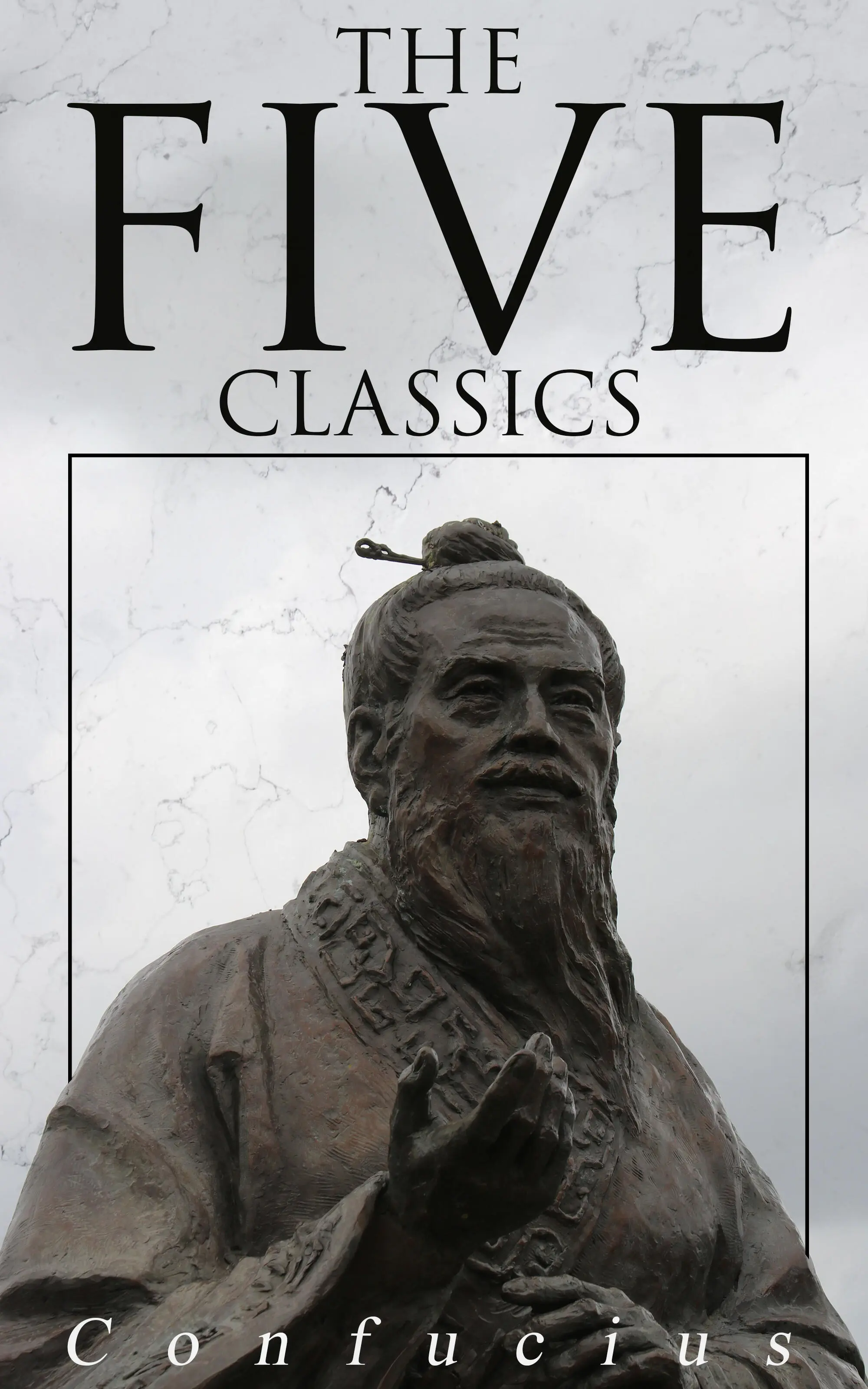
- Название:The Five Classics
- Автор:
- Жанр:
- Год:неизвестен
- ISBN:нет данных
- Рейтинг книги:5 / 5. Голосов: 1
-
Избранное:Добавить в избранное
- Отзывы:
-
Ваша оценка:
The Five Classics: краткое содержание, описание и аннотация
Предлагаем к чтению аннотацию, описание, краткое содержание или предисловие (зависит от того, что написал сам автор книги «The Five Classics»). Если вы не нашли необходимую информацию о книге — напишите в комментариях, мы постараемся отыскать её.
I Ching – The book contains a divination system comparable to Western geomancy or the West African Ifá system. In Western cultures and modern East Asia, it is still widely used for this purpose.
Shu King – A collection of documents and speeches alleged to have been written by rulers and officials of the early Zhou period and before. It is possibly the oldest Chinese narrative, and may date from the 6th century BC. It includes examples of early Chinese prose.
The Shih King – A collection of 305 poems divided into 160 folk songs, 105 festal songs sung at court ceremonies, and 40 hymns and eulogies sung at sacrifices to heroes and ancestral spirits of the royal house.
The Li Ki – Describes ancient rites, social forms and court ceremonies. The version studied today is a re-worked version compiled by scholars in the third century BC rather than the original text, which is said to have been edited by Confucius himself.
Spring and Autumn Annals – A historical record of the State of Lu, Confucius's native state, 722–481 BC.
The Five Classics — читать онлайн ознакомительный отрывок
Ниже представлен текст книги, разбитый по страницам. Система сохранения места последней прочитанной страницы, позволяет с удобством читать онлайн бесплатно книгу «The Five Classics», без необходимости каждый раз заново искать на чём Вы остановились. Поставьте закладку, и сможете в любой момент перейти на страницу, на которой закончили чтение.
Интервал:
Закладка:
Line 2 is weak, but also in its right place, and central; giving us the idea of an officer, obedient to duty and the right. His wound in the left thigh may impede his movements, but does not disable him. He finds means to save himself, and maintains his good purpose.
Line 3, strong and in a strong place, is the topmost line of the lower. trigram. It responds also to line 6, in which the idea of the sovereign, emblemed by the upper trigram, is concentrated. The lower trigram is the emblem of light or brightness, the idea of which again is expressed by the south, to which we turn when we look at the sun in its meridian height. Hence the subject of the p. 137 line becomes a hunter pursuing his game, and successfully. The good officer will be successful in his struggle; but let him not be over eager to put all things right at once.
Line 4 is weak, but in its right place. K û Hsî says he does not understand the symbolism, as given in the Text. The translation indicates the view of it commonly accepted. The subject of the line evidently escapes from his position of danger with little damage.
Line 5 should be the place of the ruler or sovereign in the hexagram; but 6 is assigned as that place in Ming Î. The officer occupying 5, the centre of the upper trigram, and near to the sovereign, has his ideal in the count of K î, whose action appears in the Shû, III, pp. 123, 127, 128. He is a historical personage.
Line 6 sets forth the fate of the ruler, who opposes himself to the officer who would do him good and intelligent service. Instead of becoming as the sun, enlightening all from the height of the sky, he is as the sun hidden below the earth. I can well believe that the writer had the last king of Shang in his mind.
Hexagram XXXVII. 37Kiâ Zăn
Table of Contents

For (the realisation of what is taught in) K iâ Z ăn, (or for the regulation of the family), what is most advantageous is that the wife be firm and correct.
1. The first line, undivided, shows its subject establishing restrictive regulations in his household Occasion for repentance will disappear.
2. The second line, divided, shows its subject taking nothing on herself, but in her central place attending to the preparation of the food. Through her firm correctness there will be good fortune.
3. The third line, undivided, shows its subject (treating) the members of the household with stern severity. There will be occasion for repentance, there will be peril, (but) there will (also) be good fortune. If the wife and children were to be smirking and chattering, in the end there would be occasion for regret.
4. The fourth line, divided, shows its subject enriching the family. There will be great good fortune.
5. The fifth line, undivided, shows the influence of the king extending to his family. There need be no anxiety; there will be good fortune.
6. The topmost line, undivided, shows its subject possessed of sincerity and arrayed in majesty. In the end there will be good fortune.
Footnotes
37. K iâ Z ăn, the name of the hexagram, simply means 'a household,' or 'the members of a family.' The subject of the essay based on the figure, however, is the regulation of the family, effected mainly by the co-operation of husband and wife in their several spheres, and only needing to become universal to secure the good order of the kingdom. The important place occupied by the wife in the family is seen in the short sentence of the Thwan. That she be firm and correct, and do her part well, is the first thing necessary to its regulation.
Line 1 is strong, and in a strong place. It suggests the necessity of strict rule in governing the family. Regulations must be established, and their observance strictly insisted on.
Line 2 is weak, and in the proper place for it,--the centre, moreover, of the lower trigram. It fitly represents the wife, and what is said on it tells us of her special sphere and duty; and that she should be unassuming in regard to all beyond her sphere; always being firm and correct. See the Shih, III, 350.
Line 3 is strong, and in an odd place. If the place were central, the strength would be tempered; but the subject of the line, in the topmost place of the trigram, may be expected to exceed in severity. But severity is not a bad thing in regulating a family;--it is better than laxity and indulgence.
Line 4 is weak, and in its proper place. The wife is again suggested to us, and we are told, that notwithstanding her being confined to the internal affairs of the household, she can do much to enrich the family.
The subject of the strong fifth line appears as the king. This may be the husband spoken of as also a king; or the real king whose merit is revealed first in his family, as often in the Shih, where king Wăn is the theme. The central place here tempers the display of the strength and power.
Line 6 is also strong, and being in an even place, the subject of it might degenerate into stern severity, but he is supposed to be sincere, complete in his personal character and self-culture, and hence his action will only lead to good fortune.
Hexagram XXXVIII. 38Khwei
Table of Contents

Kh wei indicates that, (notwithstanding the condition of things which it denotes), in small matters there will (still) be good success.
1. The first line, undivided, shows that (to its subject) occasion for repentance will disappear. He has lost his horses, but let him not seek for them;--they will return of themselves. Should he meet with bad men, he will not err (in communicating with them).
2. The second line, undivided, shows its subject happening to meet with his lord in a bye-passage. There will be no error.
3. In the third line, divided, we see one whose carriage is dragged back, while the oxen in it are pushed back, and he is himself subjected to the shaving of his head and the cutting off of his nose. There is no good beginning, but there will be a good end.
4. The fourth line, undivided, shows its subject solitary amidst the (prevailing) disunion. (But) he meets with the good man (represented by the first line), and they blend their sincere desires together. The position is one of peril, but there will be no mistake.
5. The fifth line, divided, shows that (to its subject) occasion for repentance will disappear. With his relative (and minister he unites closely and readily) as if he were biting through a piece of skin. When he goes forward (with this help), what error can there be?
6. The topmost line, undivided, shows its subject solitary amidst the (prevailing) disunion. (In the subject of the third line, he seems to) see a pig bearing on its back a load of mud, (or fancies) there is a carriage full of ghosts. He first bends his bow against him, and afterwards unbends it, (for he discovers) that he is not an assailant to injure, but a near relative. Going forward, he shall meet with (genial) rain, and there will be good fortune.
Footnotes
38. Kh wei denotes a social state in which division and mutual alienation prevail, and the hexagram teaches how in small matters this condition may be healed, and the way prepared for the cure of the whole system. The writer or writers of Appendixes I and II point out the indication in the figure of division and disunion according to their views. In Appendix VI those things appear as a necessary sequel to the regulation of the family; while it is impossible to discover any allusion to the family in the Text.
Читать дальшеИнтервал:
Закладка:
Похожие книги на «The Five Classics»
Представляем Вашему вниманию похожие книги на «The Five Classics» списком для выбора. Мы отобрали схожую по названию и смыслу литературу в надежде предоставить читателям больше вариантов отыскать новые, интересные, ещё непрочитанные произведения.






Обсуждение, отзывы о книге «The Five Classics» и просто собственные мнения читателей. Оставьте ваши комментарии, напишите, что Вы думаете о произведении, его смысле или главных героях. Укажите что конкретно понравилось, а что нет, и почему Вы так считаете.