Confucius - The Five Classics
Здесь есть возможность читать онлайн «Confucius - The Five Classics» — ознакомительный отрывок электронной книги совершенно бесплатно, а после прочтения отрывка купить полную версию. В некоторых случаях можно слушать аудио, скачать через торрент в формате fb2 и присутствует краткое содержание. Жанр: unrecognised, на английском языке. Описание произведения, (предисловие) а так же отзывы посетителей доступны на портале библиотеки ЛибКат.
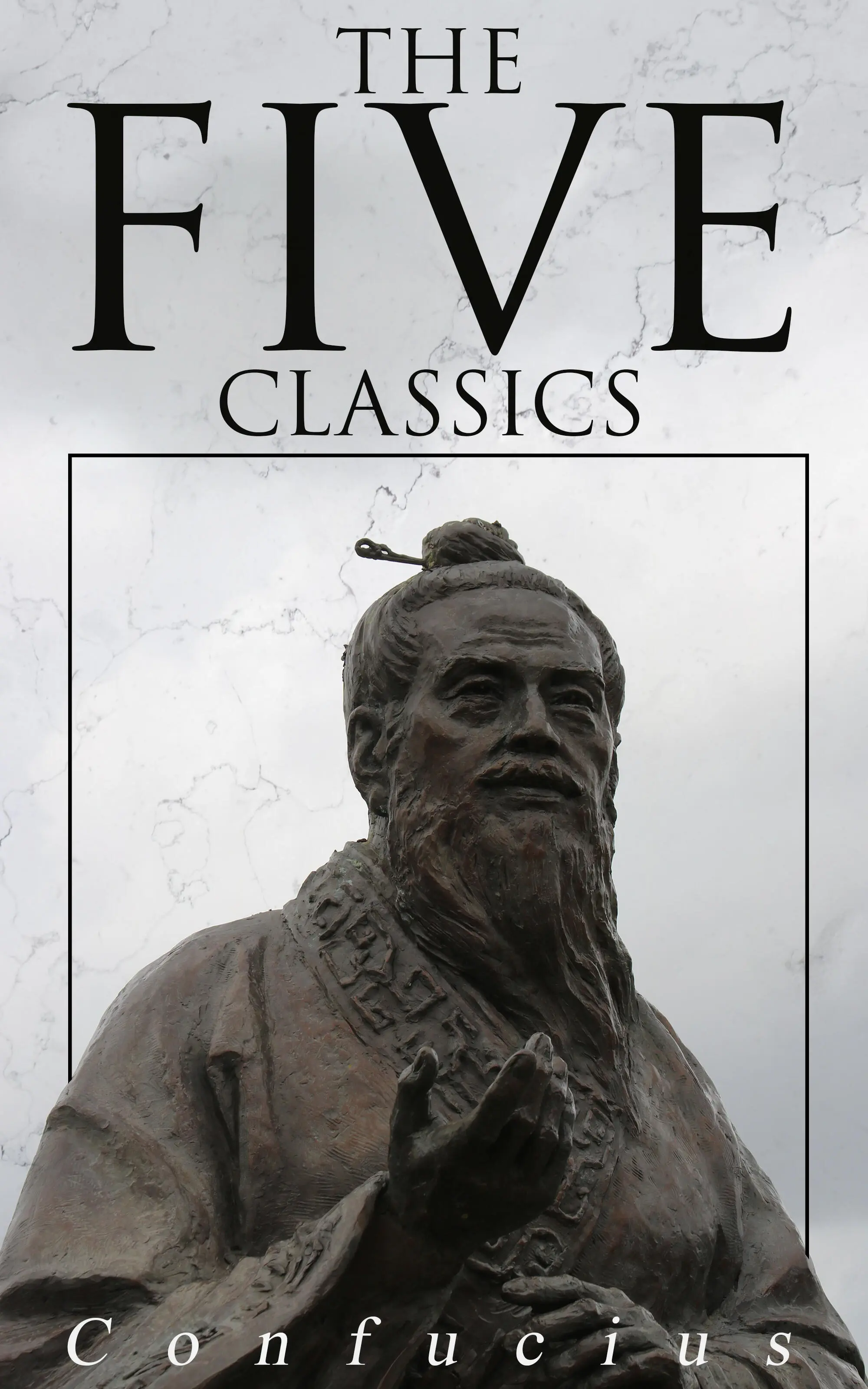
- Название:The Five Classics
- Автор:
- Жанр:
- Год:неизвестен
- ISBN:нет данных
- Рейтинг книги:5 / 5. Голосов: 1
-
Избранное:Добавить в избранное
- Отзывы:
-
Ваша оценка:
The Five Classics: краткое содержание, описание и аннотация
Предлагаем к чтению аннотацию, описание, краткое содержание или предисловие (зависит от того, что написал сам автор книги «The Five Classics»). Если вы не нашли необходимую информацию о книге — напишите в комментариях, мы постараемся отыскать её.
I Ching – The book contains a divination system comparable to Western geomancy or the West African Ifá system. In Western cultures and modern East Asia, it is still widely used for this purpose.
Shu King – A collection of documents and speeches alleged to have been written by rulers and officials of the early Zhou period and before. It is possibly the oldest Chinese narrative, and may date from the 6th century BC. It includes examples of early Chinese prose.
The Shih King – A collection of 305 poems divided into 160 folk songs, 105 festal songs sung at court ceremonies, and 40 hymns and eulogies sung at sacrifices to heroes and ancestral spirits of the royal house.
The Li Ki – Describes ancient rites, social forms and court ceremonies. The version studied today is a re-worked version compiled by scholars in the third century BC rather than the original text, which is said to have been edited by Confucius himself.
Spring and Autumn Annals – A historical record of the State of Lu, Confucius's native state, 722–481 BC.
The Five Classics — читать онлайн ознакомительный отрывок
Ниже представлен текст книги, разбитый по страницам. Система сохранения места последней прочитанной страницы, позволяет с удобством читать онлайн бесплатно книгу «The Five Classics», без необходимости каждый раз заново искать на чём Вы остановились. Поставьте закладку, и сможете в любой момент перейти на страницу, на которой закончили чтение.
Интервал:
Закладка:
The action of the hexagram is over; where can the weak 6 go forward to? Let him abide where he is, and serve the great man immediately below him. So shall he also be great;--in meritorious action at least.
Hexagram XL. 40Kieh
Table of Contents

In (the state indicated by) K ieh advantage will be found in the south-west. If no (further) operations be called for, there will be good fortune in coming back (to the old conditions). If some operations be called for, there will be good fortune in the early conducting of them.
1. The first line, divided, shows that its subject will commit no error.
2. The second line, undivided, shows its subject catch, in hunting, three foxes, and obtain the yellow (= golden) arrows. With firm correctness there will be good fortune.
3. The third line, divided, shows a porter with his burden, (yet) riding in a carriage. He will (only) tempt robbers to attack him. However firm and correct he may (try to) be, there will be cause for regret.
4. (To the subject of) the fourth line, undivided, (it is said), 'Remove your toes. Friends will (then) come, between you and whom there will be mutual confidence.'
5. The fifth line, divided, shows (its subject), the superior man (= the ruler), executing his function of removing (whatever is injurious to the idea of the hexagram), in which case there will he good fortune, and confidence in him will be shown even by the small men.
6. In the sixth line, divided, we see a feudal prince (with his bow) shooting at a falcon on the top of a high wall, and hitting it. (The effect of his action) will be in every way advantageous.
Footnotes
40. K ieh is the symbol of loosing,--untying a knot or unravelling a complication; and as the name of this hexagram, it denotes a condition in which the obstruction and difficulty indicated by the preceding K ieh have been removed. The object of the author is to show, as if from the lines of the figure, how this new and better state of the kingdom is to be dealt with. See what is said on the Thwan of K ien for 'the advantage to be found in the south-west.' If further active operations be not necessary to complete the subjugation of the country, the sooner things fall into their old channels the better. The new masters of the kingdom should not be anxious to change all the old manners and ways. Let them do, as the duke of K âu actually did do with the subjugated people of Shang. If p. 146 further operations be necessary, let them be carried through without delay. Nothing is said in the Thwan about the discountenancing and removal of small men,--unworthy ministers or officers; but that subject appears in more! than one of the lines.
There is a weak line, instead of a strong, in the first place; but this is compensated for by its strong correlate in 4.
K û Hsî says he does not understand the symbolism under line 2. The place is even, but the line itself is strong; the strength therefore is modified or tempered. And 2 is the correlate of the ruler in 5. We are to look to its subject therefore for a minister striving to realise the idea of the hexagram, and pacify the subdued kingdom. He becomes a hunter, and disposes of unworthy men, represented by 'the three foxes.' He also gets the yellow arrows, the instruments used in war or in hunting, whose colour is 'correct,' and whose form is 'straight.' His firm correctness will be good.
Line 3 is weak, when it should be strong; and occupying, as it does, the topmost place of the lower trigram, it suggests the symbolism of a porter in a carriage. People will say, 'How did he get there? The things cannot be his own.' And robbers will attack and plunder him. The subject of the line cannot protect himself, nor accomplish anything good.
What is said on the fourth line appears in the form of an address to its subject. The line is strong in an even place, and 1, its correlate, is weak in an odd place. Such a union will not be productive of good. In the symbolism 1 becomes the toe of the subject of 4. How the friend or friends, who are to come to him on the removal of this toe, are represented, I do not perceive.
Line 5 is weak in an odd place; but the place is that of the ruler, to whom it belongs to perfect the idea of the hexagram by p. 147 removing all that is contrary to the peace and good order of the kingdom. It will be his duty to remove especially all the small men represented by the divided lines, which he can do with the help of his strong correlate in 2. Then even the small men will change their ways, and repair to him.
Line 6 is the highest line in the figure, but not the place of the ruler. Hence it appears as occupied by a feudal duke, who carries out the idea of the figure against small men, according to the symbolism employed.
Hexagram XLI. 41Sun
Table of Contents

In (what is denoted by) Sun, if there be sincerity (in him who employs it), there will be great good fortune:--freedom from error; firmness and correctness that can be maintained; and advantage in every movement that shall be made. In what shall this (sincerity in the exercise of Sun) be employed? (Even) in sacrifice two baskets of grain, (though there be nothing else), may be presented.
1. The first line, undivided, shows its subject suspending his own affairs, and hurrying away (to help the subject of the fourth line). He will commit no error, but let him consider how far he should contribute of what is his (for the other).
2 . The second line, undivided, shows that it will be advantageous for its subject to maintain a firm correctness, and that action on his part will be evil. He can give increase (to his correlate) without taking from himself
3. The third line, divided, shows how of three men walking together, the number is diminished by one; and how one, walking, finds his friend.
4. The fourth line, divided, shows its subject diminishing the ailment under which he labours by making (the subject of the first line) hasten (to his help), and make him glad. There will be no error.
5. The fifth line, divided, shows parties adding to (the stores of) its subject ten pairs of tortoise shells, and accepting no refusal. There will be great good fortune.
6. The topmost line, undivided, shows its subject giving increase to others without taking from himself. There will be no error. With firm correctness there will be good fortune. There will be advantage in every movement that shall be made. He will find ministers more than can be counted by their clans.
Footnotes
41.The interpretation of this hexagram is encompassed with great difficulties. Sun is the symbol for the idea of diminishing or diminution; and what is said in Appendix I has made it to be accepted as teaching the duty of the subject to take of what is his and contribute to his ruler, or the expenses of the government under which he lives; in other words, readily and cheerfully to pay his taxes. P. Regis says, Sun seu (vectigalis causa) minuere . . . est valde utile;' and Canon McClatchie in translating Appendix I has:--'Diminishing (by taxation for instance) .... is very lucky.' Possibly, king Wăn may have seen in the figures the subject of taxation; but the symbolism of his son takes a much wider range. My own reading of the figure and Text comes near to the view of Kh ăng-ȝze, that 'every diminution and repression of what we have in excess to bring it into accordance with right and reason is comprehended under Sun.'
Читать дальшеИнтервал:
Закладка:
Похожие книги на «The Five Classics»
Представляем Вашему вниманию похожие книги на «The Five Classics» списком для выбора. Мы отобрали схожую по названию и смыслу литературу в надежде предоставить читателям больше вариантов отыскать новые, интересные, ещё непрочитанные произведения.





Обсуждение, отзывы о книге «The Five Classics» и просто собственные мнения читателей. Оставьте ваши комментарии, напишите, что Вы думаете о произведении, его смысле или главных героях. Укажите что конкретно понравилось, а что нет, и почему Вы так считаете.