Rethinking Prototyping
Здесь есть возможность читать онлайн «Rethinking Prototyping» — ознакомительный отрывок электронной книги совершенно бесплатно, а после прочтения отрывка купить полную версию. В некоторых случаях можно слушать аудио, скачать через торрент в формате fb2 и присутствует краткое содержание. Жанр: unrecognised, на английском языке. Описание произведения, (предисловие) а так же отзывы посетителей доступны на портале библиотеки ЛибКат.
- Название:Rethinking Prototyping
- Автор:
- Жанр:
- Год:неизвестен
- ISBN:нет данных
- Рейтинг книги:3 / 5. Голосов: 1
-
Избранное:Добавить в избранное
- Отзывы:
-
Ваша оценка:
Rethinking Prototyping: краткое содержание, описание и аннотация
Предлагаем к чтению аннотацию, описание, краткое содержание или предисловие (зависит от того, что написал сам автор книги «Rethinking Prototyping»). Если вы не нашли необходимую информацию о книге — напишите в комментариях, мы постараемся отыскать её.
The Design Modelling Symposium Berlin 2013 would like to challenge the participants to reflect on the possibility of computational systems that bridge design phase and occupancy of buildings. This rethinking of the designed artifact beyond its physical has had profound effects on other industries already. How does it affect architecture and engineering?
At the scale of engineering and building systems new perspectives may open up by engaging built form as a continuous prototype, which can track and respond during use and serve as a real world implementation of its design model. This has been tried many times from intelligent façades to smart homes and networked grids but much of it was only technology driven and not approached from a more holistic design perspective.
Rethinking Prototyping — читать онлайн ознакомительный отрывок
Ниже представлен текст книги, разбитый по страницам. Система сохранения места последней прочитанной страницы, позволяет с удобством читать онлайн бесплатно книгу «Rethinking Prototyping», без необходимости каждый раз заново искать на чём Вы остановились. Поставьте закладку, и сможете в любой момент перейти на страницу, на которой закончили чтение.
Интервал:
Закладка:
Fig. 19 Trimmed mesh
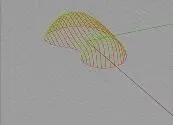
Fig. 20 Final mesh and support outline
Mesh Optimisation
Since the form has been known and the procedure to mesh the surface is known now, an optimisation of the mesh can be performed (Fig. 21). The aim is to find a mesh that can mesh the entire surface and that creates acceptable stresses in the beams. To this end, the curvature of the elements is checked using the following equation (Eq. 3):

(3)
Different sets of guide-curves are chosen and the resulting meshes are compared according to this criterion:
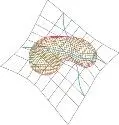
Mesh n°1

Mesh n°2
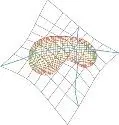
Mesh n°3
Fig. 21 Mesh testing
Grid Processing
The generated mesh can be shaped in a matrix. This allows both its transformation in a planar grid of regular pitch (Fig. 22) and automatic definition of triangulation elements for bracing.
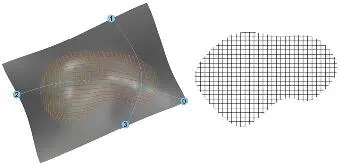
Fig. 22 Developed surface and derived grid.
Generation of Analysis Model
A procedure gathers and processes all the geometric information. It creates an import file for the automatic generation of an analysis model in GSA, a third-party software dedicated to structural analysis. Additional components assist the designer in the definition of complex load cases, such as non-uniform wind and snow loads, directly in Rhino & Grasshopper .
2.6 Structural Analysis
Once the structural model is built by our tools, it can be loaded in the structural analysis software to perform:
Computation of the permanent flexural stress and the relaxed shape using a dynamic relaxation algorithm (Fig. 23)
Loading analysis according to the Eurocode (self-weight, snow, wind ...)
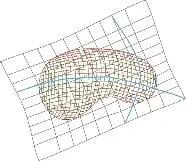
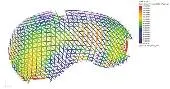
Fig. 23 Final compass mesh and corresponding relaxed mesh (stress diagram).
3 Conclusion
This paper has presented the different steps for the design of a gridshell in composites materials built for the Solidays Festival in 2011 in Paris. The first step was the optimisation of the shape in order to avoid concentrations of curvature locally. The second step showed a tool to automatically mesh a surface using the compass method. With this tool the optimum orientation of the mesh is studied. The last step showed the details of the structural analysis of the gridshell. This construction demonstrated the technical feasibility and also the economical feasibility of the gridshell in composites materials.
Acknowledgements
The authors would like to thank the students E. Roux, E. Blache, J.-R. Nguyen, A. Grandi, G. Frambourt, T. Perarnaun, their university supervisor R. Mège and the association Solidarité Sida for their initiative and confidence. Special thanks also to T/E/S/S and Viry for their technical and financial support, which permitted this project to become real. Thanks also to all our partners who provided significant material assistance: Serge Ferrari, Top Glass & Solutions Composites, Owens Corning Reinforcement, DSM Resins, ENSG, Esmery Caron, Axmann, Chastagner and ¨Paris Voile.
References
Douthe, C; Baverel, O.; Caron, J.-F., 2007: Gridshell in Composite Materials: Towards Wide-Span Shelters. Journal of the I.A.S.S , Volume 48 Issue 155, pp. 175-180.
Douthe, C.; Baverel, O., Caron, J.-F., 2006: Form-Finding of a Gridshell in Composite Materials. Journal of the International Association for Shell and Spatial Structures , Volume 47, Issue 150, pp. 53-62.
Douthe, C.; Caron, J.-F.; Baverel, O., 2010: Gridshell Structures in Glass-Fibre Reinforced Polymers. Construction and Building Materials , Volume 24, Issue 9, pp. 1580-1589.
Bouhaya, L.; Baverel, O.; Caron, J.-F., 2009: Mapping Two-Way Continuous Elastic Grid on an Imposed Surface: Application to Gridshells. In Proceedings of the International Association for Shell and Spatial Structures (IASS) Symposius, Valencia.
Otto, F.; Hennicke, J.; Matsushita, K., 1974. Gitterschalen Gridshells, Institut für Leichte Flächentragwerke . IL 10 , p. 340.
Happold, E.; Lidell, W.I., 1975: Timber Lattice Roof for the Mannheim Bundesgartenschau. The Structural Engineer , Volume 53 Issue 3, pp. 99-135.
Harris, R.; Rohmer, J.; Kelly, O.; Johnson, S., 2003. Design and Construction of the Downland Gridshell. Building Research & Information , Volume 31, Issue 6, 2003, pp. 427-454.
Ban, S., 2006: The Japanese Pavilion. In: McQuais, M. (ed): Shigeru Ban , Phaedon Press, pp. 8-11.
Designing Regular and Irregular Elastic Gridshells by Six DOF Dynamic Relaxation
Jian-Min Li and Jan Knippers
1 Introduction
An elastic gridshell defined in this paper is a single-layer or double-layer shell structure that consists of initially straight and continuous members, has equal/regular or various/irregular grid lengths and allows scissoring movements in the joints during the erection process (Fig.1). Designing a grid shell of this type needs to fulfil many geometrical and mechanical constraints. The grid pattern needs to be as close to the target surface as possible. Meanwhile, important from material aspects, an ideal grid pattern should exhibit the lowest strain energy compared with other patterns.
Most of form-finding methods for elastic grid shells are based on simplified structural models, which consist of only three degrees of freedom (DOF) per node [1][2][3] such that bending and torsion effects cannot be accurately considered. We use dynamic relaxation method (DR) with six DOF per node and Bernoulli beam elements, which have 12 DOF each, to solve the optimised grid pattern, which fulfils the geometric constraint and exhibits the lowest strain energy [4]. One advantage of our scheme is that it can handle both the form-finding and loading analyses. The obtained form can be directly transformed to a bearing structure. There is no need to transfer the form-finding result to another finite-element solver.
To address the feature of bending-active elastic gridshells [5], we demonstrate a simple method to create pre-stress in grid shells such that we can start the form-finding or the loading analysis from a strained geometry. With this method, we are no longer restricted from beginning in an unstrained state and, thus, the tedious and tricky pre-stressing procedure for bending-active structures is prevented.
Читать дальшеИнтервал:
Закладка:
Похожие книги на «Rethinking Prototyping»
Представляем Вашему вниманию похожие книги на «Rethinking Prototyping» списком для выбора. Мы отобрали схожую по названию и смыслу литературу в надежде предоставить читателям больше вариантов отыскать новые, интересные, ещё непрочитанные произведения.


Обсуждение, отзывы о книге «Rethinking Prototyping» и просто собственные мнения читателей. Оставьте ваши комментарии, напишите, что Вы думаете о произведении, его смысле или главных героях. Укажите что конкретно понравилось, а что нет, и почему Вы так считаете.