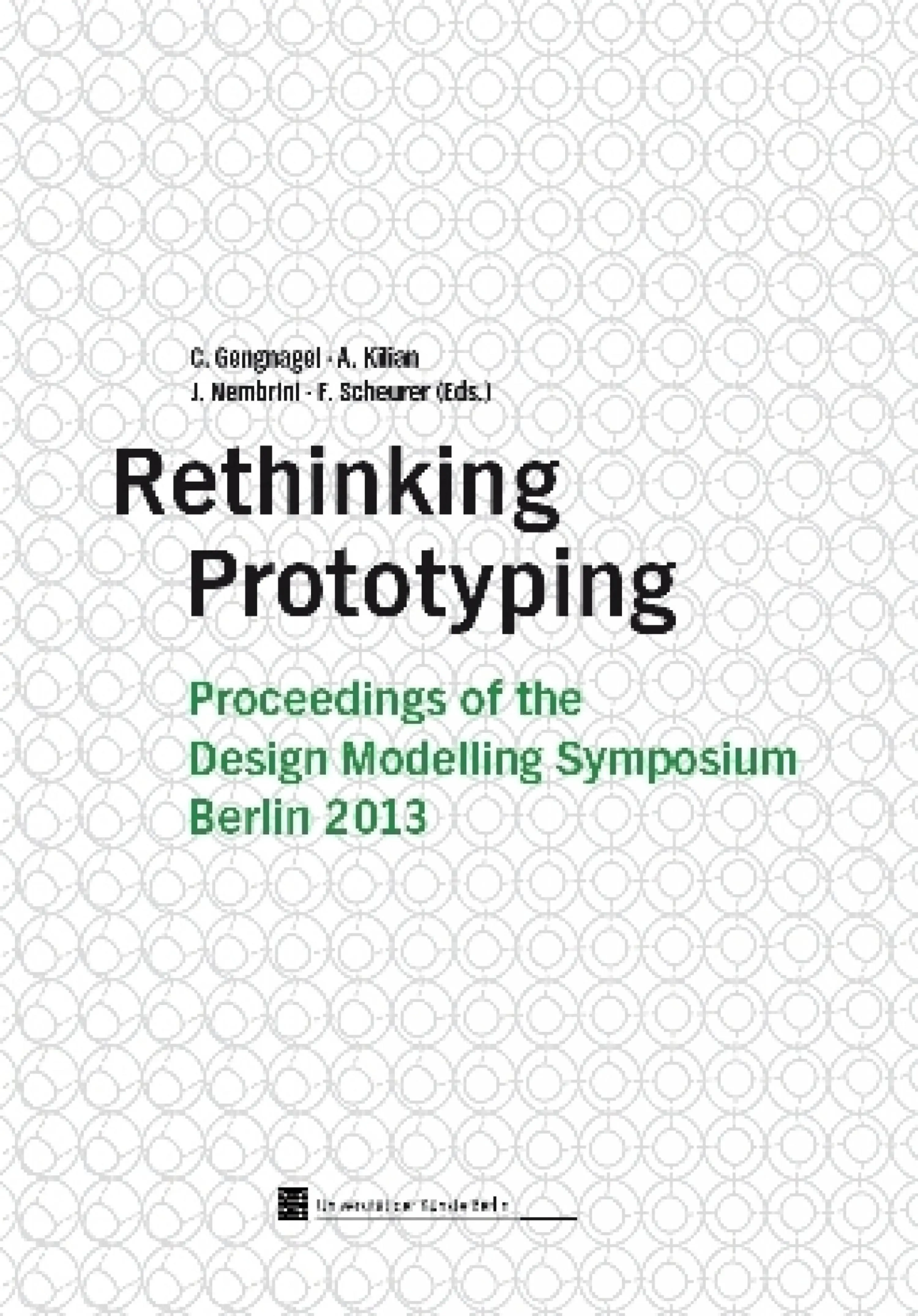
Rethinking Prototyping
Здесь есть возможность читать онлайн «Rethinking Prototyping» — ознакомительный отрывок электронной книги совершенно бесплатно, а после прочтения отрывка купить полную версию. В некоторых случаях можно слушать аудио, скачать через торрент в формате fb2 и присутствует краткое содержание. Жанр: unrecognised, на английском языке. Описание произведения, (предисловие) а так же отзывы посетителей доступны на портале библиотеки ЛибКат.
- Название:Rethinking Prototyping
- Автор:
- Жанр:
- Год:неизвестен
- ISBN:нет данных
- Рейтинг книги:3 / 5. Голосов: 1
-
Избранное:Добавить в избранное
- Отзывы:
-
Ваша оценка:
Rethinking Prototyping: краткое содержание, описание и аннотация
Предлагаем к чтению аннотацию, описание, краткое содержание или предисловие (зависит от того, что написал сам автор книги «Rethinking Prototyping»). Если вы не нашли необходимую информацию о книге — напишите в комментариях, мы постараемся отыскать её.
The Design Modelling Symposium Berlin 2013 would like to challenge the participants to reflect on the possibility of computational systems that bridge design phase and occupancy of buildings. This rethinking of the designed artifact beyond its physical has had profound effects on other industries already. How does it affect architecture and engineering?
At the scale of engineering and building systems new perspectives may open up by engaging built form as a continuous prototype, which can track and respond during use and serve as a real world implementation of its design model. This has been tried many times from intelligent façades to smart homes and networked grids but much of it was only technology driven and not approached from a more holistic design perspective.
Rethinking Prototyping — читать онлайн ознакомительный отрывок
Ниже представлен текст книги, разбитый по страницам. Система сохранения места последней прочитанной страницы, позволяет с удобством читать онлайн бесплатно книгу «Rethinking Prototyping», без необходимости каждый раз заново искать на чём Вы остановились. Поставьте закладку, и сможете в любой момент перейти на страницу, на которой закончили чтение.
Интервал:
Закладка:
Design Modelling Symposium Berlin, 28/09 - 02/10/2013
Advisory Committee
Christoph Gengnagel, UdK Berlin
Axel Kilian, Princeton University
Julien Nembrini, UdK Berlin
Norbert Palz, UdK Berlin
Fabian Scheurer, designtoproduction, Zurich
Ioannis Zonitsas, Visual-Dream, Berlin
Organising Committee
Prof. Dr.-Ing. Christoph Gengnagel, UdK Berlin
Prof. Norbert Palz, UdK Berlin
Dagmar Rumpenhorst-Zonitsas, Daglicious Coordination
Scientific Committee
Sigrid Adriaenssens, Princeton University
Marc Alexa, TU Berlin
Jussi Ängeslevä, UdK Berlin
Olivier Bavarel, UR Navier, Université Paris-Est
Philippe Block, ETH Zürich
Alexander Bobenko, TU Berlin
Peter von Bülow, University of Michigan
Neil Burford, University of Dundee
Jeroen Coenders, TU Delft
Christian Derix, Aedas London
Günther Filz, Universität Innsbruck
Al Fisher, University of Bath
Christoph Gengnagel, UdK Berlin
Michael Hensel, Oslo School of Architecture and Design
Johann Habakuk Israel, Fraunhofer IPK Berlin
Axel Kilian, Princeton University
Toni Kotnik, ETH Zürich
Oliver Tessmann, KTH, Stockholm
Stefan Peters, TU Graz
Julian Lienhard, Universität Stuttgart
Julien Nembrini, UdK Berlin
Norbert Palz, UdK Berlin
Fabian Scheurer, designtoproduction Zurich
Volker Schmid, TU Berlin
Paul Shepherd, University of Bath
Martin Tamke, CITA Copenhagen
Florian Förster, Buro Happold Berlin
Roland Wüchner, TU München
Tobias Wallisser, ABK Stuttgart, LAVA Berlin
Main sponsor

Co-Sponsors



Contents
Foreword
Structural Design
Physical and Numerical Prototyping for Integrated Bending and Form-Active Textile Hybrid Structures
From Shape to Shell: A Design Tool to Materialise FreeForm Shapes Using Gridshell Structures
Designing Regular and Irregular Elastic Gridshells by Six DOF Dynamic Relaxation
Shaping Structural Systems
Bridging the Gap
Funicular Funnel Shells
From Structural Purity to Site Specificity New Canopies for the Entrance Gates of the Messe Frankfurt
Architectural Design
DesignScript: A Learning Environment for Design Computation
Frequencies of Wood – Designing in Abstract Domains
Enhancing Free-Form Architecture with Conical Panels
Embodied Prototypes: The Interaction of Material System and Environment
Combined Self-Organising Systems for Spatial Net Structures
A Framework for Flexible Search and Optimisation in Parametric Design
Operative Diagramatology: Structural Folding for Architectural Design
The Materiability Research
Ascending Curve - Digital Realisation of Shanghai Tower
MIKADOweb – Innovative Light-Weight Structure
Fuzzy Modelling with Self-Organising Maps
ALIVE - Designing with Aggregate Behaviour in Self-Aware Systems
Integrated Design Methods for the Simulation of Fibre-Based Structures
Complex Geometry
Behavioural Prototyping: An Approach to Agent-Based Computational Design Driven by Fabrication Characteristics and Material Constraints
From Generic to Specific - Prototyping a Computational Growth Model
Linear Folded V-shaped Stripes
Free-Form Shading and Lighting Systems from Planar Quads
Climate Design
Optimisation of the Building Skin Geometry to Maximise Solar Energy Collection
Analysing The Performance-Based Computational Design Process: A Data Study
Climate-Specific Mass-Customisation of Low-Technology Architecture as Part of a High-Technology Process
Digital Fabrication
Examples for Tool Integration in Design Concepts and Production Methods of Load Carrying Structures
Unlocking Robotic Design
Autonomous Tectonics - A Research into Emergent Robotic Construction Methods
Material Products: How Data is Successfully Transformed into Real-World Objects
The Design Carport – Prototyping Matter
Sketch-Based Pipeline for Mass Customisation
Prototyping
Prototyping Robotic Production: Development of Elastically-Bent Wood-Plate Morphologies with Curved Finger-Joint Seams
Design and Manufacturing of Self-Supporting Folded Structures Using Incremental Sheet Forming
Architectural “Making” Modes in Relation to Prototype Notions The Stripe Pavilion: Progression from a Bespoke to a Parametric-Algorithmic Mode
Blended Prototyping Design for Mobile Applications
Design Workflows for Digitally Calibrated Heterogenous Building Elements
Sustainability-Open: Why Every Building Will Be Sustainable in the Future
Prototyping Helixator
Validation Framework for Urban Mobility Product-Service Systems by Smart Hybrid Prototyping
Porsche Pavilion - Designing the World‘s Largest Seamless Monocoque Shell
The Generator 2.0
A Process where Performance Drives the Physical Design
Gradient Grid - A Spring Mesh with Different Zones of Flexibility
Serial and Persistent Prototyping Addressing Architectural Acoustics
Foreword
Prototypical Models of Design
At this Symposium, we look forward to discussing the relationship between prototypes and models of design. The term prototype stands for an implemented design step rather than a trial run for mass production, as an extension to the thought and computational constructs that make up the model of design. The term models of design stands for the idea and all underlying abstractions and assumptions that define the design process.
The relation between model of design and prototype gains importance as our understanding and relating of material systems to their simulated abstract models improves and computation increasingly becomes embodied in physical constructs replacing complex mechanical assemblies with computational feedback and control.
In architecture, the mechanical complexity has usually been lower than in other engineering fields; but obviously much of architecture’s complexity lies in its cultural context and the human occupation due to its scale and the social density of the built environment. Buildings need to evolve due to their potential long lifespan and are essentially evolving prototypes of the initial design intent reflected in the design model. Bridging the gap between design abstraction during the design development and the operation of the built structure is an ongoing challenge. Inherent to the use of digital tools for design is a tension between using simulation and computational processes to develop robust physical constructs that work as physical assemblies but independent of their computational simulations, or whether to move the computational processes into the built form and further sophisticate the feedback and control cycles and adaptability of physical constructs. In other words, computational processes may be found at many levels whether implicitly as computationally crafted material behaviour and/or explicitly in the computational capabilities of construction elements.
Читать дальшеИнтервал:
Закладка:
Похожие книги на «Rethinking Prototyping»
Представляем Вашему вниманию похожие книги на «Rethinking Prototyping» списком для выбора. Мы отобрали схожую по названию и смыслу литературу в надежде предоставить читателям больше вариантов отыскать новые, интересные, ещё непрочитанные произведения.

Обсуждение, отзывы о книге «Rethinking Prototyping» и просто собственные мнения читателей. Оставьте ваши комментарии, напишите, что Вы думаете о произведении, его смысле или главных героях. Укажите что конкретно понравилось, а что нет, и почему Вы так считаете.