Rethinking Prototyping
Здесь есть возможность читать онлайн «Rethinking Prototyping» — ознакомительный отрывок электронной книги совершенно бесплатно, а после прочтения отрывка купить полную версию. В некоторых случаях можно слушать аудио, скачать через торрент в формате fb2 и присутствует краткое содержание. Жанр: unrecognised, на английском языке. Описание произведения, (предисловие) а так же отзывы посетителей доступны на портале библиотеки ЛибКат.
- Название:Rethinking Prototyping
- Автор:
- Жанр:
- Год:неизвестен
- ISBN:нет данных
- Рейтинг книги:3 / 5. Голосов: 1
-
Избранное:Добавить в избранное
- Отзывы:
-
Ваша оценка:
Rethinking Prototyping: краткое содержание, описание и аннотация
Предлагаем к чтению аннотацию, описание, краткое содержание или предисловие (зависит от того, что написал сам автор книги «Rethinking Prototyping»). Если вы не нашли необходимую информацию о книге — напишите в комментариях, мы постараемся отыскать её.
The Design Modelling Symposium Berlin 2013 would like to challenge the participants to reflect on the possibility of computational systems that bridge design phase and occupancy of buildings. This rethinking of the designed artifact beyond its physical has had profound effects on other industries already. How does it affect architecture and engineering?
At the scale of engineering and building systems new perspectives may open up by engaging built form as a continuous prototype, which can track and respond during use and serve as a real world implementation of its design model. This has been tried many times from intelligent façades to smart homes and networked grids but much of it was only technology driven and not approached from a more holistic design perspective.
Rethinking Prototyping — читать онлайн ознакомительный отрывок
Ниже представлен текст книги, разбитый по страницам. Система сохранения места последней прочитанной страницы, позволяет с удобством читать онлайн бесплатно книгу «Rethinking Prototyping», без необходимости каждый раз заново искать на чём Вы остановились. Поставьте закладку, и сможете в любой момент перейти на страницу, на которой закончили чтение.
Интервал:
Закладка:
3 Prototyping Framework for Textile Hybrid Systems
For designing a system formed of structural action, it can be decomposed into parameters of topology, structural forces, and materiality. Fig. 3 unravels these groups of parameters, as they would be addressed within a spring-based modelling and simulation environment. Topology specifies the count, type and associations of all elements within the system. Force describes the primary internal stresses, which the system will undergo, in this case tensile, compressive and bending actions. Materiality defines input parameters relevant to a material’s structural performance, while also translating values for computational or scaled behaviour into specific material definitions for fabrication and assembly. By distinguishing these parameters, particular relationships can be explored and exploited in their influence to material behaviour, as it forms force-active spatial architectures (Ahlquist and Menges 2011). This research describes the relationship between these aspects of material behaviour and relevant modes of design in physical form-finding, spring-based numerical methods, and simulation using finite element analysis.
3.1 Physical Form-Finding and Computational Means
While physical form-finding provides agile means for studying relationships of materiality and structural action within a single model, there is a limitation for any such study to predict behaviour beyond its own specific arrangement and scale. With a homogeneous material description, bending-active behaviour is generally scale-able as long as the topological input is repeated (Levien 2009). To establish a vehicle for design search, an individual study must serve as a prototypical case, projecting a design space, which implies a new vocabulary for form, performance and generative means (Coyne 1990). When integrating textile behaviour into a bending-active system, the extensibility of any one prototypical constructional model becomes further limited as the structural and spatial performance of the textile shifts greatly between scales.
While the physical prototype projects a narrow set of parametric rules and material descriptions, it can be a resource in defining fundamental logics of topology, proportion and behaviour, for further computational exploration. In this research, computational explorations occur through two venues: modelling and simulation of relative material descriptions with spring-based numerical methods, and finite element analysis defining precise mechanical (material and force) relationships. Spring-based methods calculate force based upon linear elastic stress-strain relationships (Hooke’s Law of Elasticity); using a numerical integration method such as Euler or Runge-Kutta to approximate the equilibrium of multiple interconnected springs (Kilian and Oschendorf 2005). Such methods are deployed to primarily explore varied relationships between topology and force. Both conditions are easily manipulable during the process of spring-based form-finding, enabling immediacy for feedback and ability to extract how minute manipulations affect the overall system behaviour. A fundamental layer of this research is the continued development of a modelling environment, programmed in Processing (Java) with a particle-spring library, allowing for complex topologies and force descriptions to be initially generated then actively re-modelled through an interface.
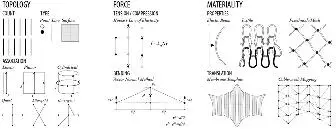
Fig. 3 Decomposition of material behaviour for spring-based modelling and simulation (Ahlquist 2013)
Finite element methods (FEM), on the other hand, contribute to forming complex equilibrium structures in defining the complete mechanical behaviour of the system. The given necessity for simulation of large elastic deformations in order to form-find bending-active structures poses no problem to modern nonlinear finite element analysis (Fertis 2006). However, software using FEM does not serve well as an expansive design environment, specifically for textile hybrid systems due to the inability to manipulate geometry and behaviour during the form-finding process. This necessitates the input data, for the pre-processing of the simulation, to be based upon the unrolled geometry of either physical form-finding or a computational environment such as the spring-based methods described above. Though the advantage, as well as necessity, of FEM in the development of textile hybrids, lies in the possibility of a complete mechanical description of the system. Provided that form-finding solvers are included in the software, the possibility of freely combining shell, beam, cable, coupling and spring elements, enables FEM to simulate the exact physical properties of the system in an uninterrupted mechanical description. Such means allows the FEM environment to accomplish, in a single model, the complete scope of form-finding, analysis of performance under external loads, and finally, the unrolling and patterning for fabrication.
4 Cellular Structure: Exploring Topological and Geometric Variation
Where bending action is triggered in a material system, certain geometric values become necessary inputs to the form-finding process. In simple terms, the length of the bending-active elements must be stated prior to the initiation of the form-finding process. In physical form-finding, geometry is inextricable from topology. The components in their count, type, and associations, carry with them their material properties. This introduces a helpful constraint in managing the complexity of searching for states of form- and bending-active equilibria. In developing the cell strategy for the M1, the physical studies define a proportional geometric logic for the bending-active aspect of the system. The exact geometry of the multi-cell array is only realized when arranged within the interleaved macro-structure. As both, the region within the meta-structure and the proportional rules of the individual cell are three-dimensionally complex, the spring-based modelling environment is well suited to explore the variation of geometric inputs arranging the meso-scale cellular textile hybrid system.
4.1 Modelling and Active Manipulation of Material Behaviour
Within the range of linear elastic material behaviour underlying the spring-based methods, a single spring element may compute tension or compression, and, in a combined arrangement, also bending action. Bending stiffness is simulated by adding positional constraint to the nodes (particles) that form a linear element. Three commonly known methods for simulating this behaviour are crossover, vector position and vector normal (Provot 1995; Volino 2006; Adrianessens 2001). In modelling behaviour with springs, there is a unique consideration where certain springs define only a particular aspect of material behaviour such as shear or bending stiffness, while others simulate the totality of behaviour and display the resultant material form such as a surface geometry or linear bending element.
In defining the tensile surface of a textile hybrid system, a mesh of springs both simulates the tensile condition in warp, weft and shear behaviour, as well as defines the material surface. In simulating bending stiffness, a linear array of springs implies the material condition of an elastic element, but the springs simulating constraint at the nodes do not have any geometric representation, as shown in Fig. 4. The flexibility in which a spring may drastically shift behaviour, between tension and compression, along with how relationships of geometry and behaviour can be more gradually tuned has been implemented as the foundation of the modelling environment programmed in Processing (Java). The key capacity in this particular mode of design is how the characterisations of behaviour can be manipulated, in topology and force description, during the effort of form-finding allowing freedom to define behaviour of different material make-up and composition.
Читать дальшеИнтервал:
Закладка:
Похожие книги на «Rethinking Prototyping»
Представляем Вашему вниманию похожие книги на «Rethinking Prototyping» списком для выбора. Мы отобрали схожую по названию и смыслу литературу в надежде предоставить читателям больше вариантов отыскать новые, интересные, ещё непрочитанные произведения.

Обсуждение, отзывы о книге «Rethinking Prototyping» и просто собственные мнения читателей. Оставьте ваши комментарии, напишите, что Вы думаете о произведении, его смысле или главных героях. Укажите что конкретно понравилось, а что нет, и почему Вы так считаете.