Rethinking Prototyping
Здесь есть возможность читать онлайн «Rethinking Prototyping» — ознакомительный отрывок электронной книги совершенно бесплатно, а после прочтения отрывка купить полную версию. В некоторых случаях можно слушать аудио, скачать через торрент в формате fb2 и присутствует краткое содержание. Жанр: unrecognised, на английском языке. Описание произведения, (предисловие) а так же отзывы посетителей доступны на портале библиотеки ЛибКат.
- Название:Rethinking Prototyping
- Автор:
- Жанр:
- Год:неизвестен
- ISBN:нет данных
- Рейтинг книги:3 / 5. Голосов: 1
-
Избранное:Добавить в избранное
- Отзывы:
-
Ваша оценка:
Rethinking Prototyping: краткое содержание, описание и аннотация
Предлагаем к чтению аннотацию, описание, краткое содержание или предисловие (зависит от того, что написал сам автор книги «Rethinking Prototyping»). Если вы не нашли необходимую информацию о книге — напишите в комментариях, мы постараемся отыскать её.
The Design Modelling Symposium Berlin 2013 would like to challenge the participants to reflect on the possibility of computational systems that bridge design phase and occupancy of buildings. This rethinking of the designed artifact beyond its physical has had profound effects on other industries already. How does it affect architecture and engineering?
At the scale of engineering and building systems new perspectives may open up by engaging built form as a continuous prototype, which can track and respond during use and serve as a real world implementation of its design model. This has been tried many times from intelligent façades to smart homes and networked grids but much of it was only technology driven and not approached from a more holistic design perspective.
Rethinking Prototyping — читать онлайн ознакомительный отрывок
Ниже представлен текст книги, разбитый по страницам. Система сохранения места последней прочитанной страницы, позволяет с удобством читать онлайн бесплатно книгу «Rethinking Prototyping», без необходимости каждый раз заново искать на чём Вы остановились. Поставьте закладку, и сможете в любой момент перейти на страницу, на которой закончили чтение.
Интервал:
Закладка:
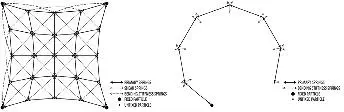
Fig. 4 Comparison of spring topology between simulating a surface and a linear element with bending stiffness (Ahlquist 2013)
4.2 Transferring Relational Logics from Physical Form-Finding to Computational Exploration
In the M1, the array of interconnected cells serve as secondary support to the overall structural system, while, more critically, providing a means for differentiating the spatial conditions underneath the primary membrane surface. The geometries of the bending rods are calibrated to act as stiffening struts spanning between the upper and lower level of the meta-scale bending-active network. Within the cellular structure, a series of tensioned textiles further stiffen the system and serve as the media for diffusing light. The fundamental relationships between the boundary condition for the cells, the structure of an individual cell and its relation to its neighbour are most readily represented in physical form-finding studies, as shown in Fig 5. Yet, due to the complexity of those combined conditions specifying the geometry, which successfully resolves all of those parameters and constraints, is more readily accomplished in the spring-based environment where active manipulation of local and global behaviours is possible.
The spring-based modelling environment in Processing exposes variables related to the simulation of bending stiffness. Using the vector position method, the ratio of stiffness in the springs defining the linear beam elements to the degrees of constraint in the nodes can be varied to express differing amounts overall stiffness and curvature, thus implying different material properties. The lengths of the linear beam elements are exposed locally and globally enabling for the acute management of bending-active behaviour when multiple elements interconnect. These two capacities allow initially simple topological and geometric arrangements to be formed into the complex relationships defined by the physical cell models and made suitable to the context of the interleaved bending-active structure, as shown in Fig. 6.
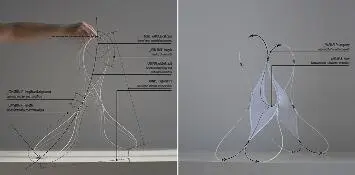
Fig. 5 Rules for bending-active cell structure (Ahlquist, 2012)
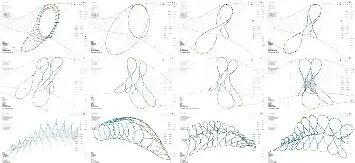
Fig. 6 Form-finding sequence for cells in spring-based modelling and simulation environment, programmed in Processing (Java) by Sean Ahlquist (Ahlquist, 2012)
5 Interleaving Structure: Developing Force Equilibria
The interleaving macro structure of the M1 exhibits how multiple modelling and simulation techniques can be used at various scales to develop an intricate structural system. The development of a bending-active system goes hand in hand with its form-finding which in contrast to membrane structures includes the consideration of a large number of geometric and material input variables. The instant feedback of mechanical behaviour possible with the construction of a physical model is indispensable in finding ways for shortcutting forces in an intricate equilibrium system. Holding an elastically bent element in your hands directly shows the spring back tendency of the system and thereby supplies direct feedback for the position and orientation of necessary constraints. When interlocking multiple elements in a physical simulation, the moment of overlap is malleable and easily adjustable. Therefore, complex but harmoniously stressed equilibrium systems may be readily found through methods in physical form-finding.
5.1 Resolving Geometry through Multiple Modes of Simulation
Such freedoms afforded in physical form-finding are not readily available in computational analysis. While the spring-based vector position method allows for the simulation of elastic bending on already curved elements, the input geometry for finite element analysis is required to be straight or planar in order for shape and residual bending stresses to be simulated accurately. The form-finding sequence shown in Fig. 7 shows the transformation of individual straight elements into a network of interconnected leaves. The resultant bending-active geometry is compared to the scaled physical model, which provides the initial topological input as shown in Fig. 8. The geometric difference measured in relative length, was found to be smaller than 3%. In the case of both the meta-scale interleaved structure and meso-scale cellular structure, the precedent for the computational explorations and analysis was established through a physically feasible system.

Fig. 7 Sequence of form-finding for bending-active structure of the M1 using FEM software Sofistik (Lienhard, 2012)
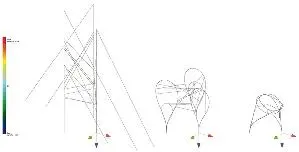
Fig. 8 Comparison between physical form-finding model and computational model in Sofistik (Photo by Ahlquist, 2013; Sofistik model by Lienhard, 2012)
5.2 Designing the Complete Mechanical Behaviour
For the M1, the importance of generating the complete mechanical behaviour was exhibited in defining the final geometry of the entire system. In physical form-finding and spring-based modelling the results are approximations due respectively to their scalar nature and the relative calculations of material behaviour. In this case, the behaviour of the forces in the tensile surfaces resolves the geometry for critical cantilever conditions. Several iterations are explored to define the geometry of the free-spanning edge beam condition, whose position is only realized in the exact equilibrium of bending stiffness in the boundary rod and tensile stress in the upper and lower membrane surfaces as shown in Fig. 9. While this is only a single feature within the textile hybrid system, it can be explored efficiently as the topology generation and form-finding process is automated as a programmed routine within the FE software Sofistik.
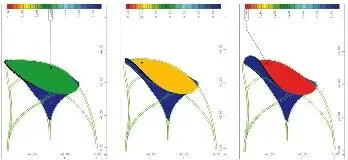
Fig. 9 Form-finding of the brow condition for M1, with various membrane pre-stress ratios (Lienhard, 2012)
Element length is a critical consideration not only for the effort of form generation but also for the construction of an architecture that relies upon continuous and integrated structural behaviour. In typical building structures the joining of elements is solved at crossing nodes or points where the momentum curve passes through zero. Though in bending active structures the beam elements pass through the nodes with continuous curvature as defined by bending stress. Adjoining elements at these moments is unfavourable. Rather, the locations of low bending curvature are targeted as the moments for adjoining elements. For the M1 this defined the location of crossing nodes and total length of elements, as shown in Fig. 10, in order to assure positioning the joints at the locations of smallest bending stress and, at the same time, maximizing individual element lengths.
Читать дальшеИнтервал:
Закладка:
Похожие книги на «Rethinking Prototyping»
Представляем Вашему вниманию похожие книги на «Rethinking Prototyping» списком для выбора. Мы отобрали схожую по названию и смыслу литературу в надежде предоставить читателям больше вариантов отыскать новые, интересные, ещё непрочитанные произведения.

Обсуждение, отзывы о книге «Rethinking Prototyping» и просто собственные мнения читателей. Оставьте ваши комментарии, напишите, что Вы думаете о произведении, его смысле или главных героях. Укажите что конкретно понравилось, а что нет, и почему Вы так считаете.