Rethinking Prototyping
Здесь есть возможность читать онлайн «Rethinking Prototyping» — ознакомительный отрывок электронной книги совершенно бесплатно, а после прочтения отрывка купить полную версию. В некоторых случаях можно слушать аудио, скачать через торрент в формате fb2 и присутствует краткое содержание. Жанр: unrecognised, на английском языке. Описание произведения, (предисловие) а так же отзывы посетителей доступны на портале библиотеки ЛибКат.
- Название:Rethinking Prototyping
- Автор:
- Жанр:
- Год:неизвестен
- ISBN:нет данных
- Рейтинг книги:3 / 5. Голосов: 1
-
Избранное:Добавить в избранное
- Отзывы:
-
Ваша оценка:
Rethinking Prototyping: краткое содержание, описание и аннотация
Предлагаем к чтению аннотацию, описание, краткое содержание или предисловие (зависит от того, что написал сам автор книги «Rethinking Prototyping»). Если вы не нашли необходимую информацию о книге — напишите в комментариях, мы постараемся отыскать её.
The Design Modelling Symposium Berlin 2013 would like to challenge the participants to reflect on the possibility of computational systems that bridge design phase and occupancy of buildings. This rethinking of the designed artifact beyond its physical has had profound effects on other industries already. How does it affect architecture and engineering?
At the scale of engineering and building systems new perspectives may open up by engaging built form as a continuous prototype, which can track and respond during use and serve as a real world implementation of its design model. This has been tried many times from intelligent façades to smart homes and networked grids but much of it was only technology driven and not approached from a more holistic design perspective.
Rethinking Prototyping — читать онлайн ознакомительный отрывок
Ниже представлен текст книги, разбитый по страницам. Система сохранения места последней прочитанной страницы, позволяет с удобством читать онлайн бесплатно книгу «Rethinking Prototyping», без необходимости каждый раз заново искать на чём Вы остановились. Поставьте закладку, и сможете в любой момент перейти на страницу, на которой закончили чтение.
Интервал:
Закладка:
In other engineering disciplines, one can see a fascinating trend where complex and large scale mechanical assemblies for mechanical control are replaced by simpler mechanics empowered by computational controls such as for instance in the case of the development of helicopters to quadcopters or windmills to autonomously flying power kites.
Architecture and engineering structures are obviously different from aerospace constructs in terms of development costs and impact on the physical environment, but similar effects may be achievable in enabling existing infrastructure and structure to operate beyond their initial design intent and capabilities. Already actuated structures responding computationally to live loads thus simpler or lighter than conventional ones are being developed and constructed. Even the average eco-building corresponds to the definition of a robot with complex control algorithms linking sensors to actuators. Imagining coordination and collaboration on a building-to-building scale as well as at the scale of cities, think of smart grids, is not inconceivable.
However fascinating, such developments implicitly entail further vulnerability to system failure. Structures losing their control capabilities may collapse; automatically-shaded Passivehaus buildings overheat and become non-liveable. Directly embedding complex computational processes in the architecture calls for a careful balance between system performance and robustness.
Actually, long-going efforts in autonomous robotics suggest achieving robustness through embedding non-digital computational capabilities in physical constructs by exploiting system dynamics and non-linearities. Control only then provides the additional performance delta that makes the system reach the prescribed efficiency. Models, meaning our abstract understanding and invention of such processes play a crucial role in the development of new ideas and increasingly so as we rely more and more on their implementations in digital form.
We hope this collection of papers presents a range of insights at the cutting edge of the fields in addressing these questions and thank all participants for their contributions.
C. Gengnagel, University of the Arts, Berlin
A. Kilian, Princeton University, Princeton
J. Nembrini, University of the Arts, Berlin
Physical and Numerical Prototyping for Integrated Bending and Form-Active Textile Hybrid Structures
Sean Ahlquist, Julian Lienhardt, Jan Knippers and Achim Menges
1 Introduction
This paper describes research for the development and implementation of a functionally and structurally intricate textile hybrid architecture, entitled M1, built in Monthoiron, France as part of the La Tour de l’Architecte complex. The term textile hybrid stands for the mutual exchange of structural action between bending- and form-active systems based on textile material behaviour. The implementation of such a structural logic is critical to this particular project as its presence is minimally impactful to the site, which houses a historically protected, and decrepit stone tower from the fifteenth century’s, as shown in Fig.1. The design by Leonardo da Vinci employed an innovative buttressing system to structure the tower without a significant foundation. The buttresses have since been scavenged from the site, though the M1 structure seeks a minimal footprint to protect areas where traces of the original buttressing structure still exist.
To explore the complexities for minimal site imposition, lightweight material deployment and spatial differentiation, a set of multi-scalar and multi-modal prototyping procedures are developed. In both physical and numerical simulation, data towards eventual full-scale implementation is cumulatively compiled and calibrated, interleaving aspects of topology, material specification, force distribution and geometry. This paper defines prototyping as the interplay between modes of design in physical form-finding, approximated simulation through spring-based methods, and finite element analysis to form, articulate and materialise the textile hybrid structure. A particular feature in the exchange between and within these modes of design is the consideration of geometric input as a critical variable in the form-finding of bending-active behaviour.
Sean Ahlquist
University of Michigan, Taubman College of Architecture and Urban Planning, Ann Arbor, USA
Julian Lienhardt, Jan Knippers
University of Stuttgart, Institute for Building Structures and Structural Design, Stuttgart, Germany
Achim Menges
University of Stuttgart, Institute for Computational Design, Stuttgart, Germany
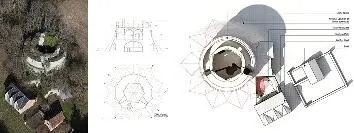
Fig. 1 Stone Tower and M1 Textile Hybrid at La Tour de l’Architecte, Monthoiron, France (Photos and drawings provided by Christian Armbruster, 2011; Ahlquist and Lienhard, 2012)
2 Multi-Hierarchical Textile Hybrid
The M1 textile hybrid project is formed via a multi-hierarchical arrangement of glass-fibre reinforced polymer (GFRP) rods of varying cross-sectional dimensions, which are structurally integrated with Polyester PVC membranes and polyamide-based textiles. The primary structure, in Fig. 2a, is formed of a series of interleaved loops emerging from only three foundations at the boundary. The meta-scale bending-active structure morphs between gridshell-like moments and free-spans stabilized by the tensile membranes. A secondary system (Fig. 2b) provides additional support through a series of interconnected cells embedded within the longest spanning region of the structure. Working to disintegrate the homogeneous nature of the textile membrane, the cells are differentiated in their form and orientation. The levels of hierarchy coalesce to form a clear span of up to eight meters with a total structure weighing only 60kg, while simultaneously generating variation in all scales of the spatial architecture.
Such articulation in behaviour and geometry is arrived at through an intricate exchange between various modes of form-finding. While the form-finding of tensile membrane structures considers stress harmoniously as an input variable, the form-finding of bending-active structures commonly results in varying stress distributions based on a comparatively large number of geometric and mechanical input variables. Therefore, the process of form-finding in the development of bending-active and, furthermore, textile hybrid structures eschews the consideration of structural optimisation. Aligning all input variables to form a functioning equilibrium, which satisfies both mechanical behaviour and contextual constraints, becomes the challenge within the form-finding processes and overall design framework. Due to this unique combination of freedom and complexity, it is shown through this research that a single computational technique alone does not offer the necessary flexibility and insight for developing textile hybrid structures. Rather, the combination and integration of multiple modes and techniques of design into a structured framework is shown to be necessary for the exploration and rationalization of complex textile hybrid structures.
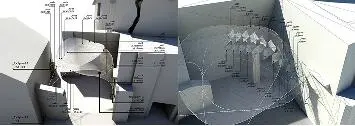
Fig. 2 Multi-hierarchical textile hybrid system (Ahlquist and Lienhard, 2012)
These modes of design, in prototyping through form-finding, include physical models, spring-based computational studies and finite element analysis. Via physical experiments, specifications of topology and approximations of geometry are derived. Through spring-based modelling, also referred to as mass-spring methods or particle systems, variation is generated in the interactions between bending resistance and tensile forces (Ahlquist et al. 2013). In finite element analysis, fixed topological arrangements are inputs for exploration of specific mechanical relationships, force equilibria and further structural investigations (Lienhard et al. 2012). Each avenue serves to advance and articulate design aspects of the textile hybrid while also establishing the degree of fidelity towards the overall design framework.
Читать дальшеИнтервал:
Закладка:
Похожие книги на «Rethinking Prototyping»
Представляем Вашему вниманию похожие книги на «Rethinking Prototyping» списком для выбора. Мы отобрали схожую по названию и смыслу литературу в надежде предоставить читателям больше вариантов отыскать новые, интересные, ещё непрочитанные произведения.

Обсуждение, отзывы о книге «Rethinking Prototyping» и просто собственные мнения читателей. Оставьте ваши комментарии, напишите, что Вы думаете о произведении, его смысле или главных героях. Укажите что конкретно понравилось, а что нет, и почему Вы так считаете.