Rethinking Prototyping
Здесь есть возможность читать онлайн «Rethinking Prototyping» — ознакомительный отрывок электронной книги совершенно бесплатно, а после прочтения отрывка купить полную версию. В некоторых случаях можно слушать аудио, скачать через торрент в формате fb2 и присутствует краткое содержание. Жанр: unrecognised, на английском языке. Описание произведения, (предисловие) а так же отзывы посетителей доступны на портале библиотеки ЛибКат.
- Название:Rethinking Prototyping
- Автор:
- Жанр:
- Год:неизвестен
- ISBN:нет данных
- Рейтинг книги:3 / 5. Голосов: 1
-
Избранное:Добавить в избранное
- Отзывы:
-
Ваша оценка:
Rethinking Prototyping: краткое содержание, описание и аннотация
Предлагаем к чтению аннотацию, описание, краткое содержание или предисловие (зависит от того, что написал сам автор книги «Rethinking Prototyping»). Если вы не нашли необходимую информацию о книге — напишите в комментариях, мы постараемся отыскать её.
The Design Modelling Symposium Berlin 2013 would like to challenge the participants to reflect on the possibility of computational systems that bridge design phase and occupancy of buildings. This rethinking of the designed artifact beyond its physical has had profound effects on other industries already. How does it affect architecture and engineering?
At the scale of engineering and building systems new perspectives may open up by engaging built form as a continuous prototype, which can track and respond during use and serve as a real world implementation of its design model. This has been tried many times from intelligent façades to smart homes and networked grids but much of it was only technology driven and not approached from a more holistic design perspective.
Rethinking Prototyping — читать онлайн ознакомительный отрывок
Ниже представлен текст книги, разбитый по страницам. Система сохранения места последней прочитанной страницы, позволяет с удобством читать онлайн бесплатно книгу «Rethinking Prototyping», без необходимости каждый раз заново искать на чём Вы остановились. Поставьте закладку, и сможете в любой момент перейти на страницу, на которой закончили чтение.
Интервал:
Закладка:
The profession of the structural engineer is relatively young - compared to other professional profiles, and above all, compared to the history of building. Since the beginning of the ninetennth century, methods of structural analysis have been established and continuously developed. The characteristics of structural analysis can be described as a reduction or de-construction of a building into parts that can be calculated and dimensioned: In order of increasing scale the typical elements are nodes, columns and beams, plates and slabs, cables and arches, frames, shells and membranes. These structural elements can be isolated from a system and are part of a common language of architects and engineers, which can be very useful under diverse aspects: they facilitate communication, and serving as prototypes for the design and construction of a building, they can also support architectural concepts.
On the other hand, thinking in structural prototypes can also mean a loss of intuition and creativity.
From the author‘s point of view, there are two approaches to the analysis and design of structures: classical structural analysis on one side, and the principles of lightweight structures on the other side. The images shown in Fig. 1 represent these two views. Galileo Galilei in the later periods of his life was dealing with mathematics and mechanics and drew this in his „Discorsi e dimonstrationi matematiche“ (Galilei 1638). His cantilever illustrates the thinking in analysable elements . Michell‘s approach in „The Limits of Economy of Material in Frame-Structures“, published in the Philosophical Magazine in 1904, represents another approach: Taking off with a force to be transmitted from A to B, the material layout within a given design space is developed. The construction of structural element is the following step. Michell‘s approach today finds applications in numerical analysis and optimisation.
New design approaches and tools in architecture and engineering contribute to blur the borders of what is architecture and what is engineering. Designers of diverse backgrounds discuss and develop new methods from design development to construction. The method of structural optimisation is a very valuable design tool for designers of all backgrounds. This can contribute extensively to establish a common language for architects and engineers: It is the common, broadly adaptable tool that brings designers of various specialisations back together. Liberating the designer from pre-defined structural elements opens up a conceptual view that can strongly influence and support the design process.
Irmgard Lochner
Biberach University of Applied Sciences, Biberach, Germany
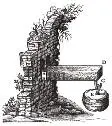
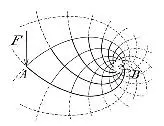
Fig. 1 Galileo Galilei‘s illustration of a cantilever (1st); Michell structure (2nd)
2 Method: Topology Optimisation Using the Homogenization Method
2.1 Structural Optimisation
Topology optimisation deals with the optimum layout of material within a given design space. When performing structural optimisation, the general formulation is the minimisation of the objective function f(x)
minimise f(x) objective function
such that the constraints are fulfilled:
g j (x)≤ 0; j=1,m g Inequality constraints
h k =0; k=1,m h Equality constraints
x i l ≤ x i ≤ x i u ; i=1,n Side constraints, upper and lower bounds
More descriptively, the optimisation goal can be described for example as
Develop a structure with minimum weight with given loadings and support conditions, with the constraint of the deflection not exceeding a given value (otherwise the optimisation algorithm would develop a structure with zero weight), or
Develop a structure with minimum compliance (maximum stiffness) with given loadings and support conditions, with the constraint of only a given ratio of the design space, the so-called volume fraction, to be filled with material - otherwise the optimisation algorithm would fill up all of the design space with material.
The Homogenization Method is a gradient based optimisation method as an addendum to the Finite Element Method , with the basic idea of subdividing the design space into small domains (pixels or voxels). The initial process of dividing the design space into areas with material and areas without material (0-1 problem) is re-formulated into a continuum problem. The optimisation problem is then to find an optimal structure described by pixels with density 1 (full material) and pixels density 0 (no material) plus intermediate values between 0 and 1 („porous“ material). The material layout generated by the optimisation algorithm is a design proposal , which can then be interpretated and futher developed by the designer.
Fig. 2 shows a high beam and an optimised structure under a point load (Ramm 1996). The basic idea is, the optimised structure shows a very homogeneous stress distribution and carries the same load with less material.
A MATLAB code for the application of the homogenization method to structural optimisation is presented in (Lochner, Schumacher 2014). The studies carried out in is contribution use the commercial software Altair OptiStruct , which also uses the homogenization method.
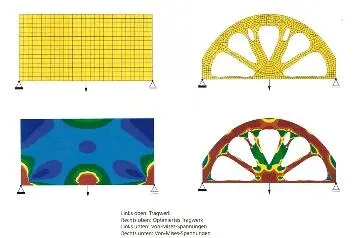
Fig. 2 Typical structure (left) and optimised structure (right) with homogenuous stress conditions
3 Shaping Structural Systems
3.1 Principles of Lightweight Structures: Descriptiveness, Deformations, Internal Forces
Frei Otto’s exclamation in 1977 „Stop building the way you build!“ is still resonating.His works are continuously published in manifold contributions.How can we apply Otto’s approaches to structural and architectural design using modern design tools?
The fundamental research of Frei Otto and his team on lightweight structures reveals basic principles about geometries in nature and building. Within given boundary conditions, structural shapes with an inherent logic are found. The approach of form-finding can be seen as a different kind of prototyping - with a clear differentiation from classical structural theory: It is not the thinking in elements but the thinking in conditions that sets up the design driver.
In structural teachings and design, this approach is very descriptive and aesthetic in a profound way. Approaching structures through thinking in deformations provides a very good understanding about how structures work and about how they can be designed. Deformations relate directly to spans; the distribution of internal forces, bending moments, principal moments or principal stresses, can be derived from a given design task in order to develop a structural geometry.
A design study based on these principles was carried out in a study at the Biberach University of Applied Sciences . The Neue Nationalgalerie in Berlin, an icon of classical modern architecture designed by Ludwig Mies van der Rohe and first opened in 1968, was taken as role model for the design task to develop a waffle slab with its geometry being derived from the support conditions of a square ground plan. The dimensions in ground plan of approximately 65m span were given as a design constraint; the layout of the waffle slab (with the built one measuring 1.80 m in height) was subject to the design. First studies show the interaction of support positions and the correspondent deformations of a continuous slab.
Читать дальшеИнтервал:
Закладка:
Похожие книги на «Rethinking Prototyping»
Представляем Вашему вниманию похожие книги на «Rethinking Prototyping» списком для выбора. Мы отобрали схожую по названию и смыслу литературу в надежде предоставить читателям больше вариантов отыскать новые, интересные, ещё непрочитанные произведения.

Обсуждение, отзывы о книге «Rethinking Prototyping» и просто собственные мнения читателей. Оставьте ваши комментарии, напишите, что Вы думаете о произведении, его смысле или главных героях. Укажите что конкретно понравилось, а что нет, и почему Вы так считаете.