Ernst Lueder - Liquid Crystal Displays
Здесь есть возможность читать онлайн «Ernst Lueder - Liquid Crystal Displays» — ознакомительный отрывок электронной книги совершенно бесплатно, а после прочтения отрывка купить полную версию. В некоторых случаях можно слушать аудио, скачать через торрент в формате fb2 и присутствует краткое содержание. Жанр: unrecognised, на английском языке. Описание произведения, (предисловие) а так же отзывы посетителей доступны на портале библиотеки ЛибКат.

- Название:Liquid Crystal Displays
- Автор:
- Жанр:
- Год:неизвестен
- ISBN:нет данных
- Рейтинг книги:4 / 5. Голосов: 1
-
Избранное:Добавить в избранное
- Отзывы:
-
Ваша оценка:
Liquid Crystal Displays: краткое содержание, описание и аннотация
Предлагаем к чтению аннотацию, описание, краткое содержание или предисловие (зависит от того, что написал сам автор книги «Liquid Crystal Displays»). Если вы не нашли необходимую информацию о книге — напишите в комментариях, мы постараемся отыскать её.
THE NEW EDITION OF THE GOLD-STANDARD IN TEACHING AND REFERENCING THE FUNDAMENTALS OF LCD TECHNOLOGIES
Liquid Crystal Displays — читать онлайн ознакомительный отрывок
Ниже представлен текст книги, разбитый по страницам. Система сохранения места последней прочитанной страницы, позволяет с удобством читать онлайн бесплатно книгу «Liquid Crystal Displays», без необходимости каждый раз заново искать на чём Вы остановились. Поставьте закладку, и сможете в любой момент перейти на страницу, на которой закончили чтение.
Интервал:
Закладка:
For a = π/2 the linearly polarized light in Figure 3.15always encounters the refractive index n ┴independent of the tilt, and hence is independent of V (curve 7 in Figure 3.16), which is of no use for a phase shifter.
3.2.5 The DAP cell or the vertically aligned cell
The cell operating with the deformation of aligned phases, called the DAP cell (Glueck, 1995), is the inverse of the Fréedericksz cell. In the field-free state the LC molecules are perpendicularly (or in other words, homeotropically) aligned to the surface of both substrates, as depicted in Figure 3.17. This cell is also called a Vertically Aligned (VA) LCD. In this situation, incoming linearly polarized light with a wave vector  in parallel to the z -axis in Figure 3.17does not encounter birefringence, and arrives at the second substrate with an unchanged state of its polarization. If the analyser is parallel to the polarizer, the full light can pass representing the normally white state. If the analyser is crossed with the polarizer, the light is blocked at the output for all wavelengths and independent of d . This is the normally black state. The cell exhibits an extremely good black state, since the blocking is again independent of λ . Further, the molecules on the orientation layer are also, contrary to the Fréedericksz cell, vertically aligned. A low black value in the denominator of the contrast in Equation (3.82)is most beneficial for a high contrast. The main attraction of the DAP cell is this extremely high contrast, reaching values of more than 500: 1.
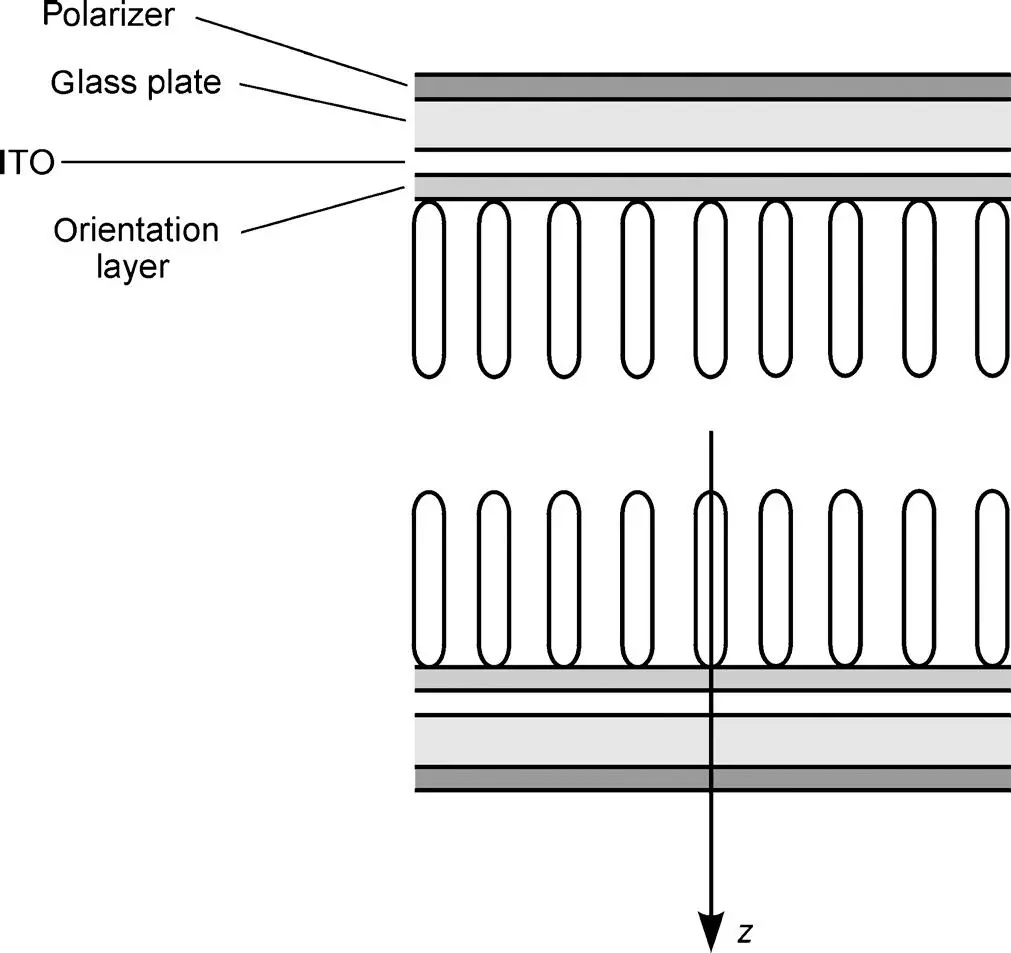
Figure 3.17 The DAP cell or Vertically Aligned (VA) cell in the field-free state
If an electrical field is applied, the LC molecules orient themselves perpendicularly to the field as Δ ε < 0. This alignment corresponds to the same alignment of the Fréedericksz cell in the field-free state. Hence, all results in Equations (3.40)through (3.87)also apply to the DAP cell, which is exposed to an electric field. The DAP cell is as well suited for phase-only modulators, as the pertinent Equations (3.90)and (3.95)also hold if a voltage V is applied. However, for the voltage-dependent refractive index n ( V ), we obtain  , but contrary to the Fréedericksz cell with n┴ for the lower voltage and n|| for the higher voltage. The homeotropic alignment of the molecules in the DAP cell requires special care. It is achieved by a spin-coated monomolecular silane-layer dissolved in ethyl alcohol, which is polymerized in the presence of humidity. The high polarity of silane thus generated anchors the polar LC molecules perpendicular to the surface. If a voltage is applied, all molecules are supposed to tilt in the same direction, since they have to end up all in parallel to each other and parallel to the plane of the substrates. This is realized by a small uniformly oriented pretilt of around 1 ° to 2° off the normal of the surface. A larger pretilt must be avoided, since it degrades the black state. The polymerized silane layer is uniformly rubbed with a carbon fibre brush to generate the grooves for the orientation of the molecules. As an alternative, this pretilted uniform orientation is produced with a very high manufacturing yield by an SiO 2layer obliquely evaporated or sputtered under an angle of 2° off the normal. This alternative also achieves a very high contrast exceeding 500: 1. The sputtering of this SiO 2layer is explained in Figure 3.18. The DAP cell is, like a Fréedericksz cell, designed as a λ/2-plate with a retardation Δ nd = λ/2, and hence d = λ/2Δ n . For most commercially available LC materials exhibiting Δ n = 0.08, this leads for λ = 550 nm to a cell thickness of d= 3.4 μ . The reflective version is a λ/4-plate with a thickness of d= 1.7 μ , which is often too thin for a high yield fabrication because small particles could easily cause shorts. The search for electro-optical effects with a larger cell thickness leads to the HAN cells and the Twisted-Nematic cells (TN-cells), which are covered in the next subsection and in Chapter 4.
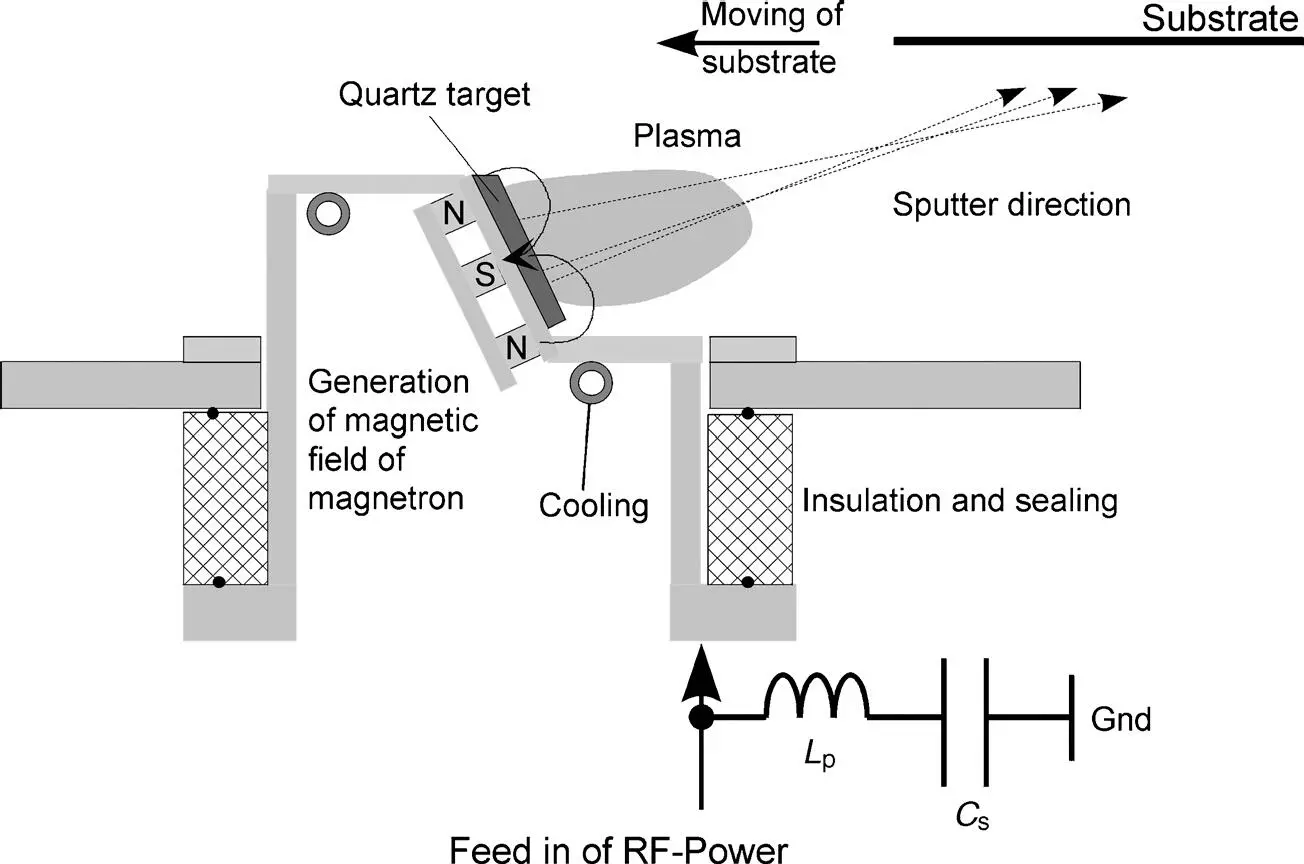
Figure 3.18 The sputtering of an SiO 2orientation layer under an oblique angle of 70°
A reflective DAP cell with a thickness d /2 can be constructed in the same way as a Fréedericksz cell.
3.2.6 The HAN cell
The Hybrid Aligned Nematic cell (HAN cell) represents a mixture between the Fréedericksz cell and the DAP cell (Glueck, 1995). We investigate the reflective version in Figure 3.19(a), because among untwisted cells they have turned out to be more important. On the plate with the polarizer the LC molecules are in the field-free state in Figure 3.19(a)oriented all in the same direction parallel to the surface of the plate like in a Fréedericksz cell, whereas on the plate with the mirror they are homeotropically oriented. The linearly polarized light enters the cell at an angle α ≠ 0 to the x -axis, as in the transmissive and reflective Fréedericksz cells. The optical anisotropy Δ п changes with z described by Δ n ( z ). At z = 0 the light wave encounters the full anisotropy Δ n , meaning that Δ n (0) = Δ n . This is only true for α ≠ 0. At z = d the light encounters no anisotropy as the medium is isotropic with a refraction index n ┴, reflecting in Δ n ( d ) = 0. Assuming a linear change of Δ n ( z ) we obtain Δ n ( z ) in Figure 3.19(b), leading to an effective retardation R of
(3.96) 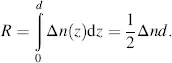
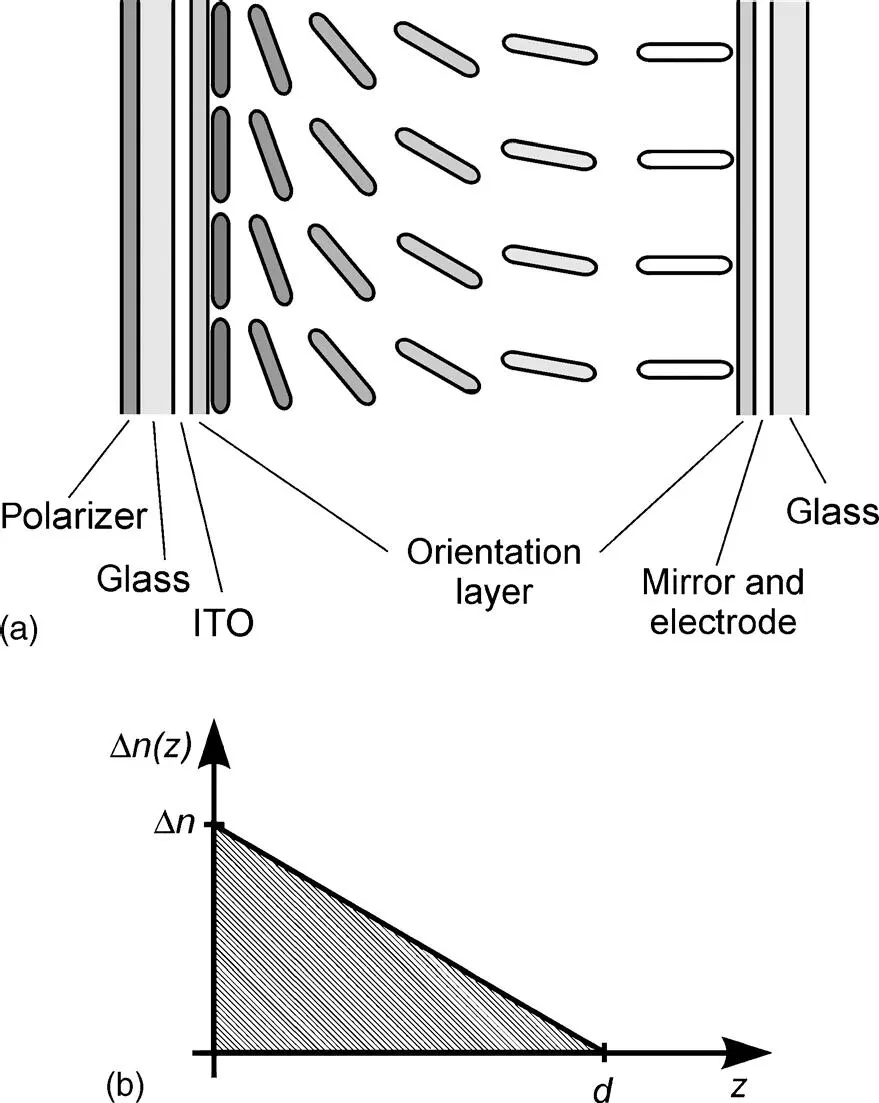
Figure 3.19 The reflective HAN cell. (a) Cross-section; (b) optical anisotropy An(z)
We know from Equations (3.45)and (3.54)that a retardation of λ /4 transforms linearly into circularly polarized light as desired at the mirror of a reflective cell. From (1/2) Δ nd = λ /4 we obtain
(3.97) 
This is twice the thickness of the reflective Fréedericksz and DAP cells, resulting in a higher fabrication yield. This advantage of the HAN cell was brought about by lowering the effective birefringence. We shall encounter the same effect again with TN cells.
The reflection of the circularly polarized light in the field-free state is depicted in Figure 3.20(a)(Glueck, 1995). After the reflection the wave reaches the polarizer rotated by 90° and is blocked. If a field is applied in Figure 3.20(b), the molecules orient themselves due to Δ ε > 0 in parallel to the field, birefringence does not take place, and the reflected wave passes the polarizer. The cell is normally black.
Читать дальшеИнтервал:
Закладка:
Похожие книги на «Liquid Crystal Displays»
Представляем Вашему вниманию похожие книги на «Liquid Crystal Displays» списком для выбора. Мы отобрали схожую по названию и смыслу литературу в надежде предоставить читателям больше вариантов отыскать новые, интересные, ещё непрочитанные произведения.












Обсуждение, отзывы о книге «Liquid Crystal Displays» и просто собственные мнения читателей. Оставьте ваши комментарии, напишите, что Вы думаете о произведении, его смысле или главных героях. Укажите что конкретно понравилось, а что нет, и почему Вы так считаете.