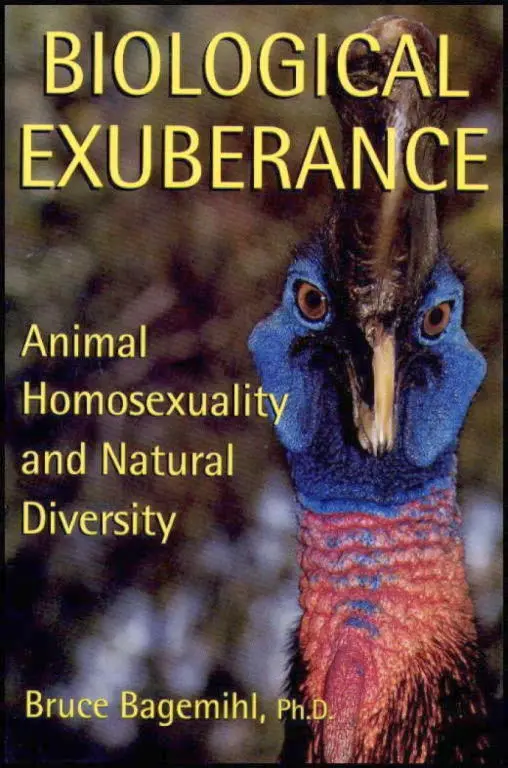
Bruce Bagemihl - Biological Exuberance
Здесь есть возможность читать онлайн «Bruce Bagemihl - Biological Exuberance» весь текст электронной книги совершенно бесплатно (целиком полную версию без сокращений). В некоторых случаях можно слушать аудио, скачать через торрент в формате fb2 и присутствует краткое содержание. Город: New York, Год выпуска: 2012, ISBN: 2012, Издательство: St. Martin's Press, Жанр: sci_zoo, на английском языке. Описание произведения, (предисловие) а так же отзывы посетителей доступны на портале библиотеки ЛибКат.
- Название:Biological Exuberance
- Автор:
- Издательство:St. Martin's Press
- Жанр:
- Год:2012
- Город:New York
- ISBN:0312192398
- Рейтинг книги:4 / 5. Голосов: 1
-
Избранное:Добавить в избранное
- Отзывы:
-
Ваша оценка:
Biological Exuberance: краткое содержание, описание и аннотация
Предлагаем к чтению аннотацию, описание, краткое содержание или предисловие (зависит от того, что написал сам автор книги «Biological Exuberance»). Если вы не нашли необходимую информацию о книге — напишите в комментариях, мы постараемся отыскать её.
Best Book One of the New York Public Library’s “25 Books to Remember” for 1999 Homosexuality in its myriad forms has been scientifically documented in more than 450 species of mammals, birds, reptiles, insects, and other animals worldwide.
is the first comprehensive account of the subject, bringing together accurate, accessible, and nonsensationalized information. Drawing upon a rich body of zoological research spanning more than two centuries, Bruce Bagemihl shows that animals engage in all types of nonreproductive sexual behavior. Sexual and gender expression in the animal world displays exuberant variety, including same-sex courtship, pair-bonding, sex, and co-parenting—even instances of lifelong homosexual bonding in species that do not have lifelong heterosexual bonding.
Part 1, “A Polysexual, Polygendered World,” begins with a survey of homosexuality, transgender, and nonreproductive heterosexuality in animals and then delves into the broader implications of these findings, including a valuable perspective on human diversity. Bagemihl also examines the hidden assumptions behind the way biologists look at natural systems and suggests a fresh perspective based on the synthesis of contemporary scientific insights with traditional knowledge from indigenous cultures.
Part 2, “A Wondrous Bestiary,” profiles more than 190 species in which scientific observers have noted homosexual or transgender behavior. Each profile is a verbal and visual “snapshot” of one or more closely related bird or mammal species, containing all the documentation required to support the author’s often controversial conclusions.
Lavishly illustrated and meticulously researched, filled with fascinating facts and astonishing descriptions of animal behavior,
is a landmark book that will change forever how we look at nature.
[May contain tables!]
Biological Exuberance — читать онлайн бесплатно полную книгу (весь текст) целиком
Ниже представлен текст книги, разбитый по страницам. Система сохранения места последней прочитанной страницы, позволяет с удобством читать онлайн бесплатно книгу «Biological Exuberance», без необходимости каждый раз заново искать на чём Вы остановились. Поставьте закладку, и сможете в любой момент перейти на страницу, на которой закончили чтение.
Интервал:
Закладка:
Frequency: Same-sex mounting probably occurs only sporadically in Vicuñas. However, heterosexual mating is also infrequent: during a seven-month study period, for example, 5–11 heterosexual matings were observed compared to one mount between females.
Orientation: At least some females that mount other females are bisexual, since this behavior occurs in pregnant females. During the time that adolescent males are living in bachelor groups, the majority of their mounting activities are same-sex. Many of these males will go on to mate heterosexually, although about 10 percent of the nonbreeding animals in male bands are adults.
About 40 percent of Vicuñas do not breed: many are younger males living in the sex-segregated male groups (although these also include some adults), and there are solitary older animals as well. Among breeding animals, there is often considerable antagonism between the sexes: males have been known to fight with pregnant females, and territorial males are openly hostile toward females from neighboring bands, often chasing and attacking them. During copulation, females sometimes refuse to lie down; a male may try to force his partner to mate by bringing his full weight onto her back, causing the female to stagger underneath him. Adult males occasionally copulate with yearling females, who are probably not old enough to breed. Sexual activity between males and females also takes place outside of the breeding season.
*asterisked references discuss homosexuality/transgender
Bosch, P. C., and G. E. Svendsen (1987) “Behavior of Male and Female Vicuna ( Vicugna vicugna Molina 1782) as It Relates to Reproductive Effort.” Journal of Mammalogy 68:425–29.
Carwardine, M. (1981) “Vicuna.” Wildlife 23:8–11.
Franklin, W. L., (1983) “Contrasting Socioecologies of South America’s Wild Camelids: The Vicuna and Guanaco.” In J. F. Eisenberg and D. G. Kleiman, eds., Advances in the Study of Mammalian Behavior, pp. 573–629. American Society of Mammalogists Special Publication no. 7. Stillwater, Okla.: American Society of Mammalogists.
———(1974) “The Social Behavior of the Vicuna.” In V. Geist and F. Walther, eds., The Behavior of Ungulates and Its Relation to Management, vol. 1, pp. 477–87. IUCN Publication no. 24. Morges, Switzerland: International Union for Conservation of Nature and Natural Resources.
Franklin, W. L., and W. Herre (1990) “South American Tylopods.” In Grzimek’s Encyclopedia of Mammals, vol. 5, pp. 96–111. New York: McGraw-Hill.
*Koford, C. B. (1957) “The Vicuna and the Puna.” Ecological Monographs 27:153–219.

IDENTIFICATION: The familiar large (up to 7½ tons), trunked mammal with enormous ears and tusks in both sexes. DISTRIBUTION: Sub-Saharan Africa; endangered. HABITAT: Varied, including forest, savanna, marsh, semidesert, mountains. STUDY AREAS: Several locations in Africa, induding Uganda and the Zambezi Valley of Zimbabwe; Kronberg Zoo, Germany; subspecies L.a. africana, the Bush Elephant, and L.a. cyclotis, the Forest Elephant.
IDENTIFICATION: Similar to African Elephant, but smaller, with tusks only in males, face and ears often mottled, forehead more convex and back more sloping, ears much smaller, and trunk with two fingerlike tips. DISTRIBUTION: India, Sri Lanka, Southeast Asia, China; endangered. HABITAT: Savanna, forest. STUDY AREAS: Periyar Tiger Reserve, Manakkavala, India; Lahugala, Sri Lanka; Pinnawala Elephant Orphanage, Sri Lanka; subspecies E.m. indicus, the Indian Elephant, and E.m. maximus, the Sri Lankan Elephant.
Elephants have a complex and highly organized community life. Females usually live in matriarchal herds of up to 50 individuals (loosely organized into family groups) led by an older female and generally containing no permanent adult males. Bulls often form male-only herds of 7–15 individuals (particularly in the African species), but may also be loners. Breeding males associate only temporarily with the female herds and mate with several different females.
Behavioral Expression: Both African and Asiatic Elephant males participate in homosexual mounting. Among African Elephants, same-sex activity—which often takes place at or in watering holes—may be preceded by a great deal of caressing and affectionate behaviors. Two males intertwine their trunks, gently nudge each other, touch mouths in a “kiss,” place their trunk tips in each other’s mouth, roll over one another, and generally frolic together (sometimes with erections). One male often signals his intention to mount by extending his trunk along the other male’s back, sometimes pushing him forward with his tusks (a gesture also used in sexual interactions between males and females). Homosexual mounting may also be preceded by one male sniffing or touching the other’s penis with the tip of his trunk. Mounting occurs in the typical heterosexual position, with one male behind the other, and often the mounting male has an erect penis. Homosexual mating lasts about the same length as heterosexual mating, generally less than a minute, although one male may mount another several times in succession. Both older bulls and younger males participate in this activity. Among Asiatic Elephants, same-sex mounting sometimes occurs as part of play-fighting, in which two males swing their trunks at each other and gently rush at and butt one another. In African Elephants living in bull herds, a form of “erotic combat” also occurs. Two males push against each other while locking tusks and intertwining trunks; this activity stimulates the males sexually, and they develop full erections over up to half a dozen such bouts. Mounting sometimes occurs following a bout.
Although female homosexual activity has not yet been observed among wild Elephants, in captivity females sometimes masturbate one another with their trunks (the female’s clitoris is nearly 17 inches long when erect or engorged). In addition, both female and male Asiatic Elephants in captivity engage in a variety of same-sex interactions with one another, including mounting activities and touching of the genitals with the trunk. Pregnant females also sometimes participate in these interactions.
Male Elephants also form “companionships,” usually composed of an older bull and an attendant younger male (in contrast, there are no long-lasting heterosexual bonds in these species). In African Elephants, the younger male often helps the older one by guarding him or pulling down branches for him; in other cases, the older bull may help a younger male (or vice versa) who is injured or suffering from blindness or paralysis. The two males are constant companions and generally isolated from other Elephants; occasionally, an older bull will have two younger attendants. Among Asiatic Elephants, such male companionships appear not to be as long-lasting as in African Elephants. Younger attendant males in African Elephants are sometimes reported to have enlarged genitalia.
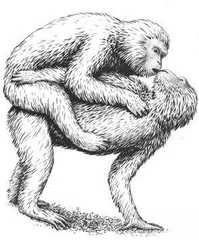
A male African Elephant mounting another male

Frequency: In wild African and Asiatic Elephants, homosexual mounting is a fairly common and regular occurrence, especially among younger bulls. In addition, Asiatic Elephant males spend an average of 10 percent of their time in play-fighting (which can also include mounting between males), while individual African Elephant bulls may participate in erotic combat up to four or five times a day during some times of the year. Approximately 18 percent of male Asiatic Elephants (not living in mixed-sex herds) have a male companion. In captivity, about 11 percent of social interactions between male Asiatic Elephants involve sexual activities, compared to approximately a quarter of social interactions between females; overall, roughly 45 percent of sexual interactions involve same-sex participants.
Читать дальшеИнтервал:
Закладка:
Похожие книги на «Biological Exuberance»
Представляем Вашему вниманию похожие книги на «Biological Exuberance» списком для выбора. Мы отобрали схожую по названию и смыслу литературу в надежде предоставить читателям больше вариантов отыскать новые, интересные, ещё непрочитанные произведения.









Обсуждение, отзывы о книге «Biological Exuberance» и просто собственные мнения читателей. Оставьте ваши комментарии, напишите, что Вы думаете о произведении, его смысле или главных героях. Укажите что конкретно понравилось, а что нет, и почему Вы так считаете.