Bruce Bagemihl - Biological Exuberance
Здесь есть возможность читать онлайн «Bruce Bagemihl - Biological Exuberance» весь текст электронной книги совершенно бесплатно (целиком полную версию без сокращений). В некоторых случаях можно слушать аудио, скачать через торрент в формате fb2 и присутствует краткое содержание. Город: New York, Год выпуска: 2012, ISBN: 2012, Издательство: St. Martin's Press, Жанр: sci_zoo, на английском языке. Описание произведения, (предисловие) а так же отзывы посетителей доступны на портале библиотеки ЛибКат.
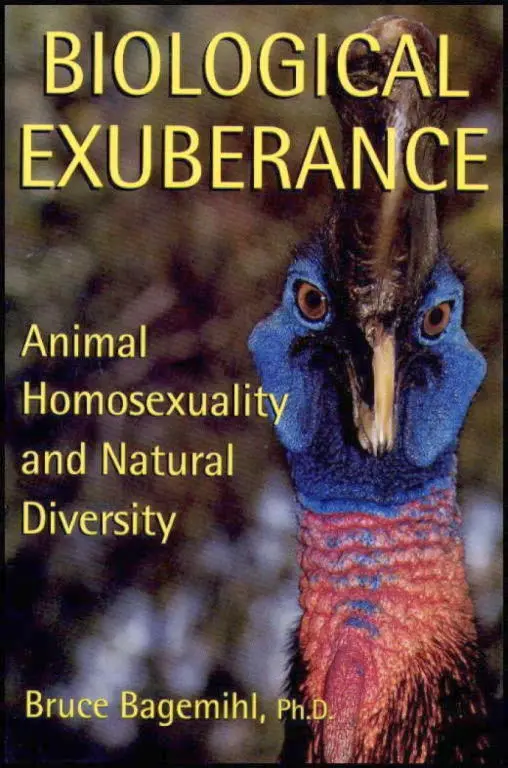
- Название:Biological Exuberance
- Автор:
- Издательство:St. Martin's Press
- Жанр:
- Год:2012
- Город:New York
- ISBN:0312192398
- Рейтинг книги:4 / 5. Голосов: 1
-
Избранное:Добавить в избранное
- Отзывы:
-
Ваша оценка:
Biological Exuberance: краткое содержание, описание и аннотация
Предлагаем к чтению аннотацию, описание, краткое содержание или предисловие (зависит от того, что написал сам автор книги «Biological Exuberance»). Если вы не нашли необходимую информацию о книге — напишите в комментариях, мы постараемся отыскать её.
Best Book One of the New York Public Library’s “25 Books to Remember” for 1999 Homosexuality in its myriad forms has been scientifically documented in more than 450 species of mammals, birds, reptiles, insects, and other animals worldwide.
is the first comprehensive account of the subject, bringing together accurate, accessible, and nonsensationalized information. Drawing upon a rich body of zoological research spanning more than two centuries, Bruce Bagemihl shows that animals engage in all types of nonreproductive sexual behavior. Sexual and gender expression in the animal world displays exuberant variety, including same-sex courtship, pair-bonding, sex, and co-parenting—even instances of lifelong homosexual bonding in species that do not have lifelong heterosexual bonding.
Part 1, “A Polysexual, Polygendered World,” begins with a survey of homosexuality, transgender, and nonreproductive heterosexuality in animals and then delves into the broader implications of these findings, including a valuable perspective on human diversity. Bagemihl also examines the hidden assumptions behind the way biologists look at natural systems and suggests a fresh perspective based on the synthesis of contemporary scientific insights with traditional knowledge from indigenous cultures.
Part 2, “A Wondrous Bestiary,” profiles more than 190 species in which scientific observers have noted homosexual or transgender behavior. Each profile is a verbal and visual “snapshot” of one or more closely related bird or mammal species, containing all the documentation required to support the author’s often controversial conclusions.
Lavishly illustrated and meticulously researched, filled with fascinating facts and astonishing descriptions of animal behavior,
is a landmark book that will change forever how we look at nature.
[May contain tables!]
Biological Exuberance — читать онлайн бесплатно полную книгу (весь текст) целиком
Ниже представлен текст книги, разбитый по страницам. Система сохранения места последней прочитанной страницы, позволяет с удобством читать онлайн бесплатно книгу «Biological Exuberance», без необходимости каждый раз заново искать на чём Вы остановились. Поставьте закладку, и сможете в любой момент перейти на страницу, на которой закончили чтение.
Интервал:
Закладка:

IDENTIFICATION: A large wild cat (up to 550 pounds) with a prominent mane in males. DISTRIBUTION: Throughout Africa and in Gujarat, northwest India; vulnerable. HABITAT: Plains, savannas, scrub, open forest. STUDY AREAS: Serengeti National Park, Tanzania; Gir Wildlife Sanctuary, India; Gay Lion Farm, California; subspecies P.I. massaieus, the Masai Lion, and P.I. persica, the Asiatic Lion.
IDENTIFICATION: A medium-sized wild cat with a sleek, greyhoundlike physique and a spotted coat DISTIBUTION-TION: Throughout Africa and sporadically in central Asia and the Middle East; vulnerable. HABITAT: Semidesert, grassland, steppes. STUDY AREAS: Serengeti National Park, Tanzania; Lion Country Safari, California; National Zoological Park, Washington, D.C.; Hogle Zoo, Utah; subspecies A.j. jubatus, the African Cheetah.
Lions have two distinct forms of social organization. Some individuals are RESIDENTS, living in prides of up to a dozen or more adult females (usually all related to one another) with their cubs, along with an associated COALITION of one to nine adult males. Other Lions are NOMADS, ranging widely as solitary individuals or pairs. Female Cheetahs are largely solitary, while males are either RESIDENTS (with their own territories) or FLOATERS (without resident territories). Some males associate in groups of two to three (occasionally four) animals, often littermates (see below). The mating system is promiscuous or polygamous: males and females gen-432 erally mate with multiple partners, no long-term heterosexual bonds are formed, and males do not typically participate in parenting.
Behavioral Expression: In female Lions, homosexual interactions are often initiated by one female pursuing another and crawling under her to encourage the other female to mount her. When mounting another female, a Lioness displays a number of behaviors also associated with heterosexual mating, including gently biting the mountee on the neck, growling, making pelvic thrusts, and rolling on her own back afterward. Sometimes Lionesses take turns mounting each other. Because most females in a pride are related to each ther—on average about as closely related as cousins—homosexual behavior among Lionesses may be largely incestuous. Among male pride-mates (residents), homosexual activity often begins with a great deal of affectionate activity (which is also a component of “greetings” interactions between males). This includes mutual head-rubbing (often accompanied by a low moaning or humming noise), presentation of the hindquarters to the other male, sliding and rubbing against each other, circling one another, and rolling on the back with an erect penis. This may lead to intense caressing and eventually mounting of one male by the other, including pelvic thrusting. Sometimes three males rub and roll together, mounting each other in turn. A male Lion sometimes courts a particular individual, keeping company with him for several days while engaging in sexual behavior. He typically defends his partner against intruding males, and often other males in the group will join him in attacking any interfering males. Because male pride-mates, like females, are usually related to each other (as close, on average, as half brothers), this activity may also be incestuous. Nomadic male Lions also form long-lasting platonic “companionships” with other males, spending nearly all of their time together; these male pair- or trio-bonds are generally stronger than heterosexual bonds between residents. Companions are usually close in age; some are pride-mates or brothers, although about half of all companionships include unrelated individuals. Females occasionally form companionships with each other as well.
Female Cheetahs sometimes court other females, including participation in courtship chases, play-fighting, and mating circles. Courtship chases take place in the early morning, late afternoon, or on moonlit nights; groups of Cheetahs—in—cluding females—chase a female in heat for up to 150 yards. This may be interspersed with mock-fighting, in which the courting animals (females or males) rise up on their hind legs and drop their forelegs on the female being courted. Females also sometimes join MATING CIRCLES, where the animals lie in a circle around the courted female, often while the males take turns fighting each other. A female Cheetah may also mount another female who is in heat, clasping her with the forelegs, gently biting the scruff of her neck (as in heterosexual copulation), and thrusting against her. Male homosexual mounting occurs as well, and one male may also mount another male that is in the act of mating with a female. During courtship interactions, males also sometimes lick and nuzzle another male’s genitals while closely following him, occasionally exhibiting an erection while doing so.
Male Cheetahs often live in permanent partnerships or COALITIONS, consisting of a pair or trio of animals; about 30 percent of these associations include animals that are not related to each other, while the remainder consist of brothers. Partners are strongly bonded to one another and probably remain together for life. Spending almost all (93 percent) of their time in each other’s company, male pair-mates frequently groom one another (licking each other’s face and neck), defend each other in fights, and prefer resting together in close contact (even if this means that one of them will not be fully shaded against the harsh midday sun). Bonded males also become strongly distressed when separated, continuously searching and calling loudly for one another with birdlike yip or chirp calls. On being reunited, they may engage in a variety of affectionate and/or sexual activities, including reciprocal mounting with erections, face-rubbing, and STUTTERING (a purrlike vocalization often associated with sexual excitement). These activities appear to be more common between siblings than nonsiblings. Very rarely, paired males may temporarily adopt or look after lost cubs (most other parents in this species—foster or otherwise—are single mothers).
Frequency: In Lions, homosexual behavior in females is fairly common in captivity, while in the wild, two Lionesses were observed to mount each other three times over two days. In males, homosexual mounting may account for up to 8 percent of all mounting episodes. About 47 percent of all companionships involving adult nomadic Lions are between males, and about 37 percent are between females. Homosexual behavior (courtship and sexual) in Cheetahs is also quite frequent (at least in captive or semiwild conditions). In the wild, 27—40 percent of males live in same-sex pairs while 16—19 percent live in same-sex trios. In one study, 1 out of 11 instances of foster-parenting involved a pair of males looking after a cub (representing perhaps less than 1 percent of all families, adoptive and nonadoptive).
Orientation: Female Lions and male Cheetahs that participate in homosexual mounting may be bisexual, since same-sex activity sometimes alternates (or co-occurs) with heterosexual mounting in the same session. Some female Lions react aggressively to homosexual overtures and therefore these individuals are probably predominantly heterosexual. However, other females engage in same-sex mounting even in the presence of males, indicating more of a “preference” for homosexual activity. Many male Cheetahs living in partnerships do court and mate with females. However, pairs or trios of males are only with females 9 percent of the time, and they may experience reduced heterosexual mating opportunities compared to single males. Moreover, same-sex coalitions usually constitute life-long pair-bonds (which are not found between males and females in this species). Only about half of all companionships of two to three male Lions ever become residents that mate with a pride of females. Those that don’t may associate exclusively with other males for most of their lives, while some that do join a pride may participate in both same-sex and opposite-sex activities.
Читать дальшеИнтервал:
Закладка:
Похожие книги на «Biological Exuberance»
Представляем Вашему вниманию похожие книги на «Biological Exuberance» списком для выбора. Мы отобрали схожую по названию и смыслу литературу в надежде предоставить читателям больше вариантов отыскать новые, интересные, ещё непрочитанные произведения.











Обсуждение, отзывы о книге «Biological Exuberance» и просто собственные мнения читателей. Оставьте ваши комментарии, напишите, что Вы думаете о произведении, его смысле или главных героях. Укажите что конкретно понравилось, а что нет, и почему Вы так считаете.