Sofia Samatar - A Stranger in Olondria
Здесь есть возможность читать онлайн «Sofia Samatar - A Stranger in Olondria» весь текст электронной книги совершенно бесплатно (целиком полную версию без сокращений). В некоторых случаях можно слушать аудио, скачать через торрент в формате fb2 и присутствует краткое содержание. Жанр: Фэнтези, на английском языке. Описание произведения, (предисловие) а так же отзывы посетителей доступны на портале библиотеки ЛибКат.
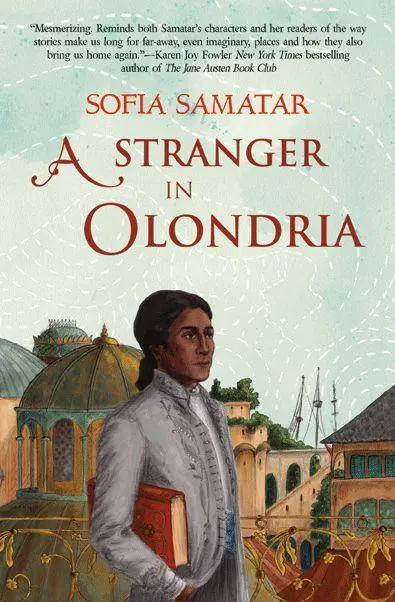
- Название:A Stranger in Olondria
- Автор:
- Жанр:
- Год:неизвестен
- ISBN:нет данных
- Рейтинг книги:5 / 5. Голосов: 1
-
Избранное:Добавить в избранное
- Отзывы:
-
Ваша оценка:
A Stranger in Olondria: краткое содержание, описание и аннотация
Предлагаем к чтению аннотацию, описание, краткое содержание или предисловие (зависит от того, что написал сам автор книги «A Stranger in Olondria»). Если вы не нашли необходимую информацию о книге — напишите в комментариях, мы постараемся отыскать её.
In desperation, Jevick seeks the aid of Olondrian priests and quickly becomes a pawn in the struggle between the empire’s two most powerful cults. Yet even as the country shimmers on the cusp of war, he must face his ghost and learn her story before he has any chance of becoming free by setting her free: an ordeal that challenges his understanding of art and life, home and exile, and the limits of that seductive necromancy, reading.
A Stranger in Olondria — читать онлайн бесплатно полную книгу (весь текст) целиком
Ниже представлен текст книги, разбитый по страницам. Система сохранения места последней прочитанной страницы, позволяет с удобством читать онлайн бесплатно книгу «A Stranger in Olondria», без необходимости каждый раз заново искать на чём Вы остановились. Поставьте закладку, и сможете в любой момент перейти на страницу, на которой закончили чтение.
Интервал:
Закладка:
All of this happened far away in the Lower Part of the earth, when it was still green land, before the fire.
And Tche and Kyomi were each alone in different parts of the forest, filled with wonder and joy and fear at everything they saw.
Now the elephant and the rain were very jealous of their creations, and their greatest worry was that these two would meet somewhere in the forest. So they held a meeting among the clouds on the top of a high mountain, and the elephant said: I do not want my Kyomi to see your Tche. For she has the sight of the gods, to which his beauty stings like a thunderclap, and if she sees him, she will surely forsake me. And the rain answered: Do not be afraid. For I have put Death itself into the third vertebra of this handsome boy. And I will tell him of it, and of its terrible potency, so that if she touches him, he will flee as if she has tried to kill him. And the elephant said: It is good. And also the girl must know that one cannot love a mortal and yet possess the sight of the gods.
Then the rain went down to the forest and found the boy sitting under a tree, where he was taking shelter, because it was raining. And she said to him: Listen, my son, what I tell you is most important. In your third vertebra you carry Death, which is waiting to catch you. You must take care that nothing touches that third vertebra of yours, especially not a woman’s hand, for it would be fatal to you!
What is a woman? asked the boy.
And the rain said: It is a creature like you, only ugly and clumsy and filled with dreadful cunning.
And the boy said: Oh! That is a terrible creature you have described! If I see one, I will run away.
And he went on with his new life, playing in the forest and in the rivers, and making boats and spears and beautiful arrows, and hunting even the flowers because he did not know any better, and sleeping on his stomach so as not to disturb Death.
And the elephant looked for Kyomi and found her down by the edge of the sea, gathering seaweed which she would cook for supper. And he said to her: Greetings, my daughter. What do you think of this sea?
And Kyomi answered with shining eyes: It is beautiful, like a long fire.
Then the elephant said: Ah! That is because you know only the gods. But if you loved a mortal man, how different it would be! Then this same sea, which is to you and me like a fire, or a great mat woven not of reeds, but of lightning, would appear to you gray and flat and even more lifeless than the mud.
How terrible! cried Kyomi. But what is a man?
That is a creature like you, the elephant said, only very ugly, with a great devouring mouth and ferocious nature.
And Kyomi said: Oh! What a terrible creature! Thank you for warning me. If I see one I will run away.
And Kyomi went on walking in the tall forests and down by the sea, gathering seaweed and drinking the dew from the flowers, happier than anyone who has ever lived after her, because she saw the world with the vision of the gods. And one afternoon she saw the boy Tche, and Tche saw her also, and they were far from the elephant and the rain. And Kyomi thought: This cannot be the man of which the elephant spoke, for he is beautiful like one of the gods. And as for Tche, he also thought, The rain did not mean this creature when she spoke of the woman who will cause me to die. And they smiled at one another and Kyomi gave the boy some seaweed and he gave her a hare which he had killed in the forest. No one knows how they came together, it might have been Ot the Deceiver who made it happen, the god in the shape of a chameleon. But they were happy, and they embraced as men and women do, hidden deep in the forest of the lost country.
And Kyomi was looking up at the sky, and suddenly it grew dark, and the trees were all blown out like a series of torches: for she had lost the sight of the gods as the elephant had foretold, and neither she nor her children would have it again. She knew it. She thought: This is the man. And weeping she drew him close, and the palm of her hand brushed over his third vertebra. And Tche cried out and thought to himself in despair: This is the woman.
Then Death leaped out and went clattering over the world.
(2)
The house my father was born in is visible from many places, but especially, on a clear day, from the sea. Lingering in your boat, at the edge of the desolate lagoon, you look up toward the lofty hills of the west. Gardens have been cut into the hillside like steps, fresh and beautiful, gardens of maize and tomatoes, guava orchards, dark green thickets of spinach and cassava, flowering patches of beans, everything tantalizing and blue in the distance. The road is a river of whiteness with small figures staggering along it, men with baskets of charcoal, donkeys with carts, and once a day the old woman coming to fill her pot in the Dyet, ringing her bell to frighten people away. The place she takes the water is there, the temple of Jabjabnot, built above a spring, straddling the cataract. It rises in plumes of mist, etched in the hill, inaccessible. It has many windows through which no one looks out.
Look up farther, along the road. There the houses begin, with their tiled roofs and pillars of carved calamander. Look at that one, the most serene, the one of the greatest elegance: that is the house in which my father was born. In the day its slatted blinds are raised to welcome the wind from the sea; the whole house is open, cool, tranquil, delicious. At night they lower the blinds, and lanterns hang from the corners of the roof, glass lamps brilliant with captive fireflies.
And here is the woman for whose sake he left that house: clumsy and startled as she paddles her boat, running aground on the mud, sometimes preferring to walk, even up to her ankles in the wet earth, because she is awkward with boats, she can’t learn to control them. And not only boats. She can’t play vyet , it’s impossible to teach her. She laughs, she waves her hands: I’m confused again! She doesn’t mind if you play, she will sit and watch you move the pieces without even the sense to feel envious or ashamed. She knows how to cook a few things, she cooks the same things over and over. Rice and peanuts, datchi in coconut milk. She talks about cooking, about a snake she saw, a baby crocodile, or nothing, she just sits there smiling wistfully.
Oh, I know she was beautiful. More than beautiful, famous, even though she was a hotun girl, without jut . There were still songs about her when I was young; there was a man who used to sing them when he rowed past our house at night. Child of the sky, beautiful night-hair, supple as a fish. Girl made of honey, disappearing in sunlight . Those were the songs they sang for my mother, full of her eyes like stars and her hair like a net to catch hearts when she walked with it loose on the wind. The only one who still sang them was that man, who was also hotun , a man older than my father with pensive eyes. I didn’t like him. But he was only one of my mother’s suitors—people said there had once been twenty of them. Oh, I believed it. Why should they lie? People in Kiem never lied for flattery’s sake. So I believed she had been a great beauty, even though to me she was this square-hipped, graceless creature with the scar on her forehead where she had once been struck with an oar in an accident. Yes, to me she was this scar, these tearful, frightened eyes, this odor of millet beginning to ferment, this hand with the fingers missing where they had been caught in a leopard trap when she was a child, this inconceivable bad luck. To me she was this terrible luck, this litany of misfortunes. And so, although I believed the tales of her beauty, I did not see how beauty alone could have drawn my father to her, to her poverty, foolishness, and constant affliction.
Читать дальшеИнтервал:
Закладка:
Похожие книги на «A Stranger in Olondria»
Представляем Вашему вниманию похожие книги на «A Stranger in Olondria» списком для выбора. Мы отобрали схожую по названию и смыслу литературу в надежде предоставить читателям больше вариантов отыскать новые, интересные, ещё непрочитанные произведения.











Обсуждение, отзывы о книге «A Stranger in Olondria» и просто собственные мнения читателей. Оставьте ваши комментарии, напишите, что Вы думаете о произведении, его смысле или главных героях. Укажите что конкретно понравилось, а что нет, и почему Вы так считаете.