Sofia Samatar - A Stranger in Olondria
Здесь есть возможность читать онлайн «Sofia Samatar - A Stranger in Olondria» весь текст электронной книги совершенно бесплатно (целиком полную версию без сокращений). В некоторых случаях можно слушать аудио, скачать через торрент в формате fb2 и присутствует краткое содержание. Жанр: Фэнтези, на английском языке. Описание произведения, (предисловие) а так же отзывы посетителей доступны на портале библиотеки ЛибКат.
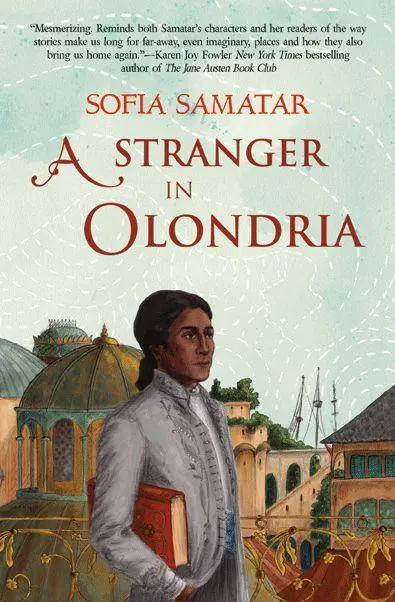
- Название:A Stranger in Olondria
- Автор:
- Жанр:
- Год:неизвестен
- ISBN:нет данных
- Рейтинг книги:5 / 5. Голосов: 1
-
Избранное:Добавить в избранное
- Отзывы:
-
Ваша оценка:
A Stranger in Olondria: краткое содержание, описание и аннотация
Предлагаем к чтению аннотацию, описание, краткое содержание или предисловие (зависит от того, что написал сам автор книги «A Stranger in Olondria»). Если вы не нашли необходимую информацию о книге — напишите в комментариях, мы постараемся отыскать её.
In desperation, Jevick seeks the aid of Olondrian priests and quickly becomes a pawn in the struggle between the empire’s two most powerful cults. Yet even as the country shimmers on the cusp of war, he must face his ghost and learn her story before he has any chance of becoming free by setting her free: an ordeal that challenges his understanding of art and life, home and exile, and the limits of that seductive necromancy, reading.
A Stranger in Olondria — читать онлайн бесплатно полную книгу (весь текст) целиком
Ниже представлен текст книги, разбитый по страницам. Система сохранения места последней прочитанной страницы, позволяет с удобством читать онлайн бесплатно книгу «A Stranger in Olondria», без необходимости каждый раз заново искать на чём Вы остановились. Поставьте закладку, и сможете в любой момент перейти на страницу, на которой закончили чтение.
Интервал:
Закладка:
Sometimes Kiem seemed as if it was always the same, unendurable. I don’t know if Tyom seemed that way too. The rain, or no rain, or mist, the rice and millet, the buffaloes up to their knees in water, the same river light, overcast, monotonous. Sometimes it seemed like a country where nothing happened, enough to make you drown yourself. I can’t stand it, I said to Ainut. And we would go searching for adventures, breathless in the heat, fighting to throw off the shroud of the long rains.
We went rowing our boats. The air was still, without wind enough to stir the reeds. We paddled slowly toward the west, for the world lay west of Kiem, and south: to the east there was nothing but ocean, inhabited by sharks, gods, and the ghosts of the drowned. We paddled beneath the beautiful blue-green hills which rose above us piled on one another like massive cloud formations, both airy and monumental, their cliffs jutting over the sea and hiding the house with the glass lanterns from our view. Below the cliffs there was a stretch of beach, sometimes littered with makeshift huts where sailors and fishermen had camped, or Tchinit the sailors’ wife, who slept in a different place every night so that the people of Kiem would not find her and burn her to death. We never saw the sailors’ wife, but once we thought we found her camp: there was a broken comb with a few long hairs. We burned these on the beach in great excitement, uttering all the most dreadful incantations we could recall or invent. Tchinit’s house was one of those, perhaps, which leaned and collapsed under the rain. And there was the house of Ipa the smith, which always seemed on the verge of disintegration but never fell, where the lonely cripple made bangles of copper wire. We rowed on. We were seeking the farthest, the most deserted beaches. Here we had once found Sedsi indigo sellers, who had given us each a square of cotton dyed the color of a bruise, and from whom we had fled, giggling, when they asked us to lie on their mats. Above these beaches there were caves in the hills, where the pirates lived. We were forbidden to go as far as this shore. There were terrible stories of the pirates, who had mouths in the palms of their hands and tails like monkeys, and lived solely on human flesh.
We rowed on. I’m tired, Ainut said. I was tired, too, but I had been waiting for her to say it first. All right, let’s go ashore, I said. We floundered into the warm sea and dragged our rowboats up onto the sand.
The beach was silent. We gathered fronds and wove them into a roof: our boats, tilted on their sides, made the walls of the house. One side was open, facing the sea. We slept and then rose, groggy with heat, and woke ourselves fully with a long swim. How sweet it was to be free, alone, with no one to call us hotun people, no one to spit in the water when we passed, nothing to remind us of our poverty, of the shame of being the children of those who were no better than animals. We grew wilder, bolder, we swam farther, tempting the sharks. Then we raced back to the shore and dashed onto the sand. We danced and sang, we made elaborate headdresses from palm fronds, we practiced fluttering our lashes at vaguely imagined boys… I don’t know how I was, but Ainut was different on the beach, with a sudden spirit of mischief and delight—she capered and said silly things that made her shriek with laughter at herself, almost horrified at her own boldness. We made dances, new ones, performing the steps exactly in unison, singing, wearing only our knotted skirts. Then we were suddenly hungry with the hunger that comes from swimming and we put on our short vests and went looking for food.
There was always food on the beach. There were coconuts and sleepy lizards, obese snails dreaming in the tide pools, and higher up there were wild bananas and datchi , although we feared the pirates in those regions, and the pariah dogs. But on this day, the day I remember, we were too giddy with happiness to think of those things, and we went up near the caves, chattering and laughing in the long grass, gathering green bananas which we would roast and season with saltwater. Ainut’s plaits were wet, and a track of salt lay on her cheek. She was baring her teeth and rolling her eyes, imitating someone. And then I saw the man and my laughter died as if forced out of me by a blow. It was all I could do to draw a breath.
He was standing near the wall of the cliff, knee-deep in the grass. He stood with his hands at his sides and looked at us. Above him there was a gaping cave mouth and a slope of rubble leading down to where he was, the man from the cave. He was dressed in rags and his hair stood up, red in color, red, horrible, stark and flagrant as if it were dipped in blood, and his eyes, worse, remembering it, his eyes seemed without any color at all, silver perhaps or the color of guava peel. Against these colors his skin looked very black. He was a painted man. Ainut followed the movement of my eyes. She stopped laughing and then I moved, my hand shot up and grasped her arm, hard, digging the nails into her flesh.
It was her weakness that made me strong. At first, when I saw the kyitna man, my instinct had been to fall, to stop breathing, to die—and perhaps, had I been alone, I would have collapsed from pure terror and they would have carried me off into their cave. But Ainut saved me, she saved us both. We looked at the man and saw a movement higher up, a shadow inside the cave, and the shadow moved into the light, its scarlet hair and beard hanging down in the dust, and Ainut screamed and screamed and went on screaming. Then the first man, the one close to us, lifted his hands and waved them as if to beckon to us, and stepped forward into the grass, and my strength came up and I yanked on Ainut’s arm and started running, dragging her, shouting at her to run, to stop screaming and run. We stumbled down the beach. The man was coming after us. Everything came back to me then, everything. My mother’s warnings, anxious, irritating, don’t go far, Jissavet, do you promise, don’t go around to the shore by the caves. I prayed to my father’s jut . If I get away I’ll listen to her, I’ll love her better, I’ll never disobey her again. Miraculously, we reached the boats. I turned and set Ainut upright and slapped her in the face as hard as I could. Get in your boat, I said. I’m leaving you. Do you hear? I’m leaving you behind.—Sobs, screams, and the bright blue sea. We thrashed into the water, climbed in the boats, hauled on the oars and pulled away, slowly, from that accursed shore.
Even when we were far out on the water, we could still see the man. He stood in the surf, tiny, waving his arms. We could still see the stain of his hair, and we spat in the ocean to clear our hearts of the sight, the impurity. The abomination.
(3)
When I was old enough I asked: Where did jut come from?
We were sitting on our pallets in the evening, the light flickering and showing our skin-maps hanging all over the walls, and my father leaned forward, his eyes dark pools, and said:
In the oldest days jut lived in the sea. All the separate janut and the whole jut , it was all there, and all one. The people faced the sea when they prayed, and they knew that something powerful lived in it, and they never teased it or insulted it. Then one day a little girl came, a girl about your size, and she said, I’m going to go and talk to jut . And the people said, It is not for human beings to talk to jut , and she said, Very well, but she knew her heart all the same. And when night came she slipped out of the house and went and stood on the cliff, and she shouted down at the sea, Jut ! Jut !—She stood there stubbornly and called to the sea as loudly as she could, Jut ! Answer me, Jut !
Читать дальшеИнтервал:
Закладка:
Похожие книги на «A Stranger in Olondria»
Представляем Вашему вниманию похожие книги на «A Stranger in Olondria» списком для выбора. Мы отобрали схожую по названию и смыслу литературу в надежде предоставить читателям больше вариантов отыскать новые, интересные, ещё непрочитанные произведения.








Обсуждение, отзывы о книге «A Stranger in Olondria» и просто собственные мнения читателей. Оставьте ваши комментарии, напишите, что Вы думаете о произведении, его смысле или главных героях. Укажите что конкретно понравилось, а что нет, и почему Вы так считаете.