Sofia Samatar - A Stranger in Olondria
Здесь есть возможность читать онлайн «Sofia Samatar - A Stranger in Olondria» весь текст электронной книги совершенно бесплатно (целиком полную версию без сокращений). В некоторых случаях можно слушать аудио, скачать через торрент в формате fb2 и присутствует краткое содержание. Жанр: Фэнтези, на английском языке. Описание произведения, (предисловие) а так же отзывы посетителей доступны на портале библиотеки ЛибКат.
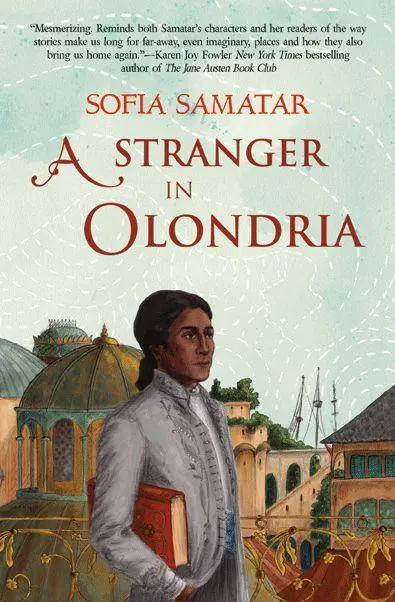
- Название:A Stranger in Olondria
- Автор:
- Жанр:
- Год:неизвестен
- ISBN:нет данных
- Рейтинг книги:5 / 5. Голосов: 1
-
Избранное:Добавить в избранное
- Отзывы:
-
Ваша оценка:
A Stranger in Olondria: краткое содержание, описание и аннотация
Предлагаем к чтению аннотацию, описание, краткое содержание или предисловие (зависит от того, что написал сам автор книги «A Stranger in Olondria»). Если вы не нашли необходимую информацию о книге — напишите в комментариях, мы постараемся отыскать её.
In desperation, Jevick seeks the aid of Olondrian priests and quickly becomes a pawn in the struggle between the empire’s two most powerful cults. Yet even as the country shimmers on the cusp of war, he must face his ghost and learn her story before he has any chance of becoming free by setting her free: an ordeal that challenges his understanding of art and life, home and exile, and the limits of that seductive necromancy, reading.
A Stranger in Olondria — читать онлайн бесплатно полную книгу (весь текст) целиком
Ниже представлен текст книги, разбитый по страницам. Система сохранения места последней прочитанной страницы, позволяет с удобством читать онлайн бесплатно книгу «A Stranger in Olondria», без необходимости каждый раз заново искать на чём Вы остановились. Поставьте закладку, и сможете в любой момент перейти на страницу, на которой закончили чтение.
Интервал:
Закладка:
And Jut answered.
I’m that girl, I think. I am like the girl who called jut . Always outside, always different from people. It’s not only that I’m different, it’s that I don’t want to be different and yet I am proud, almost proud of the difference itself. I won’t try to change. When Ainut grows up she will marry a Kiemish laborer, a poor man, but one with jut . I’ll lie with my face to the doorway, watching the wedding procession go by, already very ill, too ill to get up. At that time, the time of the wedding, I haven’t spoken to Ainut for two years, but still the procession goes by our house, that’s the way she is, she would think of me even after everything has died between us, she knows I’ll be watching her. And I am. She stands in the prow of the boat, with a necklace of marigolds, beautiful. Around her are shouts, confusion, the clashing of spears. She doesn’t turn toward me. She glides by with an averted face, remote. And then I lose sight of her in the crowd.
It comes on suddenly, the first times. I’m under the house, untying my boat. Suddenly I can’t see anything. Or what I can see is not what’s there, I see something like a swarm of flies, white and black, filling up my vision. At the same time, my head grows heavy. I lean forward, grasp the pole. Far away, through the flies, I see my hands. Just as suddenly it clears and I see my mother watching me, holding her basket. Jissi, are you all right?
It’s nothing, I say.
Then one day Ainut said: Your hair’s red.
What?
Look, right there, she said. She had turned away from the tree. She had put down her basket and was looking at me strangely as I stood holding the pole in the bright sunlight.
Look. She raised her hand, pointed. She didn’t touch my hair.
Maybe it’s papaya, I laughed, breathless. Maybe I broke one with the pole and it splashed on me.—I raised my hand and felt my hair where she pointed. It wasn’t sticky.
I don’t think it’s papaya, she said. She was always like that, thoughtful, plodding, unromantic, without invention. She looked at me with her sober eyes.
Did we break one? I asked, looking over the ground, still touching my hair gingerly.
I tried to look at my plait.
It’s too high, she said. I don’t think you can see it.
Then why did you tell me to look?—The rage was already coming over me, the desolation, the covetousness, for life, any kind of life. I touched my hair. It was as if I already knew what would happen, that we would be separated, she and I, that she would go into life, marry, have children and grow old, and I would spend a few seasons stretched in the doorway. My breath caught unnaturally, as if I were getting ready to cry.
Maybe you should go home, Ainut said.
Maybe you should mind your own business, I answered, suddenly furious. You’re so stupid. The basket’s full of ants.
I did go home, though. I went quickly, expertly through the marshes. I had always had a good hand for boats. My mother was under the house, weaving a cover for the big basket, but my father wasn’t there, his boat was gone. I pulled my boat up the slope, my hands shaking, my face hot. I was only fifteen, but still, I knew. My mind raced over my illnesses, my fevers, the times I would vomit and feel faint, and then quickly feel better again. Tati, is my hair red? I thought to myself. But I couldn’t say it. I stood there beside my boat, catching my breath. I couldn’t say it. My mother smiled; she didn’t stop weaving her basket. I couldn’t shatter her with another misfortune.
Good morning, good morning, she goes along, greeting everybody, incapable of leaving people alone, nodding to them, good morning, and they turn their backs or laugh at her, insulting, or they spit into the water. Some of them, if they are in a group, pretend to respond to her. Good morning, Hianot, Dab-Nin shouts. Her voice rings across the water, hard and flat, she’s standing in the reeds with other women, leering at us. The other women giggle. One of them raises a hand in protest, not sure she wants to participate in this, but hesitant because it’s so amusing, that stupid hotun woman panting after them like a dog. The blessing of jut! Dab-Nin shouts. The women burst out laughing, it’s too much. And to you, my mother says. Dab-Nin goes on grinning at us, my mother goes on greeting everyone, and islands of spittle float on the water.
The pestle is thudding beneath the house: it’s my mother, pounding grain. The house is full of the brown, overheated shadows of midday, and I lie in the corner under the place where the thatch is decaying, so that a pattern of tiny lights falls on my face. At first, each time the pestle strikes, I feel that it’s crushing my skull. But then my mother begins to murmur, singing. She sings only to herself so that her voice has all of its confidence and free expression of sadness, its dark color.
Little one, tender one.
The one I perceived from a distance.
Yes, the one with the quick, tart smile
and the hair pinned with white flutes.
You, fishing and bringing up baskets
of jade and glass fish.
You, scattering ribbons of light
when your laugh unrolls in the fields.
Why do you lead that nightingale
on a thread of your long hair?
Why do they say you love no one?
Why are your dawns so sad?
Is it your death which frightens you,
when it shifts underneath your heart?
Tender one, sweet little one,
orange tree, fire, and ashes.
Not until later did anyone mention the word: Olondria. But even then, in the early months of my illness, they must have considered it, they must have whispered of it in the darkness, agonized over the terrible expense. I had heard of Olondria, a land detached, fantastic, on the other side of the massive northern sea, a land of cold, of vallon , where the people were tall and colorless and spoke a language invented by the ghosts. To me it was absurdly distant, so inaccessible that it left me indifferent, unlike the bazaars of Akaneck. When my mother told me that I was to journey there, I laughed. She lowered her eyes, trembling. Don’t, she said.
I won’t cut my hair, ever. My mother notices it at last—I’ve been in the house for two days, afraid to go out. The redness spreads from the roots of my hair, as if a blood-touched egg has been cracked on the crown of my head: slowly, obscenely, like that. I say I’m not feeling well, I’m tired of boating, I give any excuse. I sit looking through our water maps, morose. Then my mother notices. She lights a candle in daylight despite the bad luck and holds it over my head, trembling.
Words pass between us. She’s quivering, reduced to grief. She presses one hand to her heart, the other gripping the rush candle. No, no, no, she says. I look at her, I’m hard-eyed, arrogant. Why not? I say, scoffing at her. I cross my arms to hide the fact that I am shaking too, I look at her with my head up, tense, defiant. She puts her fist in her mouth, bites it. Tears roll down her cheeks. I tell her: Crying won’t help anything.
But what a relief it would be to weep, throw myself into her arms, drench the front of her dress in tears, sobbing in horror, despair—to have her rock me to and fro, crooning, to let myself be broken in front of her, gathered by her, resorbed.
I do not know why such surrender seemed to me worse than death.
So, my mother trembles, staggers, weeps. She puts down the candle, she opens the pot in which we keep the tools, she brings out the old razor wrapped in cotton. She thinks we need to cut my hair, now, perhaps it will grow back normally. I refuse. She stands, aghast. The razor in her hand is like the enemy of my fate: my hair, the confirmation of destiny.
When my father comes home that night there is nothing to eat but cold datchi . My mother sits, weeping, in the corner. And I lie on my back, staring up at the slope of the thatched roof, stern, dry-eyed, with my hair in two plaits. My hair, the punishment of the gods. The pelt of the orangutan. Our house has already become the scene of a shipwreck. Fear crosses my father’s face, smoothed away at once, he puts his knapsack down and lowers the door curtain.
Читать дальшеИнтервал:
Закладка:
Похожие книги на «A Stranger in Olondria»
Представляем Вашему вниманию похожие книги на «A Stranger in Olondria» списком для выбора. Мы отобрали схожую по названию и смыслу литературу в надежде предоставить читателям больше вариантов отыскать новые, интересные, ещё непрочитанные произведения.








Обсуждение, отзывы о книге «A Stranger in Olondria» и просто собственные мнения читателей. Оставьте ваши комментарии, напишите, что Вы думаете о произведении, его смысле или главных героях. Укажите что конкретно понравилось, а что нет, и почему Вы так считаете.