Sofia Samatar - A Stranger in Olondria
Здесь есть возможность читать онлайн «Sofia Samatar - A Stranger in Olondria» весь текст электронной книги совершенно бесплатно (целиком полную версию без сокращений). В некоторых случаях можно слушать аудио, скачать через торрент в формате fb2 и присутствует краткое содержание. Жанр: Фэнтези, на английском языке. Описание произведения, (предисловие) а так же отзывы посетителей доступны на портале библиотеки ЛибКат.
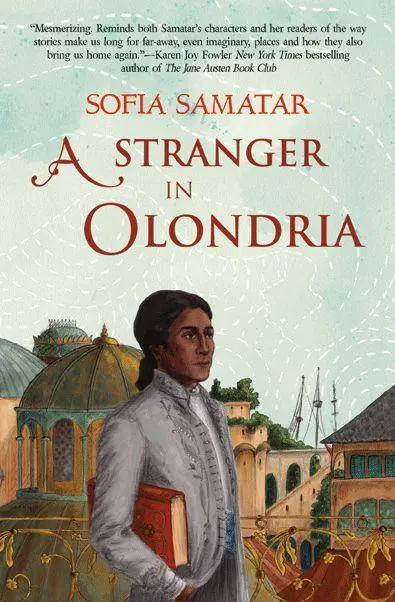
- Название:A Stranger in Olondria
- Автор:
- Жанр:
- Год:неизвестен
- ISBN:нет данных
- Рейтинг книги:5 / 5. Голосов: 1
-
Избранное:Добавить в избранное
- Отзывы:
-
Ваша оценка:
A Stranger in Olondria: краткое содержание, описание и аннотация
Предлагаем к чтению аннотацию, описание, краткое содержание или предисловие (зависит от того, что написал сам автор книги «A Stranger in Olondria»). Если вы не нашли необходимую информацию о книге — напишите в комментариях, мы постараемся отыскать её.
In desperation, Jevick seeks the aid of Olondrian priests and quickly becomes a pawn in the struggle between the empire’s two most powerful cults. Yet even as the country shimmers on the cusp of war, he must face his ghost and learn her story before he has any chance of becoming free by setting her free: an ordeal that challenges his understanding of art and life, home and exile, and the limits of that seductive necromancy, reading.
A Stranger in Olondria — читать онлайн бесплатно полную книгу (весь текст) целиком
Ниже представлен текст книги, разбитый по страницам. Система сохранения места последней прочитанной страницы, позволяет с удобством читать онлайн бесплатно книгу «A Stranger in Olondria», без необходимости каждый раз заново искать на чём Вы остановились. Поставьте закладку, и сможете в любой момент перейти на страницу, на которой закончили чтение.
Интервал:
Закладка:
Jissi, my father said. He was disappointed in me. He often said: Your mother is one of the humble. The humble are innocent; they do not need humiliation.
I rowed out to sea. I didn’t look back at them.
But now I will never row out to sea again, not alone. And I’ll never walk in the fields of millet either, hearing the wind expressing its longing amid the tall grain. And I’ll never build fires there to eat stolen fish. No, it’s over, from now on there won’t be any escape from her, her sighs, the way she squats heavily on her hams, the sloshing, sloshing sound at night as she rinses out her dress, and her odor, that smell of ancient things, of the dark. I can hear her turning over at night, sometimes snoring. She’s always tired, she sleeps in an instant, abruptly as a child. The sound of her sleep, her breathing, it’s oppressive. The house is so small, there’s no air, and I cry because I’m trapped there with her. I cry because I want my boat, I want to be out in the sunlight, I want to look at the sea again, at the mountains, it’s terrible when I can hear people talking across the water and I’m alone, never free of them and yet always alone. Yesterday, it’s always yesterday that a group of people came, people my age, and stood on the opposite bank and taunted me. Among them were Tchod and Miniki. Throw out your mother’s rags, they sang, don’t you know that eating them gives you kyitna?
In the farthest reaches of the night, Hed-hadet, the rain.
It was the beginning of the world. Hed-hadet began to swell. Bigger, bigger, as big as the mountain of Twenty Thousand Flowers, as big as the moon. No, bigger than that, as big as the ocean, bigger still, as big as the deepest night sky during the dry season. Then she burst, and the world was born in a giant shower of rain, with a great explosion of light and laughter and tears.
The sun and the moon were born then, and the pomegranate tree, and the oil-producing palm tree and the dove. The heron was born, or the thing that made the heron, and the evening star, and the bell and the drum and the thing that made the cricket. Hed-hadet gave birth to the inventor of the elephant and the inventor of the hippopotamus, and the razor and the hoe, and the datchi and the millet stalk, and the things which were to create the frog and the donkey.
Then there was a great silence. The rain stopped falling: she climbed back into the regions of the night.
All over the world, the things were looking at one another.
From the distance, chasing its dogs, came the wind.
When we met the sailors from Prav, we were climbing the rocks looking for snails. We had abandoned our boats on the beach below, and they, with their boats, were on the other side of the rocks, smoking dark cigars and making fish soup. We smelled the smoke and crept forward, lying flat on the rocks. We could look down on their heads, sleek hair, bright scarves. They all wore strips of cloth around their brows, tied on their hair behind: to collect the sweat, they explained to us later. I darted my eyes toward Ainut. No, she mouthed, shaking her head, beginning to snake backward stealthily. The sun was bright, the scent of cigar smoke acrid, overpowering. Good afternoon! I shouted down to them.
We were surprised at how fast they were on their feet, their knives unsheathed. I clung to the rocks, giddy with terror and joy. When they saw us the tension eased slowly out of their bodies and they laughed, gesturing at one another, talking in their own language. What are you doing up there? one of them called to us. Come down and eat.—Their Kideti had a smoothness, a watery quality, as if their tongues were gentler and more supple than ours. It was an accent fluid, caressing, unforgettable.
Let’s not go, Ainut whispered.
I was climbing down the rocks. You’d better be alone! shouted one of the sailors, knife held up in warning. I saw that it was a woman. She wore the same blue tunic and trousers as the two men.
We’re alone, I said. We’re just two girls. Come on, I added to Ainut, who was climbing slowly because she was trembling. One of the men took my arm and helped me jump down onto the sand, cool in the shadows. In the background the light leapt on the sea.
God of my father, the sailor said, humorously. You’re chakhet . Do you know what chakhet is?
No. What is it?
Chakhet … He waved a hand in the air as if seeking to pluck out the word. The other two were putting away their knives.
Chakhet is brave, the woman sailor said.
No, clever, said the other man.
No, no, said the one who had helped me down. He reached up a hand and helped Ainut to jump down next to me, biting his lip, his eyes narrowed in search of the word. No, chakhet … When you do something that doesn’t need to be done. When you climb a tree because it’s tall. When you swim where there are crocodiles, or answer a chief carelessly, just to prove that you can do it—that’s chakhet .
When you startle people for no reason, said the woman, picking up her cigar and blowing on it to clean off the sand. And make their cigars go out and their dinner burn…
Don’t listen to her, said the sailor who had helped us down. She was born like that.
We sat with them in the shadow of the rocks, around their fire. The odors of woodsmoke and smoke from the cigars. And from the clay pot on the fire, too, the smell of fish, peppers, and ginger cooking together, pungent, delicious. My mouth watered; it was rare to be offered such rich food. The sailors had brought the ginger and peppers with them. The one who had called me chakhet sat next to me and showed me his tin of spices, pulling it from inside his tunic. He never traveled without it. At sea, he explained, one should always put fire on the tongue, it didn’t cause thirst, that was only a rumor. The spices kept one happy, alive, they relieved the monotony. We all travel with spices on Prav, he said. While he talked, the other man, who was older, with a carved, wood-tough face, stirred the soup with a narrow twig, and the woman smoked and looked at us sardonically and smiled. She had a round face, and her breasts bulged under her tunic. The sailor with the spices asked us questions, our names, what we did in our village. I answered, and he tried to make Ainut talk. Once you begin it’s easy, he told her encouragingly, and the others laughed, and Ainut looked blank and stolid and tightened her lips. But after a time she relaxed, it was impossible to remain frightened among these sailors who were so free from care, so unruffled, with their easy laughter and indolence as they paused for a time in Kiem on their way to Dinivolim, Jennet, and Ilavet. On their way to somewhere. They told us of the black hills of Jennet, the flowers of the interior whose juice was prized by kings, and the bazaars of Akaneck where slabs of elephant meat were sold and there were golden combs, clocks, and caged dragonflies. And where is your ship? I asked. And they told us that it was up the coast in the natural harbor of Pian, among the hills, and could not believe that we had never been to Pian, never heard of it, it was so close to us, and they looked at us with pity. Poor little millet-grinders, the woman said. She watched us from the distance of her years, travel, toughness, and knowledge, with a gaze that was ironic and sage, sad and amused all at once, with her hair disarrayed by the thousand winds of the sea.
The soup was ready. They put the pot on the sand, and the older sailor unwrapped a packet of banana leaves in which there was thin maize bread. We took the bread in pieces in our fingers and dipped it into the soup. Fire on the tongue. On the sea, light flashed like a warning.
We were wonderful children, strange, vivacious, we amused them. They could not know the source of our dazzling energy, that we were intoxicated with secrets, shame, and buried unhappiness, the unspoken knowledge that we were hotun people. The attention, the approval of our elders made us delirious: we sang, we were bright-eyed, witty, impulsive, daring, we gave them everything, showed them our own beach dances, giggled and even spoke impertinently because we knew it would please them. Especially me. It was so easy to be with the sailors from Prav. I felt that I could discern every one of their wishes, and when they laughed and glanced at one another I saw that I had been right, and the thought, the power, filled me with exultation. Ainut followed me; the food and acceptance made her glow. Never could they have encountered such magical children. And wrapped in our brilliant vitality, charging it with a heady essence, was our cry: Don’t go, don’t leave us, take us with you.
Читать дальшеИнтервал:
Закладка:
Похожие книги на «A Stranger in Olondria»
Представляем Вашему вниманию похожие книги на «A Stranger in Olondria» списком для выбора. Мы отобрали схожую по названию и смыслу литературу в надежде предоставить читателям больше вариантов отыскать новые, интересные, ещё непрочитанные произведения.









Обсуждение, отзывы о книге «A Stranger in Olondria» и просто собственные мнения читателей. Оставьте ваши комментарии, напишите, что Вы думаете о произведении, его смысле или главных героях. Укажите что конкретно понравилось, а что нет, и почему Вы так считаете.