Sofia Samatar - A Stranger in Olondria
Здесь есть возможность читать онлайн «Sofia Samatar - A Stranger in Olondria» весь текст электронной книги совершенно бесплатно (целиком полную версию без сокращений). В некоторых случаях можно слушать аудио, скачать через торрент в формате fb2 и присутствует краткое содержание. Жанр: Фэнтези, на английском языке. Описание произведения, (предисловие) а так же отзывы посетителей доступны на портале библиотеки ЛибКат.
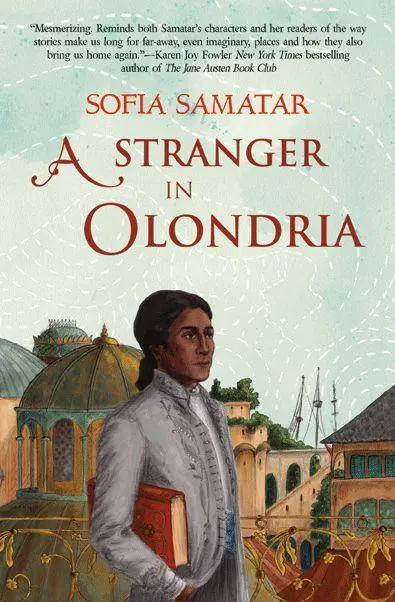
- Название:A Stranger in Olondria
- Автор:
- Жанр:
- Год:неизвестен
- ISBN:нет данных
- Рейтинг книги:5 / 5. Голосов: 1
-
Избранное:Добавить в избранное
- Отзывы:
-
Ваша оценка:
A Stranger in Olondria: краткое содержание, описание и аннотация
Предлагаем к чтению аннотацию, описание, краткое содержание или предисловие (зависит от того, что написал сам автор книги «A Stranger in Olondria»). Если вы не нашли необходимую информацию о книге — напишите в комментариях, мы постараемся отыскать её.
In desperation, Jevick seeks the aid of Olondrian priests and quickly becomes a pawn in the struggle between the empire’s two most powerful cults. Yet even as the country shimmers on the cusp of war, he must face his ghost and learn her story before he has any chance of becoming free by setting her free: an ordeal that challenges his understanding of art and life, home and exile, and the limits of that seductive necromancy, reading.
A Stranger in Olondria — читать онлайн бесплатно полную книгу (весь текст) целиком
Ниже представлен текст книги, разбитый по страницам. Система сохранения места последней прочитанной страницы, позволяет с удобством читать онлайн бесплатно книгу «A Stranger in Olondria», без необходимости каждый раз заново искать на чём Вы остановились. Поставьте закладку, и сможете в любой момент перейти на страницу, на которой закончили чтение.
Интервал:
Закладка:
Once I asked him. More than once. Why did you marry Tati? And he laughed: I’ve told that story so many times. Or else he said: That’s not a proper question for a little girl. But I would insist, and he would always give in.
Out in the waters of the lagoon he said: She was rowing her boat, and I was rowing mine in the other direction. We scraped together—our oars clacking—she nearly swiped my head with hers, frantic to get away, stuck in the canal! Well, she was so serious, and the situation so comical, that I laughed. I didn’t know anything about her. I didn’t know how poor she was, but I liked the way she laughed when I started laughing. She was so candid, so easy to please…
And in the forest, when we had paused to rest after gathering mushrooms, sitting in the cool shade, he smiled and said: Well, she had lived a different life. I liked to hear about that. I liked her voice, her quiet manner of speaking. I liked the way she cared for her mother. I thought I would like to live with them. Can’t you understand that, little frog? No? They had a happy house, peaceful, it seemed to me… There is peace in your mother, like light in a lamp.
And in the doorway at dusk, when we sat with our legs hanging over the side, watching the flickering lights from the other houses, he said: You know it was not always pleasant, living up on the hill. I know it is hard to believe. But we had sorrow. Sorrow is everywhere, of course, but on the hill we had a type which I did not want. I prefer the sorrow here.
Then you married Tati for sorrow? I asked, incredulous.
His face was still, like a tree in the shadows. I don’t know, he said.
If my father married for sorrow, then he married the right woman. Sorrow followed my mother like a lover. Her father died in his boat of a fever, his body absorbed into the river to find its way to the sea alone, to rot, to be devoured by the squids. Her brother died of a snake bite, blackening, his leg growing swollen and so pestilential in odor that he could not be kept in the house. He slept in a boat until he died, singing the songs of death and trying over and over to pluck the moon from the sky. And her sister. Her sister was last seen walking at the base of the hills. One of her sandals came to shore two days later. Her basket was found, too, her lunch still wrapped in banana leaves, but no one knew whether she had fallen or jumped.
One could reason about it. There was plenty of sorrow in Kiem, particularly among us, the hotun , the low. There was not a family who had not suffered some disaster, an accident with sharks, an attack from the pirates who lived in the caves. A fall, an encounter with crocodiles, a wound that refused to heal. Rape, madness, river blindness, kyitna . One could say that my mother was not unusual among these people, all of whom were lacerated with misfortunes.
When I was small I had everything. Mud, guavas, the smell of the sea. We stayed in our boats all day then, lacking nothing. At the fringe of the forest we gathered oranges and sometimes tyepo which we would break against a stone, seeking its cream with the tint of young leaves. We made spears and hunted eels and fish in the estuaries; we swam and wrestled, discovered shells and corals, rowed our way to the forest again, made swings out of the vines, shouted, wept, forgot everything, and laughed, and laughed. We, the hotun children. We had all been born in the Black Land, but the stigma of having no jut set us apart. The old ones who sat drinking sugarcane wine along the canal spat into the water as we passed, an accursed flotilla.
We were Tchod, Miniki, Jissavet, Ainut, Nadni, Pyev. And others: Kedi who died of the fever, Jot who died of the catarrh. These disappeared and we went on playing, not even mentioning them, feeling them only in the cold air that pressed on our backs in the forest. We made slings to kill the little birds with the colorful plumage. If we caught fish, we roasted them on green sticks. Night fell rapidly in Kiem when the sun dropped behind the hills, and the shadows rushed over the land and reached out for us.
I remember all of them. Ainut was the one I loved, because of her soft hair and sober eyes. She used to swim with me near the house. My father called us “the two frogs.” He would lower baskets of rice to us on ropes. We loved that, reaching up unsteadily from our boats, pretending that the rivers were in flood, my father shouting to us that we must be careful, pointing to the imaginary crocodiles that made us scream. Sometimes we went far away together, on expeditions to the beaches, where we made houses of palm fronds. Ainut was with me when I saw the indigo sellers from Sedso, the sailors from Prav, and the kyitna men of the caves.
When I am very sick, when it’s hard to breathe, my father sits beside me. He stays for as long as I want him, all day, all night. He sings to me, he tells me stories, he traces each one of my fingers over and over. The thumb, the pointing finger, the long one. He tells me everything he can think of, helps me sit up and lie down, invents a hundred games to deaden the pain. He lets me lie with my face toward the doorway so that I can look out and we can count the birds that go past and make up their stories. I see his face in the subtle, indoor light, a light that is delicate even in the heat of the day, moth-colored, protected. I see that he is suffering, there are lines going deeper beside his mouth, he’s aging, I can’t bear it, and I weep. Crying makes it worse. He can’t endure what’s happening to me. For his sake I stop crying, pretend it’s nothing. I smile at him and reach up to wipe the tears which have trickled into his sparse beard. I dry his face with my hair, and we laugh.
The smallest things are enough to give us hope on such long days. We discover whole worlds in the tint of the sky through the doorway. My father plays his flute; the sound is sweeter than the ripple of rain, and sometimes the rain accompanies him and shelters us under its curtain.
In the background, boiling water, carrying dishes, my mother. She walks softly so as not to disturb us. And sweeter than even the voice of the flute is the dream I have: that we live on the hill, pampered and rich, and she is only a servant.
Tell me about the hill, I demand.
He can’t refuse me anything. He sighs, plucks mournfully at the threads of his beard. Our doorway faces northwest, you can see a part of the hill from here, but not the temple and not the house with the glass firefly lanterns. I want to hear about that house, to continue the dream I’m having, the dream that smells of jasmine and makes me weep. He doesn’t want to talk about it. I force him, and I don’t care. Already I believe I deserve more from life.
He says: Imagine a large room. Much bigger than our house, five or six times bigger, with a smooth tile floor. The floor is polished twice a day, they even rub wax into it, and they rub wax into all the slats in the wooden blinds. This room is empty except for the family janut set against one wall. Yes, mine was there, on the far left. My father’s jut was decorated with hanging gold leaves, my mother’s with little bars made out of silver… Yes, now you’re getting big eyes, just like a real little frog. But what was there for us to do in that room? All alone on the hill, with nothing to look at but the sea, nothing to do but bicker, wait, and die of boredom?
Nothing he says can dismantle my dream. I sift his words in my head, choosing only those which support my fantasy, ignoring all his complaints about the boredom, his father’s tyranny, his mother’s shallowness and endless deception. I hardly notice the things he tells me with the most urgency, his brothers’ fights, the way the servants were beaten, the coldness of all the conversations meant to be subtly wounding, the ruses, lying smiles, and silken cruelty. No. I take the things I want and gather them to myself. The ladies in their gold and orange robes. Their poise as they sit on the shining floor, their skin made supple with coconut oil and wreathed in the aroma of cinnamon. Each of them has a darkened lower lip, tattooed in the manner of the Kiemish noblewomen. They are graceful, unhurried, gorgeous. The wind from the sea comes in and lifts a few strands of their plaited hair; it fills the sleeves of their robes, they are like great butterflies… I dream of them, of their beautiful plates and cups, their delicate food, the oysters and the ginger and cashew nuts, their trips to visit one another, riding in their carts festooned with marigolds, under straw umbrellas. I dream of their lanterns and even the sound of the blinds being lowered at night. The blinds can be adjusted to let in the moonlight. Now moonlight streaks the floor where a lady sits, her oiled hair shining, burning incense to drive away melancholy.
Читать дальшеИнтервал:
Закладка:
Похожие книги на «A Stranger in Olondria»
Представляем Вашему вниманию похожие книги на «A Stranger in Olondria» списком для выбора. Мы отобрали схожую по названию и смыслу литературу в надежде предоставить читателям больше вариантов отыскать новые, интересные, ещё непрочитанные произведения.









Обсуждение, отзывы о книге «A Stranger in Olondria» и просто собственные мнения читателей. Оставьте ваши комментарии, напишите, что Вы думаете о произведении, его смысле или главных героях. Укажите что конкретно понравилось, а что нет, и почему Вы так считаете.