Sofia Samatar - A Stranger in Olondria
Здесь есть возможность читать онлайн «Sofia Samatar - A Stranger in Olondria» весь текст электронной книги совершенно бесплатно (целиком полную версию без сокращений). В некоторых случаях можно слушать аудио, скачать через торрент в формате fb2 и присутствует краткое содержание. Жанр: Фэнтези, на английском языке. Описание произведения, (предисловие) а так же отзывы посетителей доступны на портале библиотеки ЛибКат.
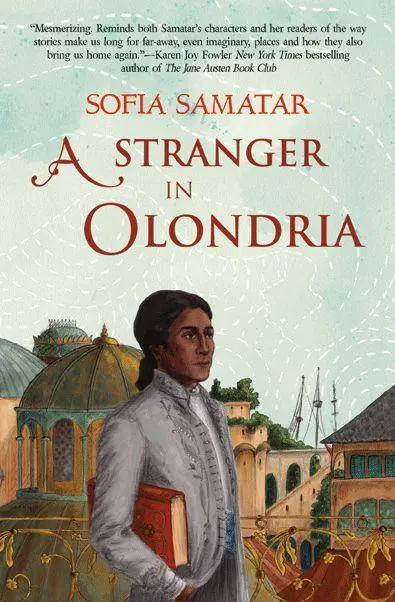
- Название:A Stranger in Olondria
- Автор:
- Жанр:
- Год:неизвестен
- ISBN:нет данных
- Рейтинг книги:5 / 5. Голосов: 1
-
Избранное:Добавить в избранное
- Отзывы:
-
Ваша оценка:
A Stranger in Olondria: краткое содержание, описание и аннотация
Предлагаем к чтению аннотацию, описание, краткое содержание или предисловие (зависит от того, что написал сам автор книги «A Stranger in Olondria»). Если вы не нашли необходимую информацию о книге — напишите в комментариях, мы постараемся отыскать её.
In desperation, Jevick seeks the aid of Olondrian priests and quickly becomes a pawn in the struggle between the empire’s two most powerful cults. Yet even as the country shimmers on the cusp of war, he must face his ghost and learn her story before he has any chance of becoming free by setting her free: an ordeal that challenges his understanding of art and life, home and exile, and the limits of that seductive necromancy, reading.
A Stranger in Olondria — читать онлайн бесплатно полную книгу (весь текст) целиком
Ниже представлен текст книги, разбитый по страницам. Система сохранения места последней прочитанной страницы, позволяет с удобством читать онлайн бесплатно книгу «A Stranger in Olondria», без необходимости каждый раз заново искать на чём Вы остановились. Поставьте закладку, и сможете в любой момент перейти на страницу, на которой закончили чтение.
Интервал:
Закладка:
She hovered above me, the red ropes of her hair almost touching my face. I thought I caught their scent: mildew and decay.
“You’ll write it?” she demanded, her face ablaze. “If I help you—you and your friend—you’ll write my vallon ?”
“Yes,” I said.
That was our bargain: a life for a life. A bargain in which we both suffered: she in the crossing over into my world, I in the crossing to hers. That night she led me through the frozen orchard and told me to dig up the fruits of the hairy vine the Kestenyi call yom afer , the “hand of the desert.” The snow numbed my fingers; the hard earth broke my nails. I clawed at the ground by starlight like a grave-robber or seeker of buried treasure. The spiny harvest stung my hands, but I soaked the roots in water that night and boiled them at dawn, and they were as soft and nourishing as cream.
She looked at Miros, too: she stepped through the curtain between the worlds and gazed at him. And she guided me out into the foothills of the Tavroun. There, in a cave dug into the hillside and hidden with dried vines, lived a Tavrouni crone with a tin ring in her lip. We shared no common language; I described my friend’s trouble with gestures. She gave me a bundle of fragrant twigs and a poultice of twisted grass. I had no way to pay her and mimed my poverty in distress, but she waved me away with the single Olondrian word: “ Avneanyi .”
And then, when I had treated Miros and he was asleep, I went upstairs to the library of Sarenha-Haladli. Squeezed in like an afterthought by the dilapidated observatory, the library had felt-covered walls and a balcony closed in latticework like a cage. The prince had built a Kestenyi collection here, only diversified by some Bainish novels and the works of Karanis of Loi, the books leaning on the shelves like broken teeth. I set my candle down on the writing desk and searched it thoroughly, scrabbling in the drawers. The thought that my light might be seen no longer frightened me: the night was so empty, so vast, reaching all the way to the mountains. I discovered a few pens, brittle as old men’s bones, a half-full bottle of ink. I chose Lantern Tales from the shelf, for its wide margins.
I sat at the desk in my jacket, dipped the pen in the ink, and steeled myself against the coming light. “I’m ready,” I said.
Yes, I called her. I asked her to come. Come, angel, I said. I called her Visible, the Ninth Wonder, Empress of Sighs. Come, I said, and I will show you magic from the north, your own words conjured into a vallon . A book, angel, a garden of spears. I will hold the pen for you, and I will weave a net to catch your voice. I will do what no one has done, I will write in Kideti, a language like you and me, a ghost hesitating between worlds. Between the rainstorms, angel, and the white light of the north. Between the river dolphins and the wolves. Between the far south, the land of elephants and amber, and this: the land of cypresses and snow.
So come. Sing to me of Kiem, speak to me of rivers. Pour your memories into my pen. Tell me your anadnedet , your life, your death story, as if you were still dying and not dead. Let me do for you what we do for those who are favored by the gods, and die slowly in the islands: let me sit beside your pallet in the firelight, and listen to the tale you long to tell. The story of a life which is revealed, after many years, to have been all along the story of a death. How one lives and goes on living, how one comes to die, under the eye of the vulture, Nedet, the goddess of ashes.
THE ANADNEDET
(1)
The angel said:
I already know about writing. We made maps: maps of the sea, of the waters between Tinimavet, Sedso, and Jiev. And maps of the rivers, the great ones, Dyet and Katapnay and Tadbati-Nut, the ones that made our country of mud on their way to the girdling sea. We made the maps on skins. First we would draw the lines with ashes and water, and later we traced them with a piece of hot iron. For many seasons our house was full of those maps, hanging on the walls, curled at the edges, dark-faced in the rushlight.
If you want to hear my anadnedet then you must begin with a map, and it must be a map of the land of Kiem. Of Kiem, the Black Land, wet and shining, the Jawbone of a Cow. I will draw a map for you like this:
There are three rivers, swollen and fed by a hundred tributaries, brown, enormous, pouring their weight to the sea. At the edge of the sea are the shimmering deltas, the dank-smelling lagoons, a landscape flat and liquid and loved by birds. To the north there are deep forests where the rivers rush in silence. To the west the coastline rises in blue hills, where there are terraced gardens and cool air, and a great temple looking down on the villages scattered in the mud.
That is one map. Here is another:
Houses standing up on stilts, skin boats tied to their poles, lying in the mud. The world is wet. There are little waterways, tracks between this house and that, and always the green light reflected up toward the sky. There is the forest, full of the jodyamu who will suck your blood unless you travel with chicken bones wrapped in banana leaves, that’s what they like, you must lay your offering down on the roots of a tree as soon as you hear them ringing their little bells in the dark. The forest, full of danger, the witches riding on their hyenas, and the souls of the dead disguised as immense fruit bats, and the bloodstained palisades of the clearing where they do the killing when there are wars, earthquakes, epidemics, storms at sea. The forest, close and solemn. And then the rivers, brown and glinting under the trees, where pregnant women go to pray, throwing their beads to Jabjabnot the hippopotamus god, with his bloated stomach and ponderous female breasts. Leave the river, paddle your boat, the great mud flats are shining and they are hunting eels, and the sky is stained with flamingoes. There you can see the old woman filling her pot at the sacred river Dyet, the pot that will strike you blind if you look into it.
That’s where we lived, in Kiem. We were hotun , the poor, without status. The others called us “people without jut .” That is what they called us when I was small, before I began to fall ill: later they called us other names, worse names. No matter what they said to us, my mother smiled at them. Her smile was uncertain, the smile of an idiot. She smiled, twisted her hands in her skirt, looked anxious, began to cry. And then she smiled again. It went on for years.
But he, my father: he was not one of us. My father had jut , and his jut was some of the strongest in southern Tinimavet. He was a nobleman, the son of a chief, a doctor of birds who had studied with two tchanavi in the hills. He could read water. He could read faces, too, and trees, thunder, owl cries, dead crickets. His hair had been silver as long as I could remember. What else can I say about him? I loved him and I still love him and I am like him, always like him, never like my mother.
When I was very small he was not with us. He was with the tchanavi . My mother used to talk to me about him. Wait until your father comes, she would say when the others teased me. Then you’re going to have jut , the best jut in the world. Who is my father? I would ask. And she: The king of the rivers. A man from the moon, a prince, a fallen star. And so I was not surprised when he put his head in at the door and I saw his silver hair and beard, like starlight or rain.
There she is, he said.—That was me he was talking about, as he smiled in the rushlight. He had been waiting to see me. He came forward into the room and I said, Look out for the grandmother, and he looked surprised and then laughed: What a quick-eyed girl!
Читать дальшеИнтервал:
Закладка:
Похожие книги на «A Stranger in Olondria»
Представляем Вашему вниманию похожие книги на «A Stranger in Olondria» списком для выбора. Мы отобрали схожую по названию и смыслу литературу в надежде предоставить читателям больше вариантов отыскать новые, интересные, ещё непрочитанные произведения.







Обсуждение, отзывы о книге «A Stranger in Olondria» и просто собственные мнения читателей. Оставьте ваши комментарии, напишите, что Вы думаете о произведении, его смысле или главных героях. Укажите что конкретно понравилось, а что нет, и почему Вы так считаете.