Sofia Samatar - A Stranger in Olondria
Здесь есть возможность читать онлайн «Sofia Samatar - A Stranger in Olondria» весь текст электронной книги совершенно бесплатно (целиком полную версию без сокращений). В некоторых случаях можно слушать аудио, скачать через торрент в формате fb2 и присутствует краткое содержание. Жанр: Фэнтези, на английском языке. Описание произведения, (предисловие) а так же отзывы посетителей доступны на портале библиотеки ЛибКат.
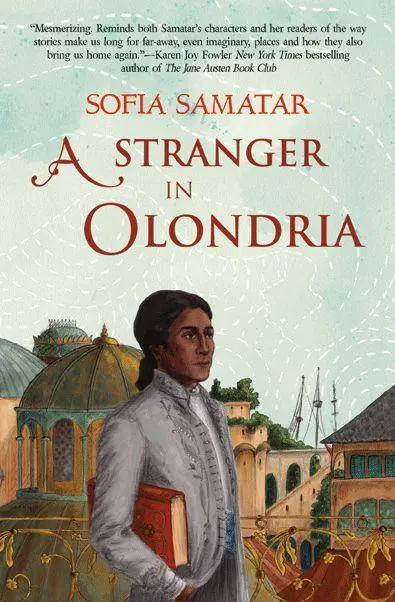
- Название:A Stranger in Olondria
- Автор:
- Жанр:
- Год:неизвестен
- ISBN:нет данных
- Рейтинг книги:5 / 5. Голосов: 1
-
Избранное:Добавить в избранное
- Отзывы:
-
Ваша оценка:
A Stranger in Olondria: краткое содержание, описание и аннотация
Предлагаем к чтению аннотацию, описание, краткое содержание или предисловие (зависит от того, что написал сам автор книги «A Stranger in Olondria»). Если вы не нашли необходимую информацию о книге — напишите в комментариях, мы постараемся отыскать её.
In desperation, Jevick seeks the aid of Olondrian priests and quickly becomes a pawn in the struggle between the empire’s two most powerful cults. Yet even as the country shimmers on the cusp of war, he must face his ghost and learn her story before he has any chance of becoming free by setting her free: an ordeal that challenges his understanding of art and life, home and exile, and the limits of that seductive necromancy, reading.
A Stranger in Olondria — читать онлайн бесплатно полную книгу (весь текст) целиком
Ниже представлен текст книги, разбитый по страницам. Система сохранения места последней прочитанной страницы, позволяет с удобством читать онлайн бесплатно книгу «A Stranger in Olondria», без необходимости каждый раз заново искать на чём Вы остановились. Поставьте закладку, и сможете в любой момент перейти на страницу, на которой закончили чтение.
Интервал:
Закладка:
I warmed my hands at the yellow blaze. There was no food in the house. The bredis , I thought reluctantly: I could boil the leather. The thought made my tortured guts writhe in my ribs. And Miros could not survive on boiled leather. He needed meat, milk, healing herbs—perhaps more. The hum of the walls in the force of the wind whose authority flattened the thorn trees kept me aware of the chilling distances outside, the endlessness of the great plateau, its vast impenitent savagery, its dreadful monotony under the wintry sky. For the first time I thought: if Auram never comes. If no one comes. I sprang up to chase the thought away and filled a blackened pot with well-water. I hung it over the fire and pulled at the damask on the walls, which came away in my hands like sheets of the finest cobweb. If no one comes . But he would come. I waited until the water boiled, soaked the damask in it, and hung it on the dead lamps to dry. The long strips fluttered in the warmth from the fire. When the water was cool I took the pail and the damask and carried them upstairs.
“Miros.”
Each time I entered the room in dread, expecting to find a corpse—but for today at least he was still alive. The door of his box bed stood open, and he turned his head toward me and smiled, and at the sight of that smile relief died in my breast. It was not Miros’s smile. It was infinitely more gentle, more withdrawn. “Good news,” I said with false cheerfulness. “No stew today.” My experimental dishes, which neither of us could swallow without gagging, had been a source of grim amusement during all our time in the house. But now he did not laugh, only smiled more tenderly than before, a smile as delicate and lifeless as the snow.
“I’m going to change your bandages,” I said in a trembling voice. “You’ll have to sit up for me. I’m sorry.”
“That’s all right,” he said.
It tore my heart to force him to change position, to pull him out of the bed, to tug the bandages where they were stuck to his body. He was as skeletal as the denuded trees in the garden. His wound, sewn up with gut, was a sullen purple, the only color on him. I poured water over it and wrapped it in lengths of tattered damask. Then I put his filthy shirt on again, and his highlander’s sheepskin jacket. I pushed him back into bed, cursing myself because I was too weak to set him down gently, and covered him up as best I could.
He was still awake. Usually he lost consciousness during my coarse attempts at nursing. His eyes were large and dark, clearer than the sky.
“Jevick,” he said. “I think I’m going to die here.”
“Nonsense,” I said with all the heartiness I could muster. “You’ll be in Sinidre next hunting season.”
He sighed. “I’ll never hunt again.”
“Of course you will.”
“No.”
He looked at me proudly, and with that new distance and coldness in his face. And everything poured out of him. He spoke of his debts and his failures, and of the woman: Baroness Ailin of Ur-Melinei.
“I am a balarin ,” he told me bitterly.
A balarin : a “sweet, free one”: the young lover of a wealthy married woman. In Sinidre he had twice fought with those who had dared to call him this name; he had blinded a man in one eye; he was fined and narrowly escaped prison. But now he admitted that it was the truth. And he was in love with her. He had realized it fully on this journey: if he could not write to her, at least know that she would remember him, he was mad; the simplest actions became unbearable.
“That’s why I fought with my uncle at the Night Market,” he said, shifting restlessly on the pillow while I knelt beside his bed. “There were letter carriers there. I wanted to send a letter west, and he wouldn’t let me. He has no pity; I don’t think there’s a nerve in his body.”
The recollection seemed to stir his blood: a touch of color came into his face. His fingers gripped the blankets with a rush of strength. And as if, having broken his reserve, he was freed from all constraint, he spoke to me of the lady of Ur-Melinei.
His position was hideous, shameful. It was the scandal of his family and the mortification of everyone who knew him. He had met her on a hunting party in the Kelevain; her husband’s property bordered on that forest. He had never seen her before. She disliked city society; her own people came from the western fringe of Olondria. She arranged an exclusive society in the country house: there were actors and musicians, hunting, dancing, and masquerades. She rode beautifully. It was whispered that she had Nissian blood. She was very fair, and black-haired like a barbarian. She was ten years older than he, she had three children who were away at school, and her husband was a diplomat of the Order of the Lamp.
It began as a mild flirtation. He was invited to Brovinhu, the baroness’s villa, and took part in her amateur theatricals. She cast him opposite herself in such tragedies as Fedmalie and The Necklace , and swooned in his arms before an intimate audience. “Alas,” she said, “thou lookest red, as if thou hast run a great distance.” And he answered: “Aye: a gulf separates this hour from the rest of my life.” Her husband sat in the front row, clapped his great, hard hands together, smoked cigars, and discussed the Balinfeil with distinguished visitors. Miros had planned to stay for a week; he stayed for the whole season, for the hunting, log fires, and dances on the terrace. And when the baron removed to Belenduri for the winter, Miros, with a few other friends, remained at Brovinhu.
They were lovers. She was the most captivating woman he had known: she eclipsed all the others, the friendly harlots, the high-strung daughters of noblemen. She was strange, sad, willful, seductive, brilliantly educated, an avowed recluse who surrounded herself with friends on her wild property. She refused to allow the grounds at Brovinhu to be cultivated; she loved the desolation of the woods. She would walk in the overgrown orchards with her two long, dove-colored hounds and hunt for coneys and pheasant in the tangled scrub of the fields. A thousand rumors encircled her: that she had been exiled from society for crushing the fan of the Duchess of Sinidre; that she feared to revive a forgotten scandal, a dead love affair, in the city; and the old story of her savage ancestry. Miros adored her too much even to ask her about these whispers, and at Brovinhu, surrounded by her friends, all excellent marksmen, all people who loved air, activity, and the wild woods, he saw the drabness of city society. Who could prefer the stuffy rooms with braziers under the tables, the compulsory visits to elderly noblewomen, to the great, dark hall at Brovinhu where one sprawled in front of the wood fire on thick carpets while the rain beat against the shutters? Who could prefer any place in the world to Ailin’s room with the high bed and the lurid Nissian hangings studded with fragments of mirror? In the mornings she would be sitting, smoking at her dressing table. She always rose before he did. Perhaps she never slept.
He spent the most glorious winter of his life, forgetting everything. And then, in the spring, she asked him to go back. “But it’s almost summer,” he said. He thought he would stay for another season. She refused: her husband was coming back, and her children, for the school holidays. He returned to Sinidre in despair and embarked on the year of torture which succeeded that brief, that paradisiacal winter: a year of secret letters, gifts, jealousy, midnight rides, meetings in parks, in village inns, in temple gardens. He often rode all the way from Sinidre to Ur-Melinei, sleeping in the long grass beside the road, only to be met in the village by her taciturn maid with the lame hip, with a note: “Impossible. Go back at once.” He was certain, by turns, that she loved him, despised him, longed for him, tired of him. He suspected her of taking another lover. He haunted the woods around Brovinhu and was almost shot by the gamekeeper, the arrow lodging in the top of his boot. When she refused to have him back for the winter, he knew she was deceiving him; but she wept and said that she was afraid of her husband: afraid for Miros’s sake. While he wished for nothing better than the chance to kill her husband honorably, in an open duel.
Читать дальшеИнтервал:
Закладка:
Похожие книги на «A Stranger in Olondria»
Представляем Вашему вниманию похожие книги на «A Stranger in Olondria» списком для выбора. Мы отобрали схожую по названию и смыслу литературу в надежде предоставить читателям больше вариантов отыскать новые, интересные, ещё непрочитанные произведения.







Обсуждение, отзывы о книге «A Stranger in Olondria» и просто собственные мнения читателей. Оставьте ваши комментарии, напишите, что Вы думаете о произведении, его смысле или главных героях. Укажите что конкретно понравилось, а что нет, и почему Вы так считаете.