Sofia Samatar - A Stranger in Olondria
Здесь есть возможность читать онлайн «Sofia Samatar - A Stranger in Olondria» весь текст электронной книги совершенно бесплатно (целиком полную версию без сокращений). В некоторых случаях можно слушать аудио, скачать через торрент в формате fb2 и присутствует краткое содержание. Жанр: Фэнтези, на английском языке. Описание произведения, (предисловие) а так же отзывы посетителей доступны на портале библиотеки ЛибКат.
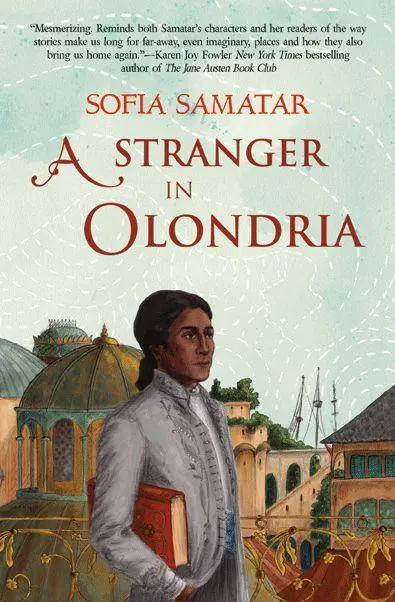
- Название:A Stranger in Olondria
- Автор:
- Жанр:
- Год:неизвестен
- ISBN:нет данных
- Рейтинг книги:5 / 5. Голосов: 1
-
Избранное:Добавить в избранное
- Отзывы:
-
Ваша оценка:
A Stranger in Olondria: краткое содержание, описание и аннотация
Предлагаем к чтению аннотацию, описание, краткое содержание или предисловие (зависит от того, что написал сам автор книги «A Stranger in Olondria»). Если вы не нашли необходимую информацию о книге — напишите в комментариях, мы постараемся отыскать её.
In desperation, Jevick seeks the aid of Olondrian priests and quickly becomes a pawn in the struggle between the empire’s two most powerful cults. Yet even as the country shimmers on the cusp of war, he must face his ghost and learn her story before he has any chance of becoming free by setting her free: an ordeal that challenges his understanding of art and life, home and exile, and the limits of that seductive necromancy, reading.
A Stranger in Olondria — читать онлайн бесплатно полную книгу (весь текст) целиком
Ниже представлен текст книги, разбитый по страницам. Система сохранения места последней прочитанной страницы, позволяет с удобством читать онлайн бесплатно книгу «A Stranger in Olondria», без необходимости каждый раз заново искать на чём Вы остановились. Поставьте закладку, и сможете в любой момент перейти на страницу, на которой закончили чтение.
Интервал:
Закладка:
You see, my mother’s mother was still alive then, wrapped up in a skin so that she wouldn’t scratch herself with her dirty nails. She was wizened, as small as a child, dried up as you would think no living creature could be, utterly shrunken and silent. You could imagine picking her up and shaking her like a gourd, the dusty organs rattling about inside her. I used to pick her up myself and row her about in my boat: me, a child of six. She was that tiny. My father stepped over her and sat with us. Eat something, eat, my mother was saying. There was datchi in coconut milk, rice, buffalo curd, a pot of my mother’s millet beer. The whole house smelled of happiness and food.
In a moment, my father said. I saw him open his pack and take something out, something reddish like clay in the light. He touched it lovingly with his slender hands, so that I knew: it was jut . He placed it gently against the wall.
I go rowing my grandmother. Her little face looks at the sky. We avoid the great canal that leads to the sea. I paddle about in the rushes, beside the green expanse of the rice, in the sunlight and the heat, the paths of dragonflies. The water is murky and brown; my grandmother’s face grows dark in the sun, even more wrinkled, but she doesn’t mind, nothing disturbs her. I sing to her:
My father is a palm,
and my mother is a jacaranda tree.
I go sailing from Ilavet to Prav
in my boat, in my little skin boat.
Kiem is known for its magic. Even you, the godless of Tyom, call on us to cure your diseases and banish your ghosts. We have powerful surgeons, doctors of leopards and doctors of crocodiles, and doctors of birds like my father, the “men of mist.” You can see them going from house to house when people are sick, stately, solemn, sitting upright in their boats, monkey skins dangling, carrying little bags sewn from the skins of frogs, their assistants wailing and ringing copper bells. They can bless musical instruments, take away warts, call down the moon. They battle the witches who ride in the forests at night. If your soul is lost, they can go to the shining land by closing their eyes and search for you, clothed in the gray plumage of herons.
At night they pass in a clamor of bells. We crouch in the doorway and watch them. Their boats ride low in the water, ringed by torchlight. Everywhere there are rustling sounds as people creep to their doors, lifting the curtains, peering down at the glow on the water. The boat stops, is moored to a post, a rope ladder descends, and they climb up into a house. It’s not our house. Now there are sighs everywhere, pitying murmurs, secret triumph. In Kiem you are always glad of another’s misfortune.
Yes, they are all like that—except my mother. She never understands; she is too stupid to learn how to behave. Her pity is real. Oh! how terrible! she says, wringing her hands, sometimes crying over the sadness of others. She cries over people we don’t even know, and worse, over people we do, that ugly Dab-Nin with her slit eyes and curling lip, who spits in the water whenever we pass and allows her son to tip my boat, watching him and laughing, not saying anything. Dab-Nin fell ill when I was thirteen, before I was ill myself. She coughed and lay on the floor with a swollen hip. And everyone sighed and was glad about it, everyone hated Dab-Nin, I’m sure it was a witch who caused her disease. And my mother wept. Oh, the poor woman. Imagine such idiocy. She would be glad if you were sick, I told her. My mother’s eyes widened, filling again with wretched tears. Her tears were her wealth, the one thing she had in abundance.
My father did not weep. He was always calm in the face of sorrow, dignified. He knew what it was to be sad. I think he was sadder than my mother, despite all of her misfortunes, because he understood more. He lacked the protection of ignorance. He could not weep at the death of a terrible woman like Dab-Nin, but somehow he was even sadder because of it, because everyone was in mourning for a creature they had all hated, because the world was foul and riddled with lies. He took me in his boat. We went down the stream from Tadbati-Nut, toward the great canal, away from the funeral, the vultures wheeling, the stench of the fire, the smoke creeping into the forest, the clanging of bells and the wailing of many voices. We went out to the sea. My father rowed to where the air was clean and we couldn’t hear the funeral anymore. The water was blue and the sun so hot that we opened our straw umbrellas and sat under them, drifting, happy on the great swells. We played vyet for a long time, and I managed to beat him once. Then we unwrapped our lunches and ate and drank. We didn’t go back until the sun was sinking and there were fires in the village, and Dab-Nin was reduced to ashes.
I know that people noticed it, our avoidance of the funeral, and that it gave them more to say against us. We were suspected of sorcery, of putting jut on people. And maybe they were right, at least about me. My father was too good to harm anyone and my mother was too stupid, but I—I was neither a saint nor a fool. I have thought about it often, wondered about it—am I a witch? Testing the thought of it in excitement and terror. In Kiem they often discovered witches who had not known their own natures, who had evil in them which acted without their knowledge, ordinary people, farmers, fishermen, grandmothers, even children, who went to be purged in the forest, screaming with fear. The doctors killed them in the clearing, killed the evil in them, destroyed their jut . When they came back they were simple and mild. They walked hesitantly and could not remember things and lived in smiling timidity until they were lost or eaten by crocodiles.
I thought about it then, for the first time: Was I a sorceress? Could I have been the one who killed Dab-Nin? Certainly I was glad she was dead, spitefully glad, exultant: it made me feel strong and happy with light and water. I was happy to be on the sea with my father for a whole day, while that horrible woman sizzled in her own fat. And later I was terrified that the doctors would find me out and take me into the forest to strip me of my power. But later still I thought: I’m not a witch, I can’t be one. Or at least I am not strong enough to do much harm. You see, had I been a witch, so many would have died in Kiem, the smoke from the funerals would have extinguished the sun.
While we were out on the water my father told me about death. I still remember his voice, his gentle gaze, the way his hair and face were patterned with light piercing through his umbrella, the way he leaned back in the boat and told this story:
The first man, who was called Tche, was the idea of the rain.
And the first woman, who was called Kyomi, was the idea of the elephant. This creator was not just an elephant, he was the inventor of the elephant, which he made as a shape to contain himself. He was his own inventor.
And the rain made the man Tche. She took her little bone-handled knife and cut his figure out of a piece of deer hide. Then she sewed it all over with pieces of coral and amber and ivory, and when she had finished, there was the most beautiful boy in the world. There has never been a boy as beautiful as the first one, though we like to say “as beautiful as Tche.” No one has since made anything so beautiful out of a deer hide. And the rain put Death into his third vertebra.
And the elephant made Kyomi. He made her with his tusk, for he never uses any other weapon. He cut her figure out of a banana leaf and sewed it all over with jade and shells, and one raven’s feather for hair. When he had finished, there was the most beautiful girl in the world, and no other girl has possessed even the tenth part of her beauty. And the elephant gave her a wonderful gift: he blew salt into her eyes, so that she had the sight of the gods, by which the world may be truly seen.
Читать дальшеИнтервал:
Закладка:
Похожие книги на «A Stranger in Olondria»
Представляем Вашему вниманию похожие книги на «A Stranger in Olondria» списком для выбора. Мы отобрали схожую по названию и смыслу литературу в надежде предоставить читателям больше вариантов отыскать новые, интересные, ещё непрочитанные произведения.







Обсуждение, отзывы о книге «A Stranger in Olondria» и просто собственные мнения читателей. Оставьте ваши комментарии, напишите, что Вы думаете о произведении, его смысле или главных героях. Укажите что конкретно понравилось, а что нет, и почему Вы так считаете.