Sofia Samatar - A Stranger in Olondria
Здесь есть возможность читать онлайн «Sofia Samatar - A Stranger in Olondria» весь текст электронной книги совершенно бесплатно (целиком полную версию без сокращений). В некоторых случаях можно слушать аудио, скачать через торрент в формате fb2 и присутствует краткое содержание. Жанр: Фэнтези, на английском языке. Описание произведения, (предисловие) а так же отзывы посетителей доступны на портале библиотеки ЛибКат.
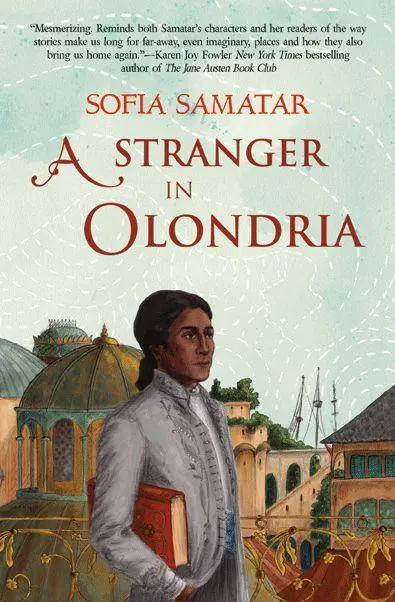
- Название:A Stranger in Olondria
- Автор:
- Жанр:
- Год:неизвестен
- ISBN:нет данных
- Рейтинг книги:5 / 5. Голосов: 1
-
Избранное:Добавить в избранное
- Отзывы:
-
Ваша оценка:
A Stranger in Olondria: краткое содержание, описание и аннотация
Предлагаем к чтению аннотацию, описание, краткое содержание или предисловие (зависит от того, что написал сам автор книги «A Stranger in Olondria»). Если вы не нашли необходимую информацию о книге — напишите в комментариях, мы постараемся отыскать её.
In desperation, Jevick seeks the aid of Olondrian priests and quickly becomes a pawn in the struggle between the empire’s two most powerful cults. Yet even as the country shimmers on the cusp of war, he must face his ghost and learn her story before he has any chance of becoming free by setting her free: an ordeal that challenges his understanding of art and life, home and exile, and the limits of that seductive necromancy, reading.
A Stranger in Olondria — читать онлайн бесплатно полную книгу (весь текст) целиком
Ниже представлен текст книги, разбитый по страницам. Система сохранения места последней прочитанной страницы, позволяет с удобством читать онлайн бесплатно книгу «A Stranger in Olondria», без необходимости каждый раз заново искать на чём Вы остановились. Поставьте закладку, и сможете в любой момент перейти на страницу, на которой закончили чтение.
Интервал:
Закладка:
“You would kill him,” she said angrily. “You, an unaccomplished boy, would kill a lord of the Order of the Lamp?”
Miros departed in rage. And then, breaking every rule she had set herself, she came, disguised, to see him in Sinidre.
They had two days. They lived secretly by the docks, in the Kalak quarter, among vendors of raw fish and green tea laden with salt, in the shabby wood houses with nets hung up in the doorways, the shrieking of hungry gulls, the sound of Kalak being spoken everywhere. At the end she looked at him, deadly pale, and said: “Very well. Kill him.” It was all that he had asked for. He was ready to kill, or to die. But other forces opposed him: when he appeared at home he was summoned immediately to a radmakanid —a family council.
By this time the scandal had reached dangerous proportions. Anonymous letters had been received by his father and his uncles; even his great-uncle the Priest of Avalei had received one on the Isle, and had arrived in Sinidre in a fierce temper. Everyone Miros loved and respected most was there in the spacious sitting room with the polished wood floor, the tall harp in the corner, the room adjoining his mother’s latticed garden. They had drawn the curtains and lit only one of the lamps, for the priest liked his surroundings dim. Miros’s mother was there, twisting her overskirt in her fine hands, and her brothers, his four successful, strong-willed uncles; her sister, his aunt, who, he thought, looked at him with some sympathy; and his father, and Miros’s three brothers and one elder sister. In accordance with Olondrian tradition, it was his maternal uncles and not his father who headed the radmakanid , for Miros belonged to their House and would inherit through his mother’s family. Chief among them, the eldest and most powerful, was the High Priest. Miros sat quietly before them, his face lashed by their accusations as if by blows, and watched his brothers irritably examining their boots. He was given a choice: enter his great-uncle’s service, or join the army. He chose the army, even though soldiers were barred from fighting duels. “I want to be sent far away,” he sobbed, later, to his mother. “To go to the Lelevai, to the Brogyar country…” First, however, he had to complete the training in Sinidre, and he could not stop himself from writing to the baroness. He received a brief, constrained note in which she forbade him to write to her or come to Ur-Melinei, which showed him that she had been threatened. He was certain that his family had warned her, coerced her. He wrote again; her next note swore that it was her own will. And now he entered a terrible time of drinking, brawls, and gambling which resulted in his rejection from the army.
After this there was a year of almost suicidal despair. He drank in his bedroom, spent whole days asleep. And finally the woods called to him, and his horses, and his old friends, other young men, light-hearted, simple, and frivolous. He hunted in the Kelevain, riding closer and closer to Brovinhu. He dreamt he would meet her in the forest. His behavior was marked; the radmakanid met for a second time, and he was commanded to join his uncle on the Isle.
Somehow she heard of it. She wrote him a single letter, not long, but it was in her own voice, and he carried it with him still. She said she was glad he was going away; she missed him; there was no hunting at Brovinhu. She had been ill and was convalescent. The letter tore him from end to end with passion, elation, and grief; in this state he went out to drink the bars of Sinidre. There he blinded a man who mocked him, calling him a balarin . Only his uncle’s influence saved him from prison.
“You can’t imagine,” he went on in a hoarse voice, “what she is like. The fact that she has been ill… She is not like me. My brothers laugh, they say she is too sophisticated for me, that I can’t possibly keep pace with such a woman. Perhaps they are right. But I believe that she did—that she does love me. Perhaps it was for my sake that she fell ill! As I said, she is nothing like me, her emotions are finer, more turbulent, she doesn’t forget anything, she could never forget her sorrow… But I—I am of coarser stuff. I have told you of my unhappiness, but I have left out all my nights at the londo tables, the way I could vow to kill myself in the morning and be singing vanadiel and laughing in a tavern by dusk. I am fickle… my emotions have, I think, no real depth… But hers! She is worth a hundred, a thousand of me. Strangely, this is the one point on which all of us—my brothers, my uncles, myself—on which all of us are agreed.”
His hand relaxed on the blanket. A faint smile touched his lips. The light was fading, the sun sinking into the desert. We sat for a time in silence, and then he sang, very softly, a few lines of a comic song I had heard in Bain:
The balarin, the balarin,
What has he done with his boots?
Oh, they’re under my lady’s bed,
What shall we do?
I had heard the song pouring out of a café, rowdily sung to bawdy laughter and the clashing of cutlery. But Miros sang it lightly, tenderly, in a pensive, faltering voice that broke away at last and was lost in the night.
When it was over, he looked at me. “I’ll never hunt again. Even if I live. I’ll fight for Avalei as I have never fought before. People say the prince is conspiring against his father the Telkan. Some even say he’s preparing an army in secret.”
I hushed him, touching his brow, but he pushed my hand away.
“I hope it’s true. I hope I live. I’ll join him. I will have vengeance for the Night Market.
“If I can’t see Ailin again, I’ll be as I should have been when she was mine. Someone who doesn’t forget. Who keeps faith.”
His sentences dissolved, and soon he was raving. I tried to cool his face with pieces of wet damask: the rotting stuff dropped in his hair. I caught his flailing arms, held him, begged him to be still. At last he stopped fighting and lay with his eyes wide open, moonlight in his tears. I sat with him until he was safely asleep, and then I closed the heavy door of his box bed against the cold. I went to the next room, the one where I slept, a place of despair like all the others, stale as a charnel house.
“Jissavet,” I said.
“Jissavet.”
She bloomed in the dark chamber, illuminating the walls. But she could not see them. It was clear to me now that she could see nothing but me. A crushing and changeless fidelity, like a perfect love affair or the dark, single-minded devotion of a saint.
“Jissavet,” I whispered.
She stretched out her hands. She was going to speak, to return to the tales of her past, those disembodied memories. But this time I could not listen. There was no time. “Stop,” I said. “Jissavet. Listen to me. I need your help. I must have food and medicine.”
“Listen to you ! I do not listen to you.”
Her face affronted, steel in a thunderstorm. Olondrian poets speak of the deadly potency of a woman’s frown, but I know what a frown can do, the lowering of a delicate eyebrow, the twist of a lip.
“Don’t do this to me,” I screamed. “I’m dying.”
The light dimmed about me, a shuttered lamp. On my hands and knees I retched, bringing up water and a little bile on the carpet.
“Dying!” she said.
“Yes,” I coughed. “I’m dying. We’re dying. We’re starving. My friend is ill. I need medicine and food.”
“I won’t go back, I told you!”
“Don’t!” I groveled on the floor, a skewered songbird. “Don’t, Jissavet… You’ll kill me, and no one will write your vallon… ”
Again the light dimmed. I had no strength to rise and lay where I had fallen, rolling onto my back to look at her.
Читать дальшеИнтервал:
Закладка:
Похожие книги на «A Stranger in Olondria»
Представляем Вашему вниманию похожие книги на «A Stranger in Olondria» списком для выбора. Мы отобрали схожую по названию и смыслу литературу в надежде предоставить читателям больше вариантов отыскать новые, интересные, ещё непрочитанные произведения.









Обсуждение, отзывы о книге «A Stranger in Olondria» и просто собственные мнения читателей. Оставьте ваши комментарии, напишите, что Вы думаете о произведении, его смысле или главных героях. Укажите что конкретно понравилось, а что нет, и почему Вы так считаете.