Robert Reed - Marrow
Здесь есть возможность читать онлайн «Robert Reed - Marrow» весь текст электронной книги совершенно бесплатно (целиком полную версию без сокращений). В некоторых случаях можно слушать аудио, скачать через торрент в формате fb2 и присутствует краткое содержание. Год выпуска: 2000, ISBN: 2000, Издательство: Tor Books, Жанр: Фантастика и фэнтези, на английском языке. Описание произведения, (предисловие) а так же отзывы посетителей доступны на портале библиотеки ЛибКат.
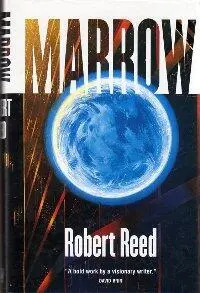
- Название:Marrow
- Автор:
- Издательство:Tor Books
- Жанр:
- Год:2000
- ISBN:0-312-86801-4
- Рейтинг книги:5 / 5. Голосов: 1
-
Избранное:Добавить в избранное
- Отзывы:
-
Ваша оценка:
Marrow: краткое содержание, описание и аннотация
Предлагаем к чтению аннотацию, описание, краткое содержание или предисловие (зависит от того, что написал сам автор книги «Marrow»). Если вы не нашли необходимую информацию о книге — напишите в комментариях, мы постараемся отыскать её.
Marrow — читать онлайн бесплатно полную книгу (весь текст) целиком
Ниже представлен текст книги, разбитый по страницам. Система сохранения места последней прочитанной страницы, позволяет с удобством читать онлайн бесплатно книгу «Marrow», без необходимости каждый раз заново искать на чём Вы остановились. Поставьте закладку, и сможете в любой момент перейти на страницу, на которой закончили чтение.
Интервал:
Закладка:
In a voice that sounded in perfect control, she told Washen, “I came. Alone, as you asked. But I assumed that it would be just the two of us, darling.”
For a careful moment, Washen said nothing.
Silence irritated Miocene and dragging her eyes back to Washen, with a grumbling tone, she said, “You wanted to tell me something. You promised to ‘explain the ship,’ if I remember your words.”
“ ‘Explain,’ ” Washen responded, “is perhaps too strong. But at least I can offer a new hypothesis about the ship’s origins.” Gesturing at the long virtuewood seats, she told her fellow captains, “Sit. Everyone, please. This explanation won’t take long, I hope. I hope. But considering what I want to tell you, you might appreciate being off your feet…”
With one hand, Washen pulled the clock from her pocket, the lid popping open with the touch of her finger. Then without looking at its face, she closed it again, and holding it high, she said, “The ship.” She said, “How old?”
Before anyone tried to answer, she said, “We found it empty. We found it streaking toward us from what’s perhaps the emptiest part of the visible universe. Of course, we uncovered clues to its age, but they’re conflicting, imprecise clues. What’s easiest to believe is that four or five or six billion years ago, in some precocious young galaxy, intelligent organic life arose, and it lived just long enough to build this marvel. To fashion the Great Ship. Then some horrific but imaginable tragedy destroyed its builders. Before they could claim their creation, they were dead. And we’re just the lucky ones to find this ancient machine…”
Washen paused for a moment. Then quietly and quickly, she said, “No. No, I think the ship is much older than six billion years.”
Miocene rose for the bait.
“Impossible,” she declared.’How can you explain anything if you let yourself entertain that idiocy?”
“Trace its course backward through space and time,” Washen interrupted, “and you see galaxies. Eventually. Empty space allows us a long view, and these are some of the oldest infrared specks of light that we can see. The universe wasn’t a billion years old, and the first suns were forming and detonating, spewing out the first metals into the tiny hot and exceptionally young cosmos—”
“Too soon,” was Miocene’s response. Unlike most of the audience, she was standing, and carried by a mixture of nervous energy and simple visceral anger, she approached Washen, her fists lifting, taking hard little jabs at the air. “That’s far too soon. How can you imagine that sentient life could have evolved then? In a universe with nothing to offer but hydrogen and helium and only thin traces of metals?”
“Except that’s not what I’m proposing,” Washen replied.
The puffy face absorbed the words, and the mouth opened again. But Miocene didn’t make any sound.
“Think even older,” Washen advised. Then she glanced at Aasleen, at Promise and Dream, telling them, “Locke explained this to me. At the center of Marrow, hydrogen and antihydrogen are created. Each fuses with its own kind. And the two kinds of helium ash are fused into carbon atoms. And the process leads to both flavors of iron, which the reactor throws together, annihilating both. And the energies from this bit of wizardry power the buttresses, and the Wayward industries, and cause Marrow to expand and contract like a great heart.”
“We’ve heard about the buttress engine,” Aasleen offered.
Washen nodded, then said, “Under our feet, it’s like the Creation.”
A few hungry faces gave knowing nods.
Miocene bristled but said nothing.
“We’ve always accepted that the ship was carved out of an ordinary Jupiter,” Washen continued. “And Marrow must have been carved from that Jupiter’s core. But I think we’re confused here. I think we’ve got it backward. Imagine an ancient, powerful intelligence. But it’s not organic. It evolves in that rapid, dense, rich environment of the earliest universe. Using the engine beneath us, it creates hydrogen and carbon and iron. Creates every element. Our ship could have been built from scratch. From nothingness. Perhaps before the universe was cold enough and dark enough for ordinary matter to form on its own, someone constructed this place. As a lab. As a means of looking into the far, far future. Although if that’s true, I wonder, why would these Builders then throw their fancy toy so very far away?” The chamber was silent. Alert.
“Clues,” said Washen. “They’re everywhere, and they’re meant to be obvious. But the mind that left them for us was strange, and I think, it was in an awful hurry.”
She glanced up at the diamond bridge, breathed deeply and said, “Marrow”
She looked at Aasleen, saying, “This is a guess. Nearly. But there are good reasons to imagine that Marrow may have been the first place where organic life evolved. Under a bright, buttress-lit sky, in an environment cold and empty compared to the surrounding universe… the first microbes were born, then evolved into a wide range of complex organisms… this place serving as nothing but an elaborate stage where future kingdoms and phyla got their first tentative existence…
“The engines and fuel tanks and habitats were built later. What was learned here was applied to its design. Humans found untouched stairs waiting for humanoid feet. Why? Because according to the Builders’ research, organic evolution would inevitably build creatures like us. We found environmental controls ready to adjust atmospheres and temperatures according to the physiologies of our passengers. Why? Because the Builders could only guess at our specific needs, and they were eager to be helpful.
“Remember our old genetic research?” she asked Promise and Dream. “Marrow life-forms are ancient. More genetic diversity than anything found on normal worlds. That tends to hint that this is a very, very old place—”
“What about those first humanoids?’Dream asked. “What happened to them?”
“They went extinct,” his sister replied instantly. “Small, highly adaptable species are what’s needed here. Not big apes stomping around on big feet.”
Aasleen offered a raised hand, then her question. “I don’t understand. Why build such a big wonderful machine, then throw it away? Maybe I’m too much of an engineer, but that sounds like a miserable waste.”
Washen dangled her clock on its chain, and she said, “Clues,” again.
Then she twirled her clock and flung it down the aisle, a dozen gaunt hands reaching out and missing it, the bright alloyed case hitting the floor with a hard click, then skidding toward the far end of the chamber, into the shadows and out of sight.
“Not only did they throw it away, but they threw it where it was certain not to hit anything for a long, long while.” She spoke slowly, with a certain and easy weight. “They sent it through the expanding universe, making sure that it pierced each wall of galaxies where the wall was thinnest.” A pause. Then, “They didn’t want it found, obviously. And if the ship’s motion had varied by a nanoscopic bit, it would have missed our galaxy, too. Missed us and continued on out of the Local Group and into another vacuous realm where it would go unnoticed for another half a billion years.”
She paused, then said, “The Builders.”
She shook her head and smiled, admitting, “I never wanted to believe in them. But they’re real, or at least they were. Somehow, Diu sensed a portion of their story. And so has Till. And so have all the Waywards. Through their culture or through some preplanned epiphany, humans have the capacity to absorb and believe in a story that is probably more than fifteen billion years old… a story from the beginnings of our Creation, and despite the cushion of time, it is a story that I suspect is still important. Still vast. Still and always, and I think we’ve got to face that unlikely fact…!”
Читать дальшеИнтервал:
Закладка:
Похожие книги на «Marrow»
Представляем Вашему вниманию похожие книги на «Marrow» списком для выбора. Мы отобрали схожую по названию и смыслу литературу в надежде предоставить читателям больше вариантов отыскать новые, интересные, ещё непрочитанные произведения.






Обсуждение, отзывы о книге «Marrow» и просто собственные мнения читателей. Оставьте ваши комментарии, напишите, что Вы думаете о произведении, его смысле или главных героях. Укажите что конкретно понравилось, а что нет, и почему Вы так считаете.