Robert Reed - Marrow
Здесь есть возможность читать онлайн «Robert Reed - Marrow» весь текст электронной книги совершенно бесплатно (целиком полную версию без сокращений). В некоторых случаях можно слушать аудио, скачать через торрент в формате fb2 и присутствует краткое содержание. Год выпуска: 2000, ISBN: 2000, Издательство: Tor Books, Жанр: Фантастика и фэнтези, на английском языке. Описание произведения, (предисловие) а так же отзывы посетителей доступны на портале библиотеки ЛибКат.
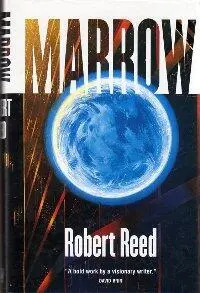
- Название:Marrow
- Автор:
- Издательство:Tor Books
- Жанр:
- Год:2000
- ISBN:0-312-86801-4
- Рейтинг книги:5 / 5. Голосов: 1
-
Избранное:Добавить в избранное
- Отзывы:
-
Ваша оценка:
Marrow: краткое содержание, описание и аннотация
Предлагаем к чтению аннотацию, описание, краткое содержание или предисловие (зависит от того, что написал сам автор книги «Marrow»). Если вы не нашли необходимую информацию о книге — напишите в комментариях, мы постараемся отыскать её.
Marrow — читать онлайн бесплатно полную книгу (весь текст) целиком
Ниже представлен текст книги, разбитый по страницам. Система сохранения места последней прочитанной страницы, позволяет с удобством читать онлайн бесплатно книгу «Marrow», без необходимости каждый раз заново искать на чём Вы остановились. Поставьте закладку, и сможете в любой момент перейти на страницу, на которой закончили чтение.
Интервал:
Закладка:
Miocene was staring at the floor, her face taut and startled, her fists fallen to her sides and forgotten.
A captain shuffled toward Washen, placing her broken clock into her offered hand.
Washen said, “Thank you,” and waited for him to sit again. Then in a careful voice, she said, “If the Builders were real, then there must have been the Bleak. Except I think the Waywards have things a little backwards. The Bleak didn’t come from outside, trying to steal the Great Ship. At least not according to our sense of geometry.” She hesitated, not quite looking at the captains. Then she asked, “Why would you build a great machine, then throw it away, and throw it as far as possible? Because the machine serves a specific, terrible purpose. A purpose that demands isolation and distance, plus the relative safety that comes with those blessings.
“I can’t know this for sure, but I’m guessing that the Ship is a prison.
“Beneath us, beneath the hot iron and even underneath the buttress engine, lives at least one Bleak. I’m guessing. The buttresses are its walls. Its bars. Marrow swells and contracts to feed the buttresses and keep them in good repair. The Builders assumed that those who first boarded the ship would be careful and thorough, and Marrow would be found soon enough. Found and deciphered. But the poor Builders didn’t guess, except maybe in their nightmares, that our species would come here and realize nothing, then make the Builders’ prison into a passenger vessel—a place of luxury and small endless lives.” Washen paused, breathed.
For a long moment, Miocene said nothing. Then in a low, furious voice, she asked, “Have you spoken to my AIs?”
“Which AIs?”
“The old scholars,” she said. Then she looked up at the arching ceiling, admitting, “One of those machines made a similar prediction. He said that the ship is a model of the universe. He claimed that Marrow’s expansion is supposed to mimic the universe’s inflationary period, and then comes lifeless space, and farther out are the living spaces…”
The woman shook her head, then dismissed everything with one word. “Coincidence.”
Aasleen asked the obvious. “If this a prison, then where are the guards? Wouldn’t the Builders leave behind something to watch over everything, and when the time came, explain it to us?”
Locke answered.
Standing beside and a little behind his mother, he reminded the captains, “Guards are wonderful. Until they decide to change sides.”
“The Bleak is imprisoned,” Washen offered, “but I think it can whisper between the bars. If you know what I mean.”
Haifa hundred captains muttered, “Diu.” Muttered,’Till.”
“Both of whom went deep inside Marrow,” Washen reminded. Then she glanced at her son, biting her lower lip before adding her last speculation.
“The Bleak,” she said, “isn’t some Builder who turned evil.”
She said, “It has to be something else entirely.”
With a booming voice, she said, “The Builders couldn’t reform the entity, or destroy it. All they could do was put it away for the time being. And now the Builders have vanished. Have died. But the thing beneath us still lives. Is still dangerous and powerful. Which pushes me toward the opinion that what we have here—what our stupid ambition has forced us to claim—is an entity even older than the Builders. Even tougher. And after it’s been locked away for so long, I think it’s safe to guess what it wants… and that it will do anything to achieve its ends…!”
Fifty-one
The injection airlocks hit the wall with a soft, sudden thump, shaped nukes piercing the hyperfiber, the roar muted by the wild keening of the pumps. Then came the abrupt purple-white flash of lasers, absolutely soundless, and Pamir hunkered down, shouting at the harum-scarum, shouting, “Shoot the car…!”
But the little car braked suddenly, slipping behind one of the empty troopships, letting the ship’s lasers intercept the spray of baby nukes while its bug-shaped body absorbed the furies of every retrofitted laser and microwave shout that the harum-scarum could aim. Steel turned to slag, and the slag exploded into a fierce white-hot rain… and the car accelerated again, dashing past the pumping station… gone…
The harum-scarum said nothing about his lousy aim. Pamir growled, “Shit,” and turned to his companion, finding no one. Where the alien should have been standing, a cloud of incandescent gas and ash drifted with a deceptive peacefulness. The gangway had melted. A random blast from below, or they would have killed him, too. Pamir wheeled and sprinted for the nearest lift-tube, his laser panning for him, his most secure nexus awakened, his quick command wrapped deep in code and squirted to every team and every AI. “Flood the bastards,” Pamir roared.
Then he leaped inside the tube, and a lift-glove grabbed him and accelerated him upward, moving too fast for him to keep his feet under him. As if suffering from a savage beating, Pamir dropped to his knees, then his aching belly, and as he lay motionless against the padded floor, it occurred to him that the pumps’ keening had changed. A deep, powerful throb rose up to him as liquid hydrogen passed through the greedy mouths, gaining a terrific velocity, a swift river born in an instant, vaster than any Amazon and fabulously, righteously furious.
A TEAM of harum-scarums had closed the giant valve.
A column of frigid, pressurized hydrogen struck the valve, and the enormous fuel line shuddered, shivered and held.
Hydrogen pooled and swirled, and half a hundred hammerwings—manned and empty—were swept down in the maelstrom. Slammed against the walls and valve, the abrupt cold shattered their alloyed hulls, splinters and anonymous gore swirling, then slowing as the pool grew deeper, settling on the bottom as a thin, uncomplaining sediment.
At the waystation, duty threw a yoke on the panic. The ranking officer—the same officer who had allowed Washen to pass—called to Till. To Miocene. Both were below somewhere, at risk. He estimated flow rates and offered computer simulations of the impending flood, and with a dry, scared, sorry voice, he mentioned, “Maybe sir, madam, you should close the tunnel. Save Marrow.” Preset charges would crack the new hyperfiber walls, and the collapse would seal everything. Would save the Waywards for another day…
At first, Miocene didn’t reply.
Till did. With a calm, almost indifferent voice, he told everyone in his command,’The tunnel remains open. Now, and always.”
“Now, but not always,” the officer grumbled.
“If you can,” Till advised, “save yourself. And if you cannot, I will kiss your soul when you are reborn again…!”
The officer straightened his back, and unable to imagine any solution, he stood beside the nearest window, and waited.
A falling hammerwing appeared.
It was the same ship that had attacked the enemy stronghold, airlocks deployed, then shattered, its gray carapace thrown against the opposite wall and plunging into one of the waystation’s buildings. There was a momentary vibration, then a high-pitched crash. Surprised, the officer realized that an atmosphere had formed outside, hydrogen fuel evaporating, forming a thick sudden wind that he could almost feel, one hand now pressed against the diamond window as the wind rose into a hurricane, then something much worse.
“But if nobody closes the tunnel,” he whispered to himself, “and if this flood reaches my house…”
Obviously, Till didn’t understand the problem.
On a different channel, the man called to Miocene. And hoping that she was listening, he explained everything again, letting the panic creep into his voice.
Outside, the torrent was worsening. The hydrogen had filled the fuel line level to the waystation, the first fingers of liquid racing between the buildings, then quickly rising into a wall that swept over and down, tugging and wrenching at the armored structures and at the scared little souls inside.
Читать дальшеИнтервал:
Закладка:
Похожие книги на «Marrow»
Представляем Вашему вниманию похожие книги на «Marrow» списком для выбора. Мы отобрали схожую по названию и смыслу литературу в надежде предоставить читателям больше вариантов отыскать новые, интересные, ещё непрочитанные произведения.









Обсуждение, отзывы о книге «Marrow» и просто собственные мнения читателей. Оставьте ваши комментарии, напишите, что Вы думаете о произведении, его смысле или главных героях. Укажите что конкретно понравилось, а что нет, и почему Вы так считаете.