Robert Reed - Marrow
Здесь есть возможность читать онлайн «Robert Reed - Marrow» весь текст электронной книги совершенно бесплатно (целиком полную версию без сокращений). В некоторых случаях можно слушать аудио, скачать через торрент в формате fb2 и присутствует краткое содержание. Год выпуска: 2000, ISBN: 2000, Издательство: Tor Books, Жанр: Фантастика и фэнтези, на английском языке. Описание произведения, (предисловие) а так же отзывы посетителей доступны на портале библиотеки ЛибКат.
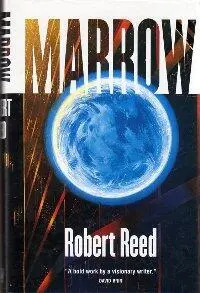
- Название:Marrow
- Автор:
- Издательство:Tor Books
- Жанр:
- Год:2000
- ISBN:0-312-86801-4
- Рейтинг книги:5 / 5. Голосов: 1
-
Избранное:Добавить в избранное
- Отзывы:
-
Ваша оценка:
Marrow: краткое содержание, описание и аннотация
Предлагаем к чтению аннотацию, описание, краткое содержание или предисловие (зависит от того, что написал сам автор книги «Marrow»). Если вы не нашли необходимую информацию о книге — напишите в комментариях, мы постараемся отыскать её.
Marrow — читать онлайн бесплатно полную книгу (весь текст) целиком
Ниже представлен текст книги, разбитый по страницам. Система сохранения места последней прочитанной страницы, позволяет с удобством читать онлайн бесплатно книгу «Marrow», без необходимости каждый раз заново искать на чём Вы остановились. Поставьте закладку, и сможете в любой момент перейти на страницу, на которой закончили чтение.
Интервал:
Закладка:
“You’ve been missing,” a uniformed man declared, staring at Locke with a mixture of awe and confusion. “We’ve been looking for your body, sir. We thought you were killed that first day”
“People make mistakes,” was Locke’s advice.
The security man nodded, then stumbled over the first obvious question.
Locke answered it before it was asked. “I was on a mission. At the insistence of Till himself He spoke with authority, and impatience. He sounded as if nothing could be more true. “I was supposed to recover my mother. By any means, at any cost.”
The man looked small inside his dark uniform.
Glancing at their prisoner, he said, “I should beg for instructions—”
“Beg to Till,” was Locke’s sound advice.
“Now,” the man sputtered.
“I’ll wait inside my car,” promised one of the greatest, most honored Waywards. “If that’s all right with you.”
He had no choice but to say, “Yes, sir.”
The waystation was perched on the throat of the access tunnel. Traffic flowed rapidly up and down. Washen saw giant steel vehicles patterned after the familiar hammer-wings. The empty ones dove into the kilometer-wide maw, while others appeared beneath them, rushing fresh units into the gaps in the Wayward lines.
The war’s carnage was relentless. And perhaps worse for the ship was the swelling, unstable panic among passengers and crew.
Washen closed her eyes, letting her nexuses sip updates. Coded squirts. Images from security eyes and ears. Avenues and public plazas were filled with terrified, furious passengers. Angry voices blamed the new Master, and the old Master, too. Plus Waywards. Remoras. And that largest, most terrifying foe: simple stupidity. Then she watched dust and pebbles falling at one-third lightspeed, smashing Wayward vehicles as their terrific momentum was transformed into a brilliant light and withering heat. An army had charged into the Remora’s desperate trap, and it would be dead in another few moments. But a new army was coming to replace what was lost. Washen opened her eyes and watched the steel hammerwings rising up to the fight. And in that mayhem of coded messages and orders and desperate pleas, one small question was misplaced. Then a fictional but utterly believable answer was delivered, wrapped snug inside bogus encryption seals.
The waystation’s AI examined the seals, and because of a subtle and recent failure in its cognitive skills, it proclaimed:
“From Till, it is. And it is authentic”
With a palpable, almost giddy relief, the Wayward told Locke, “You need to take the prisoner home. Great sir.”
“Thank you,” Locke replied.
Then he unberthed their car and dove after one of the empty hammerwings, accelerating until the rising hammer-wings blurred into a single dull line—all of Marrow seemingly rising up now, eager to behold a vast and exceptionally dangerous universe.
“Changes,” Locke had promised.
He had thoroughly described the new Marrow, displaying a good poet’s taste for sadness and Irony. Washen came with expectations. She knew that the compliant Loyalists had finished Miocene’s bridge, then with Wayward resources, the bridge had been improved, making it possible for whole armies to be transported through the fading buttresses. The old captains’ base camp housed the engineers who quickly rebuilt the access tunnel. Energy and every raw material had been brought from the world below. Lasers with a fantastic punch had widened the old tunnel, and the chamber’s own hyperfiber was salvaged and re-purified, then slathered thick and fast on the raw iron walls above. Then the same lasers were moved, digging a second, parallel tunnel barely wide enough for power and communication conduits. That was dubbed the Spine. It linked Marrow to the ship, making them one and the same.
With a soft pride, Locke mentioned, “From here, everything is our work.”
The tunnel suddenly became narrower, hammerwings missing them by nothing in the silent vacuum.
“How strong is it?” Washen inquired.
“Better than you would think,” he replied, his voice almost defensive.
Again, Washen closed her eyes and watched the war. But the Waywards had retreated, or died, and most of the Remoras’ links were dead. There was nothing to see except the battered hull glowing red, radiating the heat of impacts and battles as well as the bloody glow of the passing sun.
She shut down all of her nexuses, and she kept her eyes closed.
Quietly, Locke identified himself to someone, then demanded, “I need immediate passage to Marrow. I have a critical prisoner with me.”
Not for the first time, Washen asked herself:
“What if?”
Locke had offered to bring her here. On his own, without compliant, he had helped find workable ways through the security systems—a journey that had gone remarkably well. Which made her wonder if everything was a ruse. What if Till had told his old friend,’I want you to find your mother somehow. For both of us. Find her and bring her back home, and use any means you wish. With my blessing.”
It was possible, yes.
Always.
She remembered a different day, following their son into a distant jungle. Locke was obeying Till’s orders then. Unlikely as it seemed, it could be the same now. Of course, Locke hadn’t warned anyone about the rebellion coming, or the Remoras’ plan to scuttle the ship’s shields. Unless those events had also been allowed to happen, serving some greater, harder-to-perceive purpose.
She thought about it again, and again, with a muscular conviction, she tossed the possibility aside.
The hammerwing in front of them was slowing.
Locke pulled around it, then dove for the still invisible bottom.
Perhaps he guessed his mother’s thoughts. Or maybe it was the moment, the shared mood. “I never told you,” he began. “Did I? One of Miocene’s favorites came up with an explanation for the buttresses.”
“Which favorite?”
“Virtue,” Locke replied. “Have you met him?”
“Once,” she admitted. “Briefly.”
Their AI took control, braking their descent as they passed thousands of empty hammerwings docked and waiting for the next belly full of troops.
“You know how it is with hyperfiber,” her son continued. “How the bonds are strengthened by taming little quantum fluxes.”
“I’ve never quite understood the concept,’she confessed.
Locke nodded as if he could appreciate the sentiment. Then he smiled. He smiled and turned to his mother, his face never more sad. “According to Virtue, these buttresses are those same fluxes, but they’ve been stripped of normal matter. They’re naked, and as long as they have power, they’re very nearly eternal.”
If true, she thought, it would be the basis of another fantastic technology.
Her mind shifted. “What did Miocene think about his hypothesis?”
“If that’s true,” he said, “it would be an enormous tool. Once we learned how to duplicate it, of course.”
She waited for a moment, then asked, “What about Till?”
Locke didn’t seem to hear her question. Instead, he mentioned, “Virtue was worried. After he offered his speculation, he told everyone that stealing energy from Marrow’s core was the same as stealing it from the buttresses. We could weaken the machinery, and eventually, if we weren’t careful, we might even destroy Marrow and the ship.”
Washen listened, and she didn’t.
Their car had passed through a quick series of demon doors and slowed to a near stop, and suddenly the tunnel around her opened up, revealing the diamond blister below, the bridge thick and impressive at its center, and Marrow visible on every side. She thought she was prepared for the darkness, but it surprised her regardless. The entire world had swollen since she was last here, and it had fallen into a deeper dusk, countless lights sparkling on its iron face, each little light plainly visible through a hot, dry atmosphere.
Читать дальшеИнтервал:
Закладка:
Похожие книги на «Marrow»
Представляем Вашему вниманию похожие книги на «Marrow» списком для выбора. Мы отобрали схожую по названию и смыслу литературу в надежде предоставить читателям больше вариантов отыскать новые, интересные, ещё непрочитанные произведения.







Обсуждение, отзывы о книге «Marrow» и просто собственные мнения читателей. Оставьте ваши комментарии, напишите, что Вы думаете о произведении, его смысле или главных героях. Укажите что конкретно понравилось, а что нет, и почему Вы так считаете.