Robert Reed - Marrow
Здесь есть возможность читать онлайн «Robert Reed - Marrow» весь текст электронной книги совершенно бесплатно (целиком полную версию без сокращений). В некоторых случаях можно слушать аудио, скачать через торрент в формате fb2 и присутствует краткое содержание. Год выпуска: 2000, ISBN: 2000, Издательство: Tor Books, Жанр: Фантастика и фэнтези, на английском языке. Описание произведения, (предисловие) а так же отзывы посетителей доступны на портале библиотеки ЛибКат.
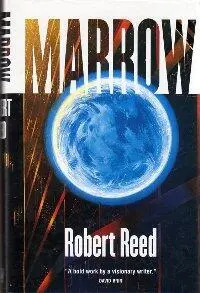
- Название:Marrow
- Автор:
- Издательство:Tor Books
- Жанр:
- Год:2000
- ISBN:0-312-86801-4
- Рейтинг книги:5 / 5. Голосов: 1
-
Избранное:Добавить в избранное
- Отзывы:
-
Ваша оценка:
Marrow: краткое содержание, описание и аннотация
Предлагаем к чтению аннотацию, описание, краткое содержание или предисловие (зависит от того, что написал сам автор книги «Marrow»). Если вы не нашли необходимую информацию о книге — напишите в комментариях, мы постараемся отыскать её.
Marrow — читать онлайн бесплатно полную книгу (весь текст) целиком
Ниже представлен текст книги, разбитый по страницам. Система сохранения места последней прочитанной страницы, позволяет с удобством читать онлайн бесплатно книгу «Marrow», без необходимости каждый раз заново искать на чём Вы остановились. Поставьте закладку, и сможете в любой момент перейти на страницу, на которой закончили чтение.
Интервал:
Закладка:
An EM pulse had pushed its AI pilot into insanity, leaving him no choice. The same pulse had killed its main reactor, leaving them depending on an auxiliary that whispered to the driver. “I am sick. I need maintenance. Do not depend on me.”
The Remora ignored the complaints. Instead, he looked back at the passengers, a whisper-signal carrying his minimal question:
“How soon?”
“Ninety-two,” said a white-as-milk face.
Minutes, she meant. Ninety-two minutes, according to the latest projection. Which was too long, and what could be taking so much time…?
But he didn’t ask the question.
Instead, he spotted a Wayward dragonfly lifting up off the horizon behind them, trying to catch them. Too late, he whispered, “Target.” Two baby men in the back of his skimmer had seen the enemy, and they were aiming at the fly’s weakest centimeter. But their ad hoc laser needed too much time to charge up, and a burst of focused light swept away holoprojection—a column of purple-white light dancing along the hull with an eerie grace, searching for something to incinerate.
Too late, the boys cried out, “Charged. Fire-!”
But Orleans had jerked the wheel, spoiling their aim, and where they would have been was blistered with the raw energies, a trailing EM scream stunning everything electronic within a full kilometer. Every lifesuit seized up for a horrible instant. The skimmer’s controls obeyed imagined orders, ignoring real ones. With his private voice, Orleans cursed, and he regained control after everyone’s living juices had been jerked savagely by the gees, and he cursed again, sharing his feelings with the others. Again, a voice said, “Fire.”
Their weapon was tiny compared to the Wayward’s, but it had sighting elements ripped out of one of the ship’s main lasers—elements meant to find and strike dust motes at a fantastic range—and the soft narrow bolt reached up into the bright lavender sky, then reached inside the armored target, bringing it plunging down to the hull, where it belonged.
There was a little cheer.
Pure reflex.
A dozen new phantoms appeared beside them, but none looked convincing. Orleans saw that immediately, and he realized that their projectors were mangled now, failing fast, and he erased the phantoms before the Waywards noticed.
Better to depend on your own camouflage now. And if he could, catch up with the rest of the fleet, then get lost among their coundess phantoms and deceits.
That seemed possible, for a little while.
The woman behind him, eavesdropping on a secure channel, leaned forward and shoved him on a shoulder, his suit’s false neurons too fried to feel more than a slight pressure.But he appreciated the pressure, the touch. Orleans leaned back into it, and again, he asked, “How soon?”
“Forty,” she replied.
The sabotage teams were back on schedule. And in twenty-two minutes, they would be inside the bunker.
The woman almost spoke again, but her voice was interrupted by the complaining voice of the skimmer’s reactor. “I am failing utterly,” it declared. Then with a prickly pride, it told Orleans, “I will last another eleven minutes. I promise.”
He said, “Fuck,” to himself.
Then with a whisper, he told the others, “Sorry. No roof for us.” Then he asked, “Any ideas? Anyone?”
There was no sense of surprise. What Orleans saw in the faces and could practically taste in the ether was nothing but a weary disappointment that evaporated in another moment. Two weeks of war had done it. Emotions were as flattened and slick as new hyperfiber. Then because it was expected, the gunnery boys said, “We should turn around. Turn and charge the fuckers, and kill a few of them!
They wouldn’t kill anyone, except themselves.
Orleans turned in his seat, showing them his face. Hard radiations had blistered his flesh, leaving mutations and weird cancers that appeared as lumps and black blisters. Amber eyes dangled, and his tusks were misaligned. But his defiant mouth announced, “That’s not a choice.”
Dozens of faces closed a wide, splendid assortment of eyes—a sign of the purest Remoran respect.
‘I know a place,” he confessed. “Not a bunker by design. But it’s got a roof Then he turned forward, muttering, “At least I hope it does,” as he wrestled the skimmer into a new course.
Again, the woman touched him on the deadened shoulder.
Was she going to tell him the time?
But no, she only wanted to feel him. And as he massaged the last drops of energy out of the skimmer’s dying reactor, and himself, Orleans concentrated on the dim touch of her hand, treating himself to a fantasy older than their species.
Remoras existed because the hull needed constant repair.
What they did very well. But not perfectly. Speed was critical when a deep blast crater needed to be filled. Hyperfiber, particularly the better grades, was sensitive to a multitude of variables. And on occasion, mistakes were made. One layer went bad before it could cure, and already one or more new layers were on top, soft as flesh and as pliable. Freed volatiles made bubbles. Bubbles weakened the patch. But to tear out the newest work and repair the damage meant time lost, and worse, it gave the universe an opportunity to strike the comet’s grave with a second, perhaps larger comet.
“Better to let the flaw remain,” Wune had said, speaking about hulls and about other matters, too. “Build around it, and preserve it. Remember: one day’s flaw will be another day’s treasure.”
A spacious flaw lay far out on the ship’s leading face. Hidden tunnels led into a chamber large enough to hide every surviving Remora, and stockpiles of machinery and shop-made weapons had been delivered secredy over the last ten days, making a last-stand fortress out of someone’s long-ago fuck-up.
Except Orleans would never reach it. His skimmer was barely able to fight its way within four kilometers of a smaller, less secure bubble. He had found it while visiting one of the tall bone-white memorials to read the names of dead friends—centuries ago, on some look-around tour. Beside the memorial was a frozen gas vent leading into the hull, into a cramped, lightless, and not particularly deep bubble.
When the skimmer died, he shouted the obvious advice: “Run!”
Lifesuits had strength, not speed. A dreamlike slowness and a dream’s sense of utter helplessness held sway, each man and woman pounding along a smooth and gray and essentially featureless plain. If not for the memorial, they would feel lost. The white spire beckoned from the first clumsy stride, and every eye that looked up could measure their progress, the minds behind the eyes thinking, “Closer. “The mouths saying, “Not far.’Everyone lying with a desperate earnestness, whispering to each other, “Just a few more seconds. Steps. Centimeters.” The sky was purposely ignored.
The lavender fire of the shields was brightening, capturing greater and greater amounts of gas and nanoscopic dusts. The giant lasers continued pummeling hazards big as fists and men and palaces. And blotting out the usual stars was a single swollen red giant sun, ancient and dying, its mass already touching the ship, starting to pull at its trajectory.
A brighter flash of light came from behind, startling everyone.
The boys said, “Skimmer,” and nothing more.
Orleans let himself slow, looking backward long enough to see darting shapes and more bursts of light. Lasers, and in the distance, the soundless delicious flash as nuclear mines detonated themselves.
Then he was running again, falling behind everyone and thinking, “We have time,” when he knew full well they didn’t. An army of Wayward monsters were charging, and if the last timetable was right, they had barely three minutes left before…
Читать дальшеИнтервал:
Закладка:
Похожие книги на «Marrow»
Представляем Вашему вниманию похожие книги на «Marrow» списком для выбора. Мы отобрали схожую по названию и смыслу литературу в надежде предоставить читателям больше вариантов отыскать новые, интересные, ещё непрочитанные произведения.









Обсуждение, отзывы о книге «Marrow» и просто собственные мнения читателей. Оставьте ваши комментарии, напишите, что Вы думаете о произведении, его смысле или главных героях. Укажите что конкретно понравилось, а что нет, и почему Вы так считаете.