Robert Reed - Marrow
Здесь есть возможность читать онлайн «Robert Reed - Marrow» весь текст электронной книги совершенно бесплатно (целиком полную версию без сокращений). В некоторых случаях можно слушать аудио, скачать через торрент в формате fb2 и присутствует краткое содержание. Год выпуска: 2000, ISBN: 2000, Издательство: Tor Books, Жанр: Фантастика и фэнтези, на английском языке. Описание произведения, (предисловие) а так же отзывы посетителей доступны на портале библиотеки ЛибКат.
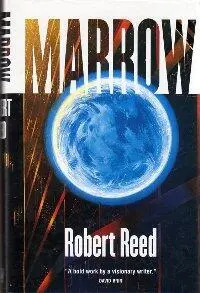
- Название:Marrow
- Автор:
- Издательство:Tor Books
- Жанр:
- Год:2000
- ISBN:0-312-86801-4
- Рейтинг книги:5 / 5. Голосов: 1
-
Избранное:Добавить в избранное
- Отзывы:
-
Ваша оценка:
Marrow: краткое содержание, описание и аннотация
Предлагаем к чтению аннотацию, описание, краткое содержание или предисловие (зависит от того, что написал сам автор книги «Marrow»). Если вы не нашли необходимую информацию о книге — напишите в комментариях, мы постараемся отыскать её.
Marrow — читать онлайн бесплатно полную книгу (весь текст) целиком
Ниже представлен текст книги, разбитый по страницам. Система сохранения места последней прочитанной страницы, позволяет с удобством читать онлайн бесплатно книгу «Marrow», без необходимости каждый раз заново искать на чём Вы остановились. Поставьте закладку, и сможете в любой момент перейти на страницу, на которой закончили чтение.
Интервал:
Закладка:
Then with the heavy grace of his lifesuit, he bent his legs and dropped to the floor, sitting on the smooth gray hull of the Great Ship.
Wayward teams were forcing their way through the bystanders. Pamir heard the broad-band squawk of sirens and saw bright helmets parting to let them pass. But he remained sitting, like the elderly judges and Orleans, showing a grim, determined face, spending those last moments reminding himself that he had done a few things just as stupid as what he was doing now.
But very few, and always for himself. No one else riding the risk.
Another harsh squawk caused the last civilians to scatter, and purple-black lifesuits emerged from the chaos, marching through the doorways with lasers held high and hard gray faces showing behind the faceplates—the descendants of lost captains, their strong features laid over a tough, uncompromising nature.
The soldiers’ armor was light, and their weapons could have been stronger. Miocene, or someone, was showing a calculated restraint.
Pamir took a deep breath, and he held it deep.
Two of the Wayward teams blocked the open doors. A third discovered an unregistered staircase leading into the city’s basement. The final two teams found Orleans, their lasers kept high but ready as they scanned him, then as they examined the other Remoras.
“On the authority of the Master Captain—” a Wayward began.
“Whose authority?” dozens of voices replied, in a sloppy chorus.
“We take this man into custody—”
A taunting laugh broke out from some, while other Remoras remained silent. And One-eye shook her head, cautioning, “We should do as they want.”
With a blurring voice, the Wayward listed other suspected saboteurs. Then with his free hand gesturing and his urgent voice breaking, he told his soldiers to hurry their scans. “Fast, and right!’ he barked. “Fast, and right!”
But the rest of Orleans’s crew was missing. Soldier after soldier said as much, their grim faces suffused with a toxic mixture of excitement and fear and an instinctive disgust. It took two scans, then a naked-eye stare through the faceplate for someone to say, “This isn’t one. Like the others, Look, sir.”
Pamir forced a grin, and finally, he let his spent breath slip out of his mouth.
A slow, astonished expression spread across the Wayward’s face. And after a little gasp, he said, “It’s that missing first-grade, sir. It’s Pamir!”
The ranking Wayward turned, and said nothing.
Every soldier felt surprise, then a wild, unexpected elation that ended when the blue-faced Remora announced.’ This is the Master Captain. Our guest, in our home. Which means—”
“Take him!’ the ranking Wayward cried out.
Half of the Remoras screamed, “No!”
The Wayward pointed his weapon, warning everyone, “Stand out of our way, or I’ll cut you out of your fucking shells! Am I understood?” Plainly.
One-eye was sitting on a standard Remoran squirt-pack. She had volunteered for the duty, arguing that even if she didn’t agree with the vote, it had been taken, and perhaps the soldiers wouldn’t scan her as closely as some. The pack’s safeties were dismantled. Its vents were permanently closed. When she kicked it into the center of the room, the Remoras and Pamir remained sitting, doing nothing but turning toward the rounded wall, putting their armored packs between them and the makeshift bomb.
The explosion was silent, then otherwise.
Pamir was still on the hull, head thrust between his knees, and the sudden blast smacked him across the slick grayness, bouncing him against Remoras and soldiers, and finally, one shoulder slamming into the diamond wall.
The building filled with a temporary, scorching atmosphere. Standing bodies were flung hardest, and lasers were ripped loose, and in the next seconds, in that purposeful mayhem, new hands grabbed the lasers, their safeties instantly rendering them harmless.
Pamir staggered to his feet.
His left knee was shattered, but the suit’s servos made the leg carry him. He screamed, “Orleans,” three times before the welcome figure appeared next to him, then sprinted ahead, the Remora flinging himself down the staircase.
A laser blast emerged, punching through the rounded ceiling.
Then the soldier was wrestled down, her weapon yanked free, and Orleans waved and called out, “This way,” and sprinted along a narrow, barely lit hallway. His lifesuit was punctured. Pamir saw a white fountain of leaking vapor. Orleans’s self was dissipating into the vacuum. But not too quickly, thought Pamir. More hope at work than any expertise.
The hall divided three ways.
Left, right. And straight down.
Orleans turned, and in a gesture old as humankind, he placed one of his gloved fingers to his rubbery mouth. “Quiet,” he was saying.
Orleans dove into the black bottomless hole. Feet first, Pamir followed.
In that perfect darkness, there was no sense of falling. The body felt nothing of its own rapid acceleration, and rime seemed to slow, and Pamir was trying to relax, readying himself for a distant floor, when a voice suddenly, unexpectedly whispered into his ears.
“Pamir?” said the voice. “Can you talk?”
Washen.
“Can you hear me, Pamir?”
He didn’t dare use even a scrambled channel. Someone might hear his convoluted bark, then trace the source. But maybe Washen realized as much, because she kept talking, making it feel as if they were falling together.
“I’ve got news,” she reported. “Our friend has helped, and will help us…”
Good.
“But I need to know,” she continued. “Will our other friends assist? Have they agreed to fight with us?”
Just then, something powerful struck the hull.
For a screeching instant, Pamir brushed against the shaft wall. The entire hull was rippling under the impact. Then he was tumbling through space again, free of weight, momentarily functioning as a tiny, tiny starship… and he closed his eyes, remembering to breathe, then telling Washen, and himself, “The Remoras will fight.”
He whispered to her, “We’ve got ourselves a war.”
THE BLEAK
My perfect, eternal solitude shattered by a wealth of stars, and by life, boisterous and abundant life, and it felt as if this was how it had always been. Skies filled with suns and living worlds, and the life within me fat and steady, prosperous beyond need or reasonable want, and how could it be any other way? Life peaceful, more than not. Life punctuated with great loves and endurable defeats. Life conjuring children out of semen and egg, software and cold crystals, and those children racing through their fresh-scrubbed incarnations with an innocent zest that always eroded into the steady cool pleasantness that is a mark of maturity that time, under its tireless hand, forces upon each of us.
I had nearly forgotten Death.
Not as a theory, never. As a principle and occasional tragedy, I couldn’t help but think of that great balancer. But as hard practicality—as the simple inevitable consequence of Life—Death seemed as left behind as my ancient, much treasured solitude.
Or perhaps I never actually knew Death.
To me, Her face appears grim and self-assured, yet unexpectedly beautiful. That beautiful face rests on a tall body growing stronger as the carnage worsens, and more lovely. A body that feeds on one soul or ten million souls, choosing her mouthfuls with a fickle maliciousness sure to leave the living wondering:
“Why not me?”
“Why am I still here, alone?”
I hear their voices. From my skin come murmurs. Shouts. Coded ticks and great white roars of EM noise, and always, lovely Death drinks in their glorious misery.
Читать дальшеИнтервал:
Закладка:
Похожие книги на «Marrow»
Представляем Вашему вниманию похожие книги на «Marrow» списком для выбора. Мы отобрали схожую по названию и смыслу литературу в надежде предоставить читателям больше вариантов отыскать новые, интересные, ещё непрочитанные произведения.







Обсуждение, отзывы о книге «Marrow» и просто собственные мнения читателей. Оставьте ваши комментарии, напишите, что Вы думаете о произведении, его смысле или главных героях. Укажите что конкретно понравилось, а что нет, и почему Вы так считаете.