Robert Reed - Marrow
Здесь есть возможность читать онлайн «Robert Reed - Marrow» весь текст электронной книги совершенно бесплатно (целиком полную версию без сокращений). В некоторых случаях можно слушать аудио, скачать через торрент в формате fb2 и присутствует краткое содержание. Год выпуска: 2000, ISBN: 2000, Издательство: Tor Books, Жанр: Фантастика и фэнтези, на английском языке. Описание произведения, (предисловие) а так же отзывы посетителей доступны на портале библиотеки ЛибКат.
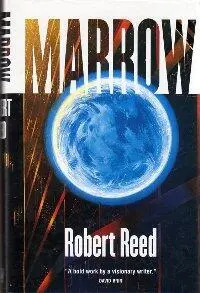
- Название:Marrow
- Автор:
- Издательство:Tor Books
- Жанр:
- Год:2000
- ISBN:0-312-86801-4
- Рейтинг книги:5 / 5. Голосов: 1
-
Избранное:Добавить в избранное
- Отзывы:
-
Ваша оценка:
Marrow: краткое содержание, описание и аннотация
Предлагаем к чтению аннотацию, описание, краткое содержание или предисловие (зависит от того, что написал сам автор книги «Marrow»). Если вы не нашли необходимую информацию о книге — напишите в комментариях, мы постараемся отыскать её.
Marrow — читать онлайн бесплатно полную книгу (весь текст) целиком
Ниже представлен текст книги, разбитый по страницам. Система сохранения места последней прочитанной страницы, позволяет с удобством читать онлайн бесплатно книгу «Marrow», без необходимости каждый раз заново искать на чём Вы остановились. Поставьте закладку, и сможете в любой момент перейти на страницу, на которой закончили чтение.
Интервал:
Закладка:
Pamir took them on another roundabout journey.
Inside a secondary fuel line, he pulled to a stop, then used the laser to surgically maim his prisoner. With Locke left harmless, he sprayed emergency lifesuits over their bodies, and after a few moments to let the suits cure, he unsealed the main hatch.
The cabin’s atmosphere exploded into the vacuum.
Pamir scrambled into the open, removed a tool kit, then gave the car a random course and an unreachable destination. Then he dragged Locke out of the car before sealing it again, and together, they watched it accelerate into the blackness.
A valve stood beside them. Built by unknown hands, unused for billions of years, it had been left open, seemingly just for them.
Pamir dragged his prisoner after him. Then he tripped a switch that slowly, slowly closed the valve.
The tertiary line was a kilometer long, ending at a tiny, never-used auxiliary tank. And past that tank was the world-sized ocean of hydrogen.
Walking rapidly, carrying Locke on his back, Pamir started to talk, his voice percolating through the spray-on fabric. “She isn’t dead,” he said. “There was a fight, and I assumed that if she was there, she was obliterated, or someone recovered her body. But Washen was left behind, and you never found her. Did you? You came back to that alien house for a reason. Your first chance in more than a century, and you ran back there to look for your mother. For Washen. One of my oldest, best friends.”
Locke took a deep, pained breath.
“We searched. If anyone fell from that habitat, we should have found them. A heavy body spat out by the decompression would have had a small horizontal vector. That’s why we looked directly beneath the alien house.” He was halfway running, thinking about how much time they had and what he would do if he couldn’t find any help. “Are you listening to me, Locke? I know something about how much abuse a person can take. And if we can find enough of your mother, she’s alive again.”
Silence.
“You were there, Locke.” Pamir said the words twice, then added, “The hydrogen has currents. Slow, but complex. And like I said, we were looking for a whole corpse. Because that’s what was easiest. But if there was just a small piece of her, like her head, the decompression would have given her a terrific horizontal vector. Her poor head would have frozen in moments and fallen hard in the darkness, dropping straight to the icy bottoms, and if that’s the case, the two of us could find her. The search equipment is still there, ready to try. It just needs to know its target—”
“She was cut into several pieces,” said the man’s close, soft voice. “Her head, with one arm still attached. We recovered the rest of her.”
Pamir waited a moment, then said, “All right, then.”
He said, “That helps us a lot. Thank you.”
Then after a sympathetic pause, he asked, “Who did that to her, Locke? Who treated your mother that way?” A deep, brooding silence.
Then with withering, practised pain, Locke admitted, “My father… Diu… was trying to kill her…”
Pamir heard a deep breath, a shallow gasp.
Then an anguished voice asked, “Is there any method you know, First-grade Pamir? Is there any way to kill a memory that you can’t forget…?”
Thirty-six
The rumor was sudden and spectacularly fantastic, and if only a little bit true, its consequences would be nothing short of momentous. The common first reaction among passengers and crew was to laugh at the whole silly notion, and mock it, and insult the soul who dared tell the foolish story, and perhaps beat him senseless, or piss on his lying face, or in some other species-specific way prove one’s doubts about what was clearly, utterly impossible.
“The Master Captain is dead!’ said billions of soft, nervous voices.
How could she be? She was too wily and much too powerful to die!
“All of her captains have been murdered! At their annual dinner! By armed strangers coming from a secret part of the ship!”
How could any of that be true? How, how, how…?
“And now these strangers have stolen control over the Great Ship!”
Which was just absurd. Of course, of course. The ship was too strong and far too large to be conquered by any force. Certainly not in a day, and with such little fuss, too. Where were the Master’s security troops? And her tough old generals? And more to the point, where were the AIs and the other elaborate machines whose only duty was to serve that giant human woman? How could such a deeply ingrained, fiercely loyal army allow an invasion to succeed in a thousand years, much less inside a single day?
For a full ship-day, that was the gist of almost every public and private conversation—abbreviated wild rumor countered with hard-headed doubt.
But the rumor had its own life, gaining breadth, depth, and a kind of robust logic.
On the second and third days, and particularly on the fourth, lowly mates and certain engineers offered new clues. What had happened wasn’t an invasion. Not precisely. It more properly resembled a mutiny, the ringleaders being one-time captains. The Vanished had returned from the dead, it was said. At least some of the missing captains had rematerialized, led by that axe-faced Submaster. That Miocene woman. In the avenues and parks, along the seashores and inside dream parlors, passengers told this new story and wrestled with its consequences. Who was Miocene? In memory, she was the quiet and efficient and apparently bloodless First Chair to the now deposed Master. And that was about all she was. Every biography written about the woman was sold ten billion times, at least. Most read only the highlights. Only enough to recognize the woman’s ambition and her obvious powers. If anyone could overthrow the Master Captain, it was her First Chair. That was the obvious verdict. Who else in Creation had intimate knowledge into every security array, every communication system, and the ship’s wellsprings of power?
But Miocene didn’t come home alone. She brought an army of loyal and tough soldiers who were deployed in the opening hours, trapping most of the ship’s troops in their barracks or surprising them in the field. A few witnesses described pitched battles and soldiers killed on both sides. But even the largest stories involved small units and minimal damage. Most of the ship’s weapons failed before they could be fired, sabatoged by security codes that the Master herself had set in place—codes meant to protect the public and the captains should those weapons find the wrong hands embracing them. A few units loyal to the Master managed to slip away, merging with the general population. But they were scattered and leaderless, without the tools necessary to hurt any enemy.
About the old Master and her captains, no one seemed to know.
One comforting tale was that the old leaders were still alive, in some diluted form or another. Perhaps they weren’t conscious or whole, but they were still capable of being reborn again… should Miocene, in her wisdom, decide to consider them harmless…
About the new Master and her staff, even less was known.
From where did they come?
A thousand rumors told the same basic story: the Vanished must have left the ship, probably against their will. Then on a mysterious high-technology world, Miocene gathered up the tools and army and fleets of star-ships necessary to catch up again. Where her fleet was today, nobody knew. Everyone agreed that the main ports were quiet; the Great Ship had been passing through a thinly inhabited region around an active, modestly dangerous black hole. And it was hard to imagine that little ships could have caught them without being seen. But didn’t that explanation make far more sense than that silly noise about secret chambers and worlds hiding within the ship’s heart?
Читать дальшеИнтервал:
Закладка:
Похожие книги на «Marrow»
Представляем Вашему вниманию похожие книги на «Marrow» списком для выбора. Мы отобрали схожую по названию и смыслу литературу в надежде предоставить читателям больше вариантов отыскать новые, интересные, ещё непрочитанные произведения.








Обсуждение, отзывы о книге «Marrow» и просто собственные мнения читателей. Оставьте ваши комментарии, напишите, что Вы думаете о произведении, его смысле или главных героях. Укажите что конкретно понравилось, а что нет, и почему Вы так считаете.