Robert Reed - Marrow
Здесь есть возможность читать онлайн «Robert Reed - Marrow» весь текст электронной книги совершенно бесплатно (целиком полную версию без сокращений). В некоторых случаях можно слушать аудио, скачать через торрент в формате fb2 и присутствует краткое содержание. Год выпуска: 2000, ISBN: 2000, Издательство: Tor Books, Жанр: Фантастика и фэнтези, на английском языке. Описание произведения, (предисловие) а так же отзывы посетителей доступны на портале библиотеки ЛибКат.
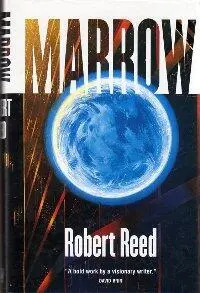
- Название:Marrow
- Автор:
- Издательство:Tor Books
- Жанр:
- Год:2000
- ISBN:0-312-86801-4
- Рейтинг книги:5 / 5. Голосов: 1
-
Избранное:Добавить в избранное
- Отзывы:
-
Ваша оценка:
Marrow: краткое содержание, описание и аннотация
Предлагаем к чтению аннотацию, описание, краткое содержание или предисловие (зависит от того, что написал сам автор книги «Marrow»). Если вы не нашли необходимую информацию о книге — напишите в комментариях, мы постараемся отыскать её.
Marrow — читать онлайн бесплатно полную книгу (весь текст) целиком
Ниже представлен текст книги, разбитый по страницам. Система сохранения места последней прочитанной страницы, позволяет с удобством читать онлайн бесплатно книгу «Marrow», без необходимости каждый раз заново искать на чём Вы остановились. Поставьте закладку, и сможете в любой момент перейти на страницу, на которой закончили чтение.
Интервал:
Закладка:
The other man grunted softly, a look of dim surprise coming to the grayish face, to the wide gray eyes.
Even without both hands, the captain had a thirty-kilo advantage. He drove with his legs, then his right shoulder, shoving his opponent against the sealed elevator door and pinning the arm with laser flush to the body… a second whoosh evaporating a portion of his ear and the edge of his captain’s cap… and Pamir screamed again, louder this time, his good hand smashing into the squirming body, punishing ribs and soft tissues while he flung the man’s hairless head against the hyperfiber door.
With a heavy clatter, the laser fell to the floor.
Pamir absorbed blows to his belly, his ribs. Then with his good hand, he grabbed the other man’s neck and yanked and twisted, squeezing until he was certain that not a breath of oxygen could slip down that crushed throat. Then he used his knee, driving bone into the groin, and when a look of pure misery passed across the choking face, he screamed, “Stop,” and flung the man back up the hallway.
The laser lay beside Washen’s clock.
Pamir reached with his bad hand, realized his blunder, then too late, put his good hand around the weapon’s handle, the whiteness of polished bone braced with the archaic heft of forged steel.
A booted foot, hard as stone, kicked Pamir in the face, shattering both cheekbones and his nose.
He felt himself flung back against the door, and lifting his good hand, he fired, a sweeping ray of blackish-blue light cooking his opponent’s other foot.
The man collapsed, and moaned quietly for a breath or two.
With his own trembling legs, Pamir pushed against the slick door, forcing himself upright, watching the stranger’s face grow composed. Resigned. Then once again, a look of defiance came into the gray face.
“Kill me,” the stranger demanded.
“Who are you?” Pamir asked.
No response.
“You’re a luddite, aren’t you?” The captain said it with confidence, unable to envision any other explanation. “Washen was living in one of your settlements. Is that it?”
A blank, uncomprehending expression gave him his answer.
“What’s your name?” he asked again. Gray eyes glanced at Pamir’s epaulets. Then with a low croaking voice, the man announced, “You’re a first-grade.”
“Pamir. That’s my name.”
The man blinked, and sighed, and said, “I don’t remember your name. You must be new to the captains’ ranks.”
“You know the roster, do you?” Silence.
“You’ve got a big memory,” Pamir allowed.
The silence acquired a distinct pride.
“But then,” Pamir added, “Washen always had an excellent memory, too.”
At the sound of her name, the man blinked. Then he stared at Pamir, and with a forced calmness, he asked, “Do you know my mother?”
“Better than anyone else, nearly.”
That statement puzzled the man, but he said nothing. “You resemble her,” Pamir confessed. “In your face, mostly. Although she was a lot tougher, I think.”
“My mother… is very strong…”
“Is?”
Silence.
“Is?” he asked again. Then he picked up Washen’s clock, using the two surviving fingers on his battered hand. The pain was constant, and manageable. He dangled the silver machine in the air between them, saying, “She’s dead. Your mother is. I found this and nothing else. And we looked everywhere, but we didn’t find a body.”
The man stared straight up, showing the ceiling his contempt.
“It happened inside the leech habitat, didn’t it?” Pamir guessed he was right, then asked, “Did you see her die?”
The man said, “Kill me,” again, but without as much feeling.
His burnt foot was healing itself. A good luddite wouldn’t possess such talents. And for the lack of any better guess, Pamir said, “I know where you’re from. From the middle of the ship somehow. Somehow.”
The man refused to blink.
But Pamir had a sense of what was true, impossible as it seemed. “How did you climb up here? Is there a secret tunnel somewhere?”
The eyes remained open. Under control.
“No,” the captain whispered. “I was digging a nice wide hole toward you. Almost all the way down, and that’s how you got up here. Am I right?”
But he didn’t wait for a response. On a secure channel, Pamir called the foremachine working inside the hole. Quietly and confidently, the AI told him, “Everything is nominal, sir. Everything is as it should be.”
Pamir shifted channels, as an experiment.
Again, “Everything is nominal, sir.”
And he selected a third channel—a route and coding system that he had never used before—and the response was a perfect, seamless quiet that caused him to mutter, “Shit,” under his breath.
His captive was flexing his growing foot.
Pamir cooked it again, with a lance of blue-black light. Then he pocketed the clock and grabbed the man by an arm, promising him,’I’ll kill you. Eventually. But we’ve got to look at something first.”
He dragged the man to his cap-car.
Racing his way along a roundabout course, Pamir tried to contact the Master. An AI’s voice responded. A constricted, heavily encoded image of the bridge and a rubber face appeared just past the car’s window. “Be brief,” was the response.
“I have an emergency here,” Pamir explained.’An armed intruder—”
“One intruder?”
He nodded. “Yes—”
“Take him to the nearest detention center. As you were instructed—”
“What instructions?”
A genuine discomfort spread across the sexless face. “A first-degree alarm has been sounded, Captain. Did you not hear it?”
“No.”
The machine’s discomfort turned to a knifing pain.
“What’s going on?” Pamir demanded.
“Our alarm system has been compromised. Plainly”
Pamir asked, “What about the captains at the feast?”
“I’ve lost all contact with the Great Hall,” the machine confessed, almost embarrassed. Then it hesitated abruptly, and with a different tone, it said, “Perhaps you should come to the Master’s station, sir. I can explain what I know, if you come to me immediately”
Pamir blanked the channel.
For a long while, he sat motionless, ignoring his prisoner, considering what he knew and what he needed to do first.
More than a century ago, after the discovery of the camouflaged hatch, the captains constructed a blind inside the local pumping station. Like any good blind, there were a dozen secret ways to slip inside it. Like anything built by captains, the facility was in perfect repair, every sensor off-line but ready to come awake with the proper codes from the approved people.
Pamir slipped into the blind without incident. But he didn’t bother with sensors; his own eyes told him everything.
Rising up the fuel line were dozens, perhaps hundreds of odd cars, windowless and vast, shaped like some kind of predatory beetlelike creature and built from a bright gray metal. Steel, perhaps. Which made them exceptionally strange vehicles, and impressive. He calculated their volume and the possible numbers of bodies stuffed inside each of them. Then staring at his prisoner, Pamir said nothing. He stared and waited until the man looked back at him, then he finally asked, “What did you want?”
“My name is Locke.”
“Locke,” he repeated. “What do you want?”
“We’re the Builders reborn,” said the strange little man. “And you’re one of the misguided souls in service of the Bleak. And we are taking the ship back from you—”
“Fine,” Pamir growled. “It’s yours.”
Then he shook his head, adding, “But that’s not what I’m asking, Mr Locke. And if you’re half as smart as your mother, you know that perfectly well…!”
Читать дальшеИнтервал:
Закладка:
Похожие книги на «Marrow»
Представляем Вашему вниманию похожие книги на «Marrow» списком для выбора. Мы отобрали схожую по названию и смыслу литературу в надежде предоставить читателям больше вариантов отыскать новые, интересные, ещё непрочитанные произведения.




Обсуждение, отзывы о книге «Marrow» и просто собственные мнения читателей. Оставьте ваши комментарии, напишите, что Вы думаете о произведении, его смысле или главных героях. Укажите что конкретно понравилось, а что нет, и почему Вы так считаете.