Robert Reed - Marrow
Здесь есть возможность читать онлайн «Robert Reed - Marrow» весь текст электронной книги совершенно бесплатно (целиком полную версию без сокращений). В некоторых случаях можно слушать аудио, скачать через торрент в формате fb2 и присутствует краткое содержание. Год выпуска: 2000, ISBN: 2000, Издательство: Tor Books, Жанр: Фантастика и фэнтези, на английском языке. Описание произведения, (предисловие) а так же отзывы посетителей доступны на портале библиотеки ЛибКат.
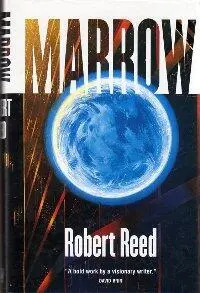
- Название:Marrow
- Автор:
- Издательство:Tor Books
- Жанр:
- Год:2000
- ISBN:0-312-86801-4
- Рейтинг книги:5 / 5. Голосов: 1
-
Избранное:Добавить в избранное
- Отзывы:
-
Ваша оценка:
Marrow: краткое содержание, описание и аннотация
Предлагаем к чтению аннотацию, описание, краткое содержание или предисловие (зависит от того, что написал сам автор книги «Marrow»). Если вы не нашли необходимую информацию о книге — напишите в комментариях, мы постараемся отыскать её.
Marrow — читать онлайн бесплатно полную книгу (весь текст) целиком
Ниже представлен текст книги, разбитый по страницам. Система сохранения места последней прочитанной страницы, позволяет с удобством читать онлайн бесплатно книгу «Marrow», без необходимости каждый раз заново искать на чём Вы остановились. Поставьте закладку, и сможете в любой момент перейти на страницу, на которой закончили чтение.
Интервал:
Закладка:
Pamir pulled to a stop and held his breath.
The stranger indeed wore a captain’s uniform, but with odd embellishments. A rich golden hair was woven into a decorative braid, and there were tall leather boots and a leather belt cluttered with tools, some familiar and some not. He was a short man, but thickly built. A strong finger gripped what was obviously a mechanical trigger, and quietly, almost softly, the man said to him, “Keep still.”
His voice had an unexpected accent.
Pamir told him, “I’m not moving anywhere.”
“Good.”
There was no way to escape, and very little chance to attack the stranger. Wearing a dress uniform, Pamir had minimal armor. In a whisper, he said, “Emergency channel. Now”
The stranger shook his head, remarking, “That won’t help.”
Sure enough, no one seemed to hear him. What was happening?
Pamir curled his toes inside his boots, then uncurled them. And he breathed deeply, twice, before saying, “You look lost, Captain. And frankly, you smell a little odd.”
The man shrugged, then gestured with his right hand. “Open this door for me.”
“Why?”
“I want to see the aliens’ house.’Then with a controlled but palpable alarm, “The house is still there, isn’t it?”
Pamir titled his head, and smiled.
“It has to be there,” the strange captain decided. “Don’t try to confuse me!”
“I can open the door for you,” said Pamir.
The man had gray eyes that easily turned to suspicion. Some calculation was made, a decision was made. He aimed his laser at Pamir’s chest, telling him, “I don’t need you. I can break your little lock myself.”
“So do it.”
“Stand still,” the stranger advised, gray eyes narrowing. “I’ll cripple you if you behave. If not, I’ll have to kill you.”
Reflexively, Pamir took a half-step backward.
Then those gray eyes dropped, and quietly, with a mixture of surprise and thick awe, he asked, “What is that?”
Pamir slowly unfastened the silver clock, then opened it.
“What are you doing with that?” he asked. “Did my mother give it to you-?”
“Washen’s your mother?” he blurted.
The stranger nodded, then asked, “Where is she?”
“Why? Don’t you know?”
The man couldn’t help but glance at the sealed doorway, and that was the moment when Pamir threw the watch, aiming for the shaved back of the head, and with all of his speed and desperation, he threw himself, too.
Thirty-four
The Grand Hall was a hemispherical compartment more than a kilometer tall at its apex and exactly twice as wide. Its ceiling had arching bands of hyperfiber riding next tonthe greenish olivine, the former lending a glittery brightness to the room’s floating lights and to every echoed sound. The original floor was simple stone, but the humans had pulverized it, then mixed compost into the rock dust, creating a rich deep soil in which grew ornamental trees from a thousand worlds, and a soft green grass known as Kentucky for no reason other than that it had always been. For most of the year, the room was a public garden. In a ship jammed with spectacles, this was a quiet, sober place where frayed nerves found solace and a few despairing souls had gone to attempt suicide. But as the captains’ feast drew near, robots set up tables and chairs in careful patterns, and the tables were covered with intricate linen designed for this single occasion, and ten thousand place settings were arranged according to conventions older than anyone could calculate. Plates whiter than bone were flanked by heavy goldware utensils, and perfumed cloth was folded in artful patterns, waiting to wash dirty faces and fingers. Crystal goblets filled themselves through hidden nipples, every liquor and molten drug grown somewhere inside the ship, and every sip of chilled water was brought up from the famous artesian wells next to the Alpha Sea, celebrating the first impromptu captains’ feast held more than a hundred millenia ago.
Each captain had her place, or his, marked with a handwritten placard, the Master Captain’s loud script obvious at a distance. The placement of one’s chair was everything. Rank mattered, but so did the quality of the officer’s year. Captains to be bestowed new honors sat near the Master’s own table. Captains who needed humiliation were assigned more distant seats than expected, the worst of them set behind a bank of walkyleen flycatchers. The meal itself was meant to be a surprise, and in an attempt to honor their passengers, it was usually an array of alien dishes, their amino acids and stereochemistry left untouched—a grand tradition that made a few bellies uncomfortable, and some years, more than a few.
Today’s meal was cold uncooked fish from the sunless depths of the harum-scarum sea. Vast dead eyes stared up at the hungry captains. The eating mouths were clamped shut while the gill mouths slowly opened and closed, the flesh too stubborn to stop its useless search for oxygen. Inside every fish stomach was a salad of purple vegetation and sour fruits and tenoil dressing that resembled, in texture and in odor, unrefined petroleum. Hidden elsewhere inside the corpse was a golden worm, smaller than any finger and treasured by the harum-scarum as a delicacy to be consumed one lucious segment at a time.
Every active captain had a place set for her and for him.
Even the absent captains were given a plate, a fish, and the honor of a seat. Though cynics liked to complain that the apparent honor only underscored their absence, giving their snobbish peers the opportunity to say whatever they wished about those who weren’t present to defend themselves.
Centuries ago, when the captains vanished abruptly, their seats remained, and placards with their names written by one of the Master’s automated hands, and their meals were prepared in the captain’s galley, delivered by crew members in dress uniforms, and left there for the flies.
For years, the Master would rise to her feet, beginning the evening with a vague yet flowery toast to those missing souls, wishing them well as they fulfilled the mysterious duties of some unmentionable assignment.
Then came the inevitable dinner when she announced with a booming, yet sorrowful voice that the captains’ vessel had struck a shard of comet, and they would not be seen again. Her toast was made with vinegary wine—the standard drink for such gloomy occasions—and dinner itself was the funeral feast borrowed from a species of cold deep-space aliens. The captains destroyed their mouths with a ritualistic bite of a methane-ice fruit. That was the last year when places were set for their vanished colleagues. For Miocene, and Hazz. And Washen. And for the rest of the much-honored dead.
More than forty-eight centuries had passed since the Vanishing.
One hundred and twenty-one feasts had been held since two ghosts had appeared suddenly, talking about a nonexistent world called Marrow.
Nothing had come of it. Someone’s stupid and very cruel joke had thrown the Master into an unseemly panic, and she had spent the last century trying to convince everyone that the apparitions were anything but real. They had to be someone’s cruel illusion. Because what other choice did she have? A Master Captain’s first duties were to her chair and her ship, and what kind of Master would she be if a holoimage and a handful of vague clues were to steer her away from traditions that had served both ship and chair for more than a hundred millennia…?
No, she didn’t want to think about the Vanished. Not tonight, or ever again. But she seemed unable to stop herself, and trying to purge her mind, to make herself stronger and inflexible, only seemed to make the ghosts stronger, too.
Читать дальшеИнтервал:
Закладка:
Похожие книги на «Marrow»
Представляем Вашему вниманию похожие книги на «Marrow» списком для выбора. Мы отобрали схожую по названию и смыслу литературу в надежде предоставить читателям больше вариантов отыскать новые, интересные, ещё непрочитанные произведения.







Обсуждение, отзывы о книге «Marrow» и просто собственные мнения читателей. Оставьте ваши комментарии, напишите, что Вы думаете о произведении, его смысле или главных героях. Укажите что конкретно понравилось, а что нет, и почему Вы так считаете.