Les Johnson - Going Interstellar
Здесь есть возможность читать онлайн «Les Johnson - Going Interstellar» весь текст электронной книги совершенно бесплатно (целиком полную версию без сокращений). В некоторых случаях можно слушать аудио, скачать через торрент в формате fb2 и присутствует краткое содержание. Жанр: Фантастика и фэнтези, Прочая научная литература, Прочая документальная литература, на английском языке. Описание произведения, (предисловие) а так же отзывы посетителей доступны на портале библиотеки ЛибКат.
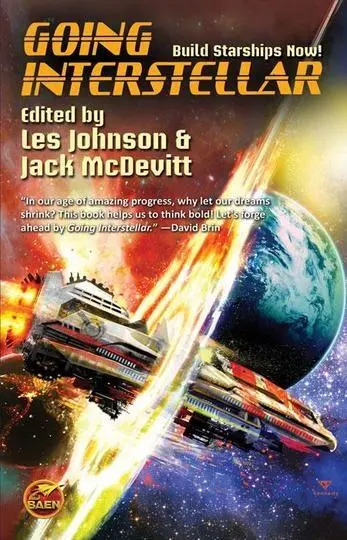
- Название:Going Interstellar
- Автор:
- Жанр:
- Год:неизвестен
- ISBN:нет данных
- Рейтинг книги:5 / 5. Голосов: 1
-
Избранное:Добавить в избранное
- Отзывы:
-
Ваша оценка:
Going Interstellar: краткое содержание, описание и аннотация
Предлагаем к чтению аннотацию, описание, краткое содержание или предисловие (зависит от того, что написал сам автор книги «Going Interstellar»). Если вы не нашли необходимую информацию о книге — напишите в комментариях, мы постараемся отыскать её.
Going Interstellar — читать онлайн бесплатно полную книгу (весь текст) целиком
Ниже представлен текст книги, разбитый по страницам. Система сохранения места последней прочитанной страницы, позволяет с удобством читать онлайн бесплатно книгу «Going Interstellar», без необходимости каждый раз заново искать на чём Вы остановились. Поставьте закладку, и сможете в любой момент перейти на страницу, на которой закончили чтение.
Интервал:
Закладка:
If we could go back in time a few decades to observe any historical event, one choice might be Einstein in his office at the Institute of Advanced Studies opening the German physics journal containing the epochal paper. Perhaps he was wearing his baggy sweater and smoking his pipe as he opened the journal and read the paper. Perhaps he did a few calculations to check the result.
Einstein knew what the Nazis planned. He had been fortunate to escape Europe and had worked to save family members and colleagues. As a non-native English speaker with a good knowledge of German and Yiddish, he may first have dropped the pencil on his desk and removed his glasses. Then he may have muttered “Oy Mein Gott,” as the terrible reality sank in.
An ordinary mortal may have visited a Princeton pub and drunk himself into oblivion. But Einstein was far from ordinary. He crafted a letter describing his concerns and posted it to President Roosevelt.
If one of us writes a concerned letter to the President of the United States (or any other world leader) we might expect a response from a low-level intern. But Roosevelt realized that Einstein was no ordinary mortal. And he knew that war clouds were thickening. He responded by convening a conclave of the best American nuclear experts to check the validity of Einstein’s concerns and the German team’s calculations. The Manhattan Project, which would result in the atomic bombs dropped on Japan in the final days of World War II, had started!
Even Einstein was amazed (and saddened) by the power of his mass-energy footnote. When he was interviewed after the Hiroshima bombing, he implied that perhaps he should have been a plumber!
After the war, nuclear experts in both the US and USSR realized that the atomic bomb—which works by the fission, or splitting, of heavy atomic nuclei—was not the final answer to humanity’s destructive quest. Work would be devoted to the more powerful thermonuclear bomb—which operates by fusing or combining light atomic nuclei in a manner analogous to the Sun.
To date, hydrogen bombs (which can yield thousands of times more energy than the Hiroshima blast) must have a fission trigger. The atomic-bomb trigger is first ignited to raise temperature, pressure and density in the fusion material to levels at which thermonuclear reactions can occur. Although the details of these devices are closely guarded military secrets, it is safe to assume that explosive-fusion reaction schemes involve heavy isotopes of hydrogen, light isotopes of helium, and perhaps lithium and boron.
Before the end of the Cold War (during which thousands of fission and fusion devices were produced) futurists realized that human civilization would ultimately exhaust its fossil-fuel reserves. Perhaps some form of controlled thermonuclear fusion might be the answer to our growing energy needs.
Two basic types of electricity-producing fusion reactors have been proposed and are being researched. One approach uses powerful electric and magnetic fields to confine the plasma (ionized gas) of thermonuclear material. Another major difficulty in achieving controlled thermonuclear fusion is the multi-million-degree temperature at which the reactants must be maintained. Although cleaner (in terms of radioactivity) than the less-powerful fission reactors now in use, currently feasible fusion reactors will also produce some radioactivity.
Confined-fusion technologists use two benchmarks to define their progress. Achievement of “scientific breakeven” would mean that an experimental fusion reactor would produce as much output energy as was used to create the fusion reaction to begin with. “Technological breakeven” means that the energy produced is at least ten times greater than the energy input. At present, experimental confined-fusion reactors operate at about 50% of scientific breakeven. Achievement of technological breakeven will require more time—and money.
Although confined-fusion reactors have promise for terrestrial energy production, inertial fusion might be more useful for in-space propulsion. Inertial fusion reactors operate using small pellets of fusion reactants. These are pelted with electron beams or lasers to raise pellet temperature and density to levels at which thermonuclear reactions can occur. Essentially, an inertial-fusion reactor is a small hydrogen bomb with the fission trigger replaced by electron or laser beams.
An inertial-fusion reactor used to produce terrestrial energy would require considerable shielding to trap the high-energy products of the thermonuclear reactions. But this is less of a problem in space. Since these reaction products largely consist of high-energy electrically charged particles, engineers quickly figured out that they could simply squirt them out the back of the spacecraft as rocket exhaust. Even before Apollo 11 reached the Moon, some scientists realized that inertial-fusion ships might some day reach the stars!
Project Orion—Birth of the Interstellar Dream
Freeman Dyson distrusted bureaucracies. During the Second World War, he worked on crew safety for the British Royal Air Force Bomber Command. Early in the war, he realized that the escape hatches on many British bombers were too small for crewmembers to depart a stricken aircraft while wearing their parachutes. Dyson wrote memo after memo to correct this defect without positive response until late in the war. Embittered, he realized that thousands of brave British airmen must have needlessly perished. He swore that never again would he trust a large bureaucracy to do the right thing. More than anything else, Dyson’s response to his wartime experience helped produce the realization that the stars are not beyond reach.
After the war, when Dyson had moved to the Princeton University Institute of Advanced Study, he mentored Theodore Taylor in his Ph.D. studies. Working on the US atomic bomb project, Taylor had become disillusioned with the effort that went into creating fake cities and nuking them. To him, this was a waste of taxpayer money since the A-bomb, after all, had been “tested” on two very real Japanese cities. Taylor, instead of concentrating on the construction of objects to be destroyed by atomic blasts, asked himself if anything could survive in the hellish vicinity near ground zero.
He designed a pumpkin-sized steel sphere, coated it with graphite, and installed it at the Eniwetok nuclear test site in the Pacific near a 20-kiloton nuclear device. To everyone’s surprise (but perhaps not Taylor’s), the metal sphere rode out the blast with minimal damage. Apparently, the graphite layer had ablated — evaporating at high speed — and carried off much of the incident energy produced by the explosion.
Dyson, Taylor and others saw a possible application for this process. As the Space Age dawned, US defense analysts recognized that there was no known defense against orbital Soviet nuclear warheads. But perhaps a spacecraft propelled by external nuclear explosions might do the trick.
This was the birth of the initially top-secret Project Orion. On a future spacecraft, Orion crews would carry with them small nuclear charges. (Okay, they would be small bombs.) The charges would be discharged on command behind a pusher plate coated with ablative material. This pusher plate, which would be impacted by the nuclear blast, would be connected to the rest of the ship by the world’s largest shock absorbers. Bang! Bang! Bang! Explosion after explosion would impulsively propel spacecraft to faster and faster speeds.
Although a full-scale Orion was never constructed, small test models propelled by chemical explosives were successfully filmed careening across the sky. One is on display (near a model of Star Trek’s Starship Enterprise ) in the Smithsonian Air and Space Museum in Washington D.C.
Читать дальшеИнтервал:
Закладка:
Похожие книги на «Going Interstellar»
Представляем Вашему вниманию похожие книги на «Going Interstellar» списком для выбора. Мы отобрали схожую по названию и смыслу литературу в надежде предоставить читателям больше вариантов отыскать новые, интересные, ещё непрочитанные произведения.











Обсуждение, отзывы о книге «Going Interstellar» и просто собственные мнения читателей. Оставьте ваши комментарии, напишите, что Вы думаете о произведении, его смысле или главных героях. Укажите что конкретно понравилось, а что нет, и почему Вы так считаете.