Les Johnson - Going Interstellar
Здесь есть возможность читать онлайн «Les Johnson - Going Interstellar» весь текст электронной книги совершенно бесплатно (целиком полную версию без сокращений). В некоторых случаях можно слушать аудио, скачать через торрент в формате fb2 и присутствует краткое содержание. Жанр: Фантастика и фэнтези, Прочая научная литература, Прочая документальная литература, на английском языке. Описание произведения, (предисловие) а так же отзывы посетителей доступны на портале библиотеки ЛибКат.
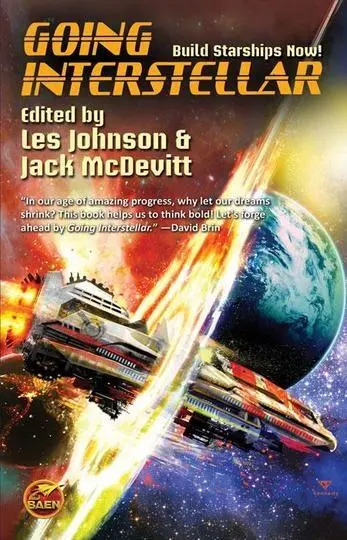
- Название:Going Interstellar
- Автор:
- Жанр:
- Год:неизвестен
- ISBN:нет данных
- Рейтинг книги:5 / 5. Голосов: 1
-
Избранное:Добавить в избранное
- Отзывы:
-
Ваша оценка:
Going Interstellar: краткое содержание, описание и аннотация
Предлагаем к чтению аннотацию, описание, краткое содержание или предисловие (зависит от того, что написал сам автор книги «Going Interstellar»). Если вы не нашли необходимую информацию о книге — напишите в комментариях, мы постараемся отыскать её.
Going Interstellar — читать онлайн бесплатно полную книгу (весь текст) целиком
Ниже представлен текст книги, разбитый по страницам. Система сохранения места последней прочитанной страницы, позволяет с удобством читать онлайн бесплатно книгу «Going Interstellar», без необходимости каждый раз заново искать на чём Вы остановились. Поставьте закладку, и сможете в любой момент перейти на страницу, на которой закончили чтение.
Интервал:
Закладка:
Harrod’s comm-link hummed; he activated it.
Bikrut’s voice growled out of it. “Intendant, where are you?”
“In zero-gee habmod three, my Overlord.”
“And you know what has happened?”
“I do. Are all the ships away?”
“Yes, all taken by the Shaddock devos—may the Dread Parents feast upon the entrails of the motherless spawn.” A long pause. “You refused to give them the access codes, didn’t you?”
“Yes, my Overlord.”
“This was well done. And yet stupid: if you had it in you to dominate, to prevail, you would have gambled all, boldly—and left behind your loyalty to my wounded House. But, since you can no longer breed, I recant my earlier decree: in appreciation of the exemplary service you have rendered us, I declare you Raised, Intendant Harrod sul-Mellis.”
That declaration, and its now-monstrously diminished significance, struck Harrod as particularly ironic. But he kept the smile out of his voice as he replied, “Harrod sul-Mellis thanks his Overlord for this signal honor.”
Bikrut made a muttering sound that might have been congratulations, complaining, or mild gastric distress.
Harrod asked, “I do not understand your remark regarding my inability to breed, Overlord Bikrut.”
“I did not say that you lacked the ability; I said that you cannot do so.”
“Meaning, you will not permit me?”
“Meaning you will not survive.”
At that moment, the ship gave yet another tortured wrench aftwards, tumbling Harrod and his helots against the bow-quarter bulkhead. “Overlord Bikrut, what do you mean—and what was that?”
“The answer is the same: the survivors of House Mellis have collected in the bridge module, which we have just detached from the command hull.”
“Uncoupled the bridge module? But it is incapable of reachieving orbit, once it is used as a planetary lifeboat. Besides, it was never refurbished—”
“That is where you are wrong, Harrod: we refurbished the bridge module’s maneuver system in the sixth year of our voyage, and left no record of the activity. With all of House Shaddock still in cold sleep, that was simple enough to achieve.”
“So you will land the bridge module—where?”
“Why, right atop the traitorous devos who were assassinating my family just a few minutes ago. They are headed to the primary landing site in the southern hemisphere. And we shall follow them.”
Of course you shall. It’s all you know how to do. It’s what makes you what you are. “Farewell, Overlord Bikrut.”
But the line was already dead.
— 12 —
The four helots who wanted to see how things would end—the last actions to be performed by the Photrek Courser —accompanied Harrod to the command module. There, he used a key wrench to open what looked like an oversized closet; the accessway led into a room packed with relays and command consoles: the auxiliary bridge. Harrod activated the screens and the sensors. Within seconds he detected the Shaddock flight to the surface: about a dozen away-craft, preparing to land near the prepositioned caches and test-settlement at the eastern end of the large landmass in the south. The remains of House Mellis were hard on their heels—and unexpected, since House Shaddock had never been told that the bridge module could function as a separate vehicle.
While the helots gawked at the descending ships, Harrod surveyed the engineering readouts. The fusion drives were gone, but the attitude and short maneuver thrusters were still functional and fully fueled. Bringing those slowly on-line, Harrod steadied Photrek Courser and altered her trajectory so that she would be over the north hemisphere in the first half of her orbit, but above the south in the second half. He turned to the helots. “It is time for you to leave. Go to the escape pods. Enter them as I have shown you and wait. I will do the rest.”
The big helot who had helped Harrod after the whipping stared at the monitors and the course plots with a frown. “I fear for you, Harrod-Lord: how can you be sure you will escape this Ark in time?”
“All is arranged,” he answered. “Now, you must go—and lead your people wisely. And kindly.”
The square-jawed helot frowned even more mightily, but then nodded and left, the other three trailing behind him.
Harrod rolled the ship slightly to port, bringing up the evacuation tubes so that they would fire at an angle, sending the escape pods into a tight cluster of islands in the mid-northern hemisphere. He had just finished calculating the pods’ collective entry angle when the lead helot’s voice boomed from the command suite’s speaker. “We are ready, Harrod-Lord.”
“Very good. Now seal up.”
“And you will be coming down, too?” The voice was worried.
“Yes. I am. I’m coming down, too.” And with that Harrod cut the commlink.
Three minutes later, Harrod discharged the escape pods. Spat free of their keel-lining launch tubes, the pods began their glittering, and ultimately, red-hot arcs down toward Senrefer Tertius Seven. And once the last of them was away, and he saw that the four hundred glowing dots had survived their entry and were now well within the atmosphere, Harrod sul-Mellis angled the great, crippled Ark into a more acute transequatorial trajectory. He checked the sensors: House Shaddock’s away-craft had landed. House Mellis’s bridge module was almost upon them. And as the tattered remains of those two embittered Houses commenced their planetside struggle for dominion, they would certainly not think to look over the shoulder. After all, no threat was expected from that direction.Consequently, given the opportunity to surprise them both, Harrod pushed the Photrek Courser into a steeper descent, watching the blue margin of the atmosphere rise up to meet him as he set his course guidon directly atop the icons denoting the survivors of both Houses.
As he rode the Ark down toward their conjoint landing ground that was, by now, also a killing field, Harrod wondered if this outcome was, in fact, not the best of all possible occurences. With the Courser crippled and now plunging to her own death, later generations from this worldlet would have no starship with which to send away yet another wave of bitter, defeated Exiles. This time, descendants of the helots—who were even now emerging from their surf-caught escape pods—would have to learn to settle their differences, find ways to understand and even embrace their enemies, rather than exterminate and banish them.
Or maybe not: he couldn’t know. Harrod could only give those future generations—and the forces of hope and fate—a chance to create a better society than the one they had come from.
Atmospheric buffeting made the Courser ’s bow begin to buck. A bit of downward thrust steadied the nose, which eased into the smooth arc of a fast descent. He checked the ship’s projected impact point and smiled: for an Intendant, a lesser being, he was doing a most admirable job.
Most admirable indeed.
FUSION STARSHIPS
Dr. Gregory Matloff
When the history of humanity’s expansion into the galaxy is written in the capital city of Tau Ceti Three, the entry for Gregory Matloff may well read, “He was one of the pioneers in the field of interstellar travel. His theoretical analyses of the technologies that might enable the human species to travel between the stars inspired generations of scientists and engineers, and are the basis of the starships that enabled settlement of this part of the galaxy.”
This is the second of his essays for Going Interstellar , and in it he describes a propulsion system that many believe will be the first to take us to the stars.
Читать дальшеИнтервал:
Закладка:
Похожие книги на «Going Interstellar»
Представляем Вашему вниманию похожие книги на «Going Interstellar» списком для выбора. Мы отобрали схожую по названию и смыслу литературу в надежде предоставить читателям больше вариантов отыскать новые, интересные, ещё непрочитанные произведения.











Обсуждение, отзывы о книге «Going Interstellar» и просто собственные мнения читателей. Оставьте ваши комментарии, напишите, что Вы думаете о произведении, его смысле или главных героях. Укажите что конкретно понравилось, а что нет, и почему Вы так считаете.