Les Johnson - Going Interstellar
Здесь есть возможность читать онлайн «Les Johnson - Going Interstellar» весь текст электронной книги совершенно бесплатно (целиком полную версию без сокращений). В некоторых случаях можно слушать аудио, скачать через торрент в формате fb2 и присутствует краткое содержание. Жанр: Фантастика и фэнтези, Прочая научная литература, Прочая документальная литература, на английском языке. Описание произведения, (предисловие) а так же отзывы посетителей доступны на портале библиотеки ЛибКат.
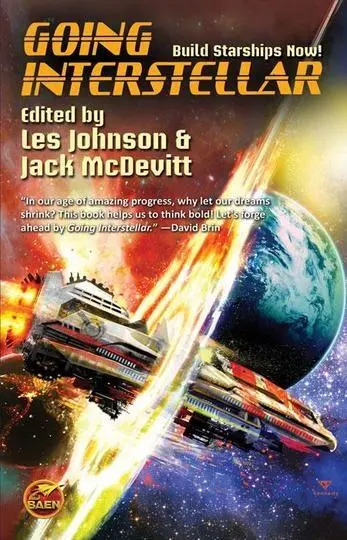
- Название:Going Interstellar
- Автор:
- Жанр:
- Год:неизвестен
- ISBN:нет данных
- Рейтинг книги:5 / 5. Голосов: 1
-
Избранное:Добавить в избранное
- Отзывы:
-
Ваша оценка:
Going Interstellar: краткое содержание, описание и аннотация
Предлагаем к чтению аннотацию, описание, краткое содержание или предисловие (зависит от того, что написал сам автор книги «Going Interstellar»). Если вы не нашли необходимую информацию о книге — напишите в комментариях, мы постараемся отыскать её.
Going Interstellar — читать онлайн бесплатно полную книгу (весь текст) целиком
Ниже представлен текст книги, разбитый по страницам. Система сохранения места последней прочитанной страницы, позволяет с удобством читать онлайн бесплатно книгу «Going Interstellar», без необходимости каждый раз заново искать на чём Вы остановились. Поставьте закладку, и сможете в любой момент перейти на страницу, на которой закончили чтение.
Интервал:
Закладка:
Okay,you want to go to the stars! If you are not in too much of a hurry, if you have lots of money and if you’ve got access to solar-system resources, there is a way. If we had to, we could probably manage all this in the not-too-distant future.
We’re talking about nuclear-fusion-propelled starships. A common physics joke goes something like this: “fusion is the energy source of the future and always will be!” But it may be that our first crude terrestrial fusion-power pilot plants will soon be ready. And space applications will inevitably follow.
Fusion will not provide Star-Trek style spacecraft. But it could propel and power robotic probes requiring a century or so to cross the interstellar gulf. Human-occupied ships requiring generations to cross between stars may also be fusion powered.
Although this type of experimental reactor (more properly called “thermonuclear fusion”) is still not on line, the physical basis for it has been around a long time. Humanity’s understanding of thermonuclear fusion (and other nuclear processes) can in fact be traced to Albert Einstein’s Miracle Year of 1905.
Early Fusion History
Few of his contemporaries would have guessed that Albert Einstein would change the world. Working as a Swiss patent clerk, this young German Jew had not distinguished himself in college. Without the help of his wife (also a physicist), Albert might not have completed the studies leading to his bachelor’s degree.
Hardly a man of action, young Albert was a dreamer. After work he would travel by tram to enjoy dinner with friends in local cafes and restaurants. He loved this mode of travel. One day, he daydreamed that the tram was a light beam upon which he was a passenger, looking back at the Earth. Suddenly, in a flash of inspiration, he had it! This was the secret of Special Relativity. For better or for worse, the Atomic Age was born.
For decades, physicists had grappled unsuccessfully with the observationally confirmed fact that the speed of light in vacuum was a constant 186,300 miles per second (300,000 kilometers per second). Even if you observed a laser projected from a starship passing at near-light speed, the velocity of the photons in the beam would still be measured as traveling at 186,300 miles per second.
As a consequence of this inconvenient truth, physicists had to accept the strange aspects of the Lorentz-Fitzgerald Contraction. As you observe a speeding starship fly past, it will be foreshortened or contracted. As its velocity approaches that of light, the Earth-bound observer will see the ship’s mass increase. Even less comprehensible, time on the ship will slow down. It sounds almost like Alice falling into the rabbit hole, or a Timothy Leary-style acid trip!
Today, the Lorentz-Fitzgerald Contraction is a verified aspect of the real world. But in the early twentieth century, it was still a theoretical novelty. And physicists such as Einstein struggled to fit it into their concepts of reality.
Another problem was magnetism. Since James Clerk Maxwell had derived his famous equations around 1870, physicists knew that electricity and magnetism were connected. Although they accepted the fact that electric charges in motion produced the force called magnetism, they wondered how this could be.
From the vantage point of his speeding trolley car, Einstein would form the framework for the solution to both problems. He proposed that time was a fourth dimension like the three familiar dimensions of height, length, and width. Combining the four-dimensional space-time geometry with a constant value for light speed in a vacuum, Einstein theoretically justified both the Lorentz-Fitzgerald Contraction and the existence of magnetism.
The explanation of magnetism was brilliant. Imagine an infinite line of electric charges, each separated from its neighbor by a constant distance. Any electric-field detector will measure a field strength depending on the device’s sensitivity and distance from the nearest charge. Now accelerate the charges up to a fraction of light speed. By the Lorentz-Fitzgerald Contraction, the separation between adjacent charges will decrease. More charges will be within the detector’s range and the measured field strength will increase.
Brilliant as this insight was, it was not enough to ensure Einstein’s future. So he labored to integrate gravity into relativity theory. The resulting theory, dubbed General Relativity, perceives the mass of a gravitating object (such as the Sun) as locally warping the four-dimensional fabric of space-time. Observations of stars near the solar limb during a post-World-War-One solar eclipse confirmed the predictions of general relativity. Einstein would go on to win a Nobel Prize and become a name equated by the general public with genius.
But in the publicity and excitement accompanying Einstein’s meteoric rise, a seemingly minor aspect of special relativity was generally ignored by non-physicists. From the imaginary vantage point of his light-speed trolley car, Einstein considered the total energy of a stationary object on Earth’s surface. Since the object was not moving, it had no kinetic energy (or energy of motion). Since it was at the same level as the Earth-surface reference frame, it had no potential energy (or energy of position). But it did posses “rest energy.” The quantity of rest energy is dependent upon the speed of light in vacuum (c) and the object’s mass (m). Rest energy is defined in that awesome expression:
Rest Energy = mc 2
Appearing in a footnote in one of Einstein’s special relativity papers, this definition of rest energy indicated that mass could be converted into energy and energy could be converted into mass. Physicists could no longer talk about the conservation of mass or the conservation of energy, but nature would now conserve “mass-energy.”
Specialists in the 1920s began to utilize mass-energy conversion and conservation in their research. Physical chemists such as Marie and Pierre Curie had pondered the question of how decay particles in radioactive processes obtained their energy. The obvious answer was that a small fraction of the mass of the decaying nucleus was converted into a particle’s kinetic energy.
Astrophysicists such as Sir Arthur Eddington had wondered how the Sun and other stars could maintain stability for the immense durations required by the fossil record. Once again, the answer required mass-energy conversion in the stellar interior.
But could humans ever tame this process or derive benefit from it? The answer came as war clouds were gathering once again in Europe. Fortunately for all of us, the censors in Nazi Germany were not well trained in nuclear physics or appreciative of its potential. As the Second World War approached, a group of German physicists solved the problem of tapping nuclear fission energy—and published their results in the open literature!
In 1938, it was known that one particular isotope of uranium—Uranium 235—was radioactive. When it decays by nuclear fission (splitting), this massive nucleus splits spontaneously into several less massive (daughter) nuclei and fast-moving (thermal) neutrons. It was also known that the fission of this nucleus could be induced by bombarding it with thermal neutrons. In their epochal paper, Otto Hahn, Lisa Meitner and Fritz Strassmann calculated the density of uranium required to trap emitted neutrons within the U-235 sample. The rapid reaction of uranium in the sample would produce enormous energy. It became known as the chain reaction.
Few realized it at the time, but this simple calculation would provide the basis of both the atomic bomb and the fission reactor. One who recognized the potential immediately was our old friend Albert Einstein.
Читать дальшеИнтервал:
Закладка:
Похожие книги на «Going Interstellar»
Представляем Вашему вниманию похожие книги на «Going Interstellar» списком для выбора. Мы отобрали схожую по названию и смыслу литературу в надежде предоставить читателям больше вариантов отыскать новые, интересные, ещё непрочитанные произведения.











Обсуждение, отзывы о книге «Going Interstellar» и просто собственные мнения читателей. Оставьте ваши комментарии, напишите, что Вы думаете о произведении, его смысле или главных героях. Укажите что конкретно понравилось, а что нет, и почему Вы так считаете.