Les Johnson - Going Interstellar
Здесь есть возможность читать онлайн «Les Johnson - Going Interstellar» весь текст электронной книги совершенно бесплатно (целиком полную версию без сокращений). В некоторых случаях можно слушать аудио, скачать через торрент в формате fb2 и присутствует краткое содержание. Жанр: Фантастика и фэнтези, Прочая научная литература, Прочая документальная литература, на английском языке. Описание произведения, (предисловие) а так же отзывы посетителей доступны на портале библиотеки ЛибКат.
- Название:Going Interstellar
- Автор:
- Жанр:
- Год:неизвестен
- ISBN:нет данных
- Рейтинг книги:5 / 5. Голосов: 1
-
Избранное:Добавить в избранное
- Отзывы:
-
Ваша оценка:
Going Interstellar: краткое содержание, описание и аннотация
Предлагаем к чтению аннотацию, описание, краткое содержание или предисловие (зависит от того, что написал сам автор книги «Going Interstellar»). Если вы не нашли необходимую информацию о книге — напишите в комментариях, мы постараемся отыскать её.
Going Interstellar — читать онлайн бесплатно полную книгу (весь текст) целиком
Ниже представлен текст книги, разбитый по страницам. Система сохранения места последней прочитанной страницы, позволяет с удобством читать онлайн бесплатно книгу «Going Interstellar», без необходимости каждый раз заново искать на чём Вы остановились. Поставьте закладку, и сможете в любой момент перейти на страницу, на которой закончили чтение.
Интервал:
Закладка:
Project Daedalus resulted in and inspired many papers published in dedicated issues of JBIS ( The Journal of the British Interplanetary Society ). In 2010, a follow-up BIS study called Project Icarus (after the son of mythological Daedalus who approached the Sun too closely and fell to his death in the Aegean) commenced.
Directed by another British researcher, Kelvin Long, Project Icarus aims to continue and update the Daedalus study. The target star is currently Alpha/Proxima Centauri. Not only is this the nearest star system to our Sun at a distance of about 4.3 light years (roughly 40 trillion miles) but the two central Centauri stars are sun-like and separated enough that multiple terrestrial planets may exist in stable orbits.
It is acknowledged that using fusion rockets to accelerate to and decelerate from 0.1c will require an enormous amount of fuel, but an un-decelerated probe that crosses the interstellar void in 50 years and then flies through the destination star system in just a few hours is not acceptable. It would be difficult to justify the expense and the effort for only a few hours worth of data. So Icarus researchers are considering non-rocket deceleration techniques. Approaches include reflecting the very tenuous interstellar plasma and/or the stellar wind(s) of the destination star(s) and using a light sail directed towards the destination star for terminal deceleration.
To again interject physics humor: the rest is simply a matter of engineering….
The Fusion Ramjet
Robert Bussard contributed to many aspects of fusion research. But when he finally achieved his fifteen minutes of fame in an episode of Star Trek: The Next Generation , his surname was pronounced “Buzzard.” What a pity for a true space visionary!
Bussard’s most famous contribution to the study of thermonuclear propulsion in space is the interstellar ramjet, which he considered in 1960. Although the Bussard interstellar ramjet may never be technologically feasible, it does represent one of the very few physically possible modes of interstellar transport that could be capable of near-light speed velocities.
In its pure form (Figure 3), the interstellar ramjet is both simple and elegant. Ahead of the spacecraft, some form of scoop projects an electromagnetic field with a diameter measured in thousands of kilometers. Interstellar protons and electrons, called a “plasma,” are directed towards the scoop by the specially tailored electromagnetic field. The plasma enters the ship and is directed to a fusion reactor at its core. Inside this reactor, plasma density and temperature are high enough to fuse protons and produce helium and energy. The energized helium exhaust is expelled from the rear of the spacecraft. As with any rocket, the reaction to the exhaust accelerates the spacecraft forward.
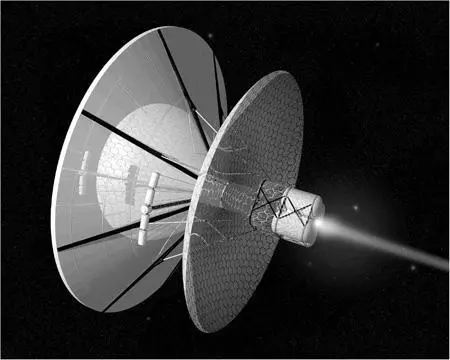
Figure 3. The Bussard interstellar ramjet would use interstellar hydrogen scooped from deep space propellant mass. (Image courtesy of NASA.)
The interstellar ramjet requires no on-board fuel. Both energy and reaction mass come from the local interstellar medium. In their epochal and very popular book Intelligent Life in the Universe (Holden-Day, San Francisco, 1966), the American astronomer Carl Sagan and his Russian co-author I. S. Shklovskii demonstrated the awesome potential of an ideal interstellar ramjet by showing how it could accelerate to nearly the speed of light—and cross the universe within the lifetime of the on-board crew (while, with thanks again to Special Relativity, billions of years elapsed on Earth).
One advantage of the ramjet is shielding from interstellar dust. Although micron-sized interstellar dust grains are very rare in the local interstellar medium, dust impacts at near the speed of light would have an effect worse than a stationary ship being impacted by multiple shotgun blasts. Such impacts may limit non-ramjet interstellar cruise velocities to a few percent of the speed of light. But since the flow of collected protons deep within the ship’s electromagnetic scoop field will collide with and atomize the fragile dust grains, ramjets will not be so limited in terms of cruise velocity.
A number of science-fiction authors have featured the interstellar ramjet in their stories. Perhaps most notably, the ramjet appeared more than once in Larry Niven’s Tales of Known Space , and propelled the crew of Leonora Christine on an impossible but entrancing voyage in Poul Anderson’s Tau Zero .
But, alas, rigorous scientific skeptics began to chip away at this most exciting concept. It was found that most electromagnetic scoops are efficient drag brakes, reflecting interstellar ions rather than collecting them. But this was not the most serious problem—by the mid-1970’s few believed that human technology could ever tame the proton-proton thermonuclear reaction. Even the catalytic carbon cycle may forever be beyond our capabilities.
There is a way around this, but it does not seem practical for high-speed flight. As tabulated by Eugene Mallove and Gregory Matloff in The Starflight Handbook (Wiley, NY, 1989), both deuterium and Helium-3 exist in the interstellar medium (and the solar wind) at concentrations of a few parts per hundred thousand. If it is possible generate electromagnetic scoop fields hundreds of thousands of kilometers across, collect the fusion fuel from the hydrogen ions, and fuse the deuterium and Helium-3, some form of ramjet might be possible. But it will be a far cry from the dream ships of Bussard, Sagan and Schlovskii, Anderson, and Niven.
Fortunately, the ramjet idea was too attractive to abandon. So a number of less capable alternatives to the proton-fusing ramjet have been proposed. Some of them might just work.
Many journal articles have been written in recent decades about interstellar propulsion using thermonuclear rockets or ramjets. Most of these articles have appeared in Acta Astronautica , an organ of the International Academy of Astronautics published by Elsevier Ltd. In Oxford UK and in The Journal of the British Interplanetary Society , published by the British Interplanetary Society in London.
A number of books have been written that review and describe the results of the technical papers. One of these, The Starflight Handbook (by Eugene Mallove and Gregory Matloff and published by Wiley in 1989) was designed to appeal to both technical and non-technical audiences.
A somewhat more recent, but more technical compendium is Prospects for Interstellar Travel (by John H. Mauldin for the American Astronautical Society and published by Univelt in San Diego CA in 1992).
The third and most up-to-date of the books considered here is the second edition of Deep Space Probes (by Gregory L. Matloff in 2005 for Springer-Praxis in Chichester, UK).
PROJECT ICARUS
A Theoretical Design Study for an Interstellar Spacecraft
Dr. Richard Obousy
“Standing on the shoulders of giants” definitely describes the task being undertaken by Richard Obousy and his colleagues as they work to design a realistic interstellar spacecraft based on state-of-the-art engineering. The shoulders upon which they stand belong to the Project Daedalus team that performed a similar study in the 1970s for The British Interplanetary Society. Led by Alan Bond, Project Daedalus became the standard by which all interstellar spacecraft concepts to follow were judged.
Читать дальшеИнтервал:
Закладка:
Похожие книги на «Going Interstellar»
Представляем Вашему вниманию похожие книги на «Going Interstellar» списком для выбора. Мы отобрали схожую по названию и смыслу литературу в надежде предоставить читателям больше вариантов отыскать новые, интересные, ещё непрочитанные произведения.











Обсуждение, отзывы о книге «Going Interstellar» и просто собственные мнения читателей. Оставьте ваши комментарии, напишите, что Вы думаете о произведении, его смысле или главных героях. Укажите что конкретно понравилось, а что нет, и почему Вы так считаете.