Les Johnson - Going Interstellar
Здесь есть возможность читать онлайн «Les Johnson - Going Interstellar» весь текст электронной книги совершенно бесплатно (целиком полную версию без сокращений). В некоторых случаях можно слушать аудио, скачать через торрент в формате fb2 и присутствует краткое содержание. Жанр: Фантастика и фэнтези, Прочая научная литература, Прочая документальная литература, на английском языке. Описание произведения, (предисловие) а так же отзывы посетителей доступны на портале библиотеки ЛибКат.
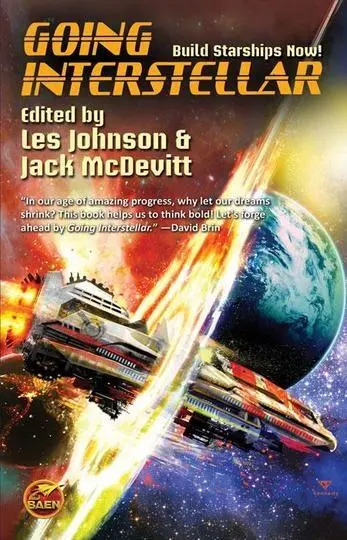
- Название:Going Interstellar
- Автор:
- Жанр:
- Год:неизвестен
- ISBN:нет данных
- Рейтинг книги:5 / 5. Голосов: 1
-
Избранное:Добавить в избранное
- Отзывы:
-
Ваша оценка:
Going Interstellar: краткое содержание, описание и аннотация
Предлагаем к чтению аннотацию, описание, краткое содержание или предисловие (зависит от того, что написал сам автор книги «Going Interstellar»). Если вы не нашли необходимую информацию о книге — напишите в комментариях, мы постараемся отыскать её.
Going Interstellar — читать онлайн бесплатно полную книгу (весь текст) целиком
Ниже представлен текст книги, разбитый по страницам. Система сохранения места последней прочитанной страницы, позволяет с удобством читать онлайн бесплатно книгу «Going Interstellar», без необходимости каждый раз заново искать на чём Вы остановились. Поставьте закладку, и сможете в любой момент перейти на страницу, на которой закончили чтение.
Интервал:
Закладка:
A more comprehensive discussion of the physics of thermonuclear fusion may be found in Dr. Gregory Matloff’s companion essay in this book. Briefly summarized, fusion is a process whereby two atoms are provided with sufficient kinetic energy to merge and create a larger atom and some by-products. Energy is created in the form of electromagnetic radiation and the vast amounts of kinetic energy contained in the new products that are formed from the reaction.
To give some perspective, fusion processes liberate approximately one million times more energy than even the most powerful chemical reactions. Imagine, for a moment, a hypothetical car of the future, where just one gram of fusion fuel could, in theory, power the vehicle for its entire lifetime. This is, of course, a huge oversimplification, and probably not feasible based on the mechanical architecture that would be necessary to harness the fusion energy, but it emphasizes the point quite nicely. Indeed, fusion processes are what have powered our own star, the Sun, for about five billion years, and will continue to do so for five billion years more.
Fusion has been understood since the early twentieth century, and efforts to harness the energy have been ongoing for most of the latter half of the twentieth century. To date, the only effective utilization of fusion energy has been in rapid and uncontrollable thermonuclear bombs, generally referred to as H-bombs. However, the controlled release of energy in power stations has not yet reached a sustainable break-even which is a situation where more energy is released than is actually put in to create the reaction in the first place. Despite this contemporary lack of success, many believe it is simply a matter of time until the technology is perfected. Indeed, progress in experimental fusion reactors has been consistent for a number of decades.
Inertial Confinement Fusion (ICF) is considered a promising approach to fusion propulsion. In ICF the charged reaction products themselves are turned directly into thrust via magnetic nozzles. This process leads to far fewer thermodynamic losses and enables much of the fusion energy to be channeled to create thrust for the spacecraft. The Daedalus spacecraft was to be powered by ICF.
The Project Icarus group has identified no less than seventeen unique approaches to nuclear fusion, including plasma jet driven magneto-inertial confinement fusion, z-pinch fusion, antimatter catalyzed fusion and electrostatic inertial confinement fusion. At the current phase in the project, no one method has yet shown to be a favorable fusion technique that would prove ideal for an interstellar mission. However, research continues, and in the future a candidate will be selected.
Alan Bond and Tony R. Martin, “Project Daedalus Reviewed”, JBIS, V39, pp. 385-390, 1986.
A. Bond & A. Martin, Project Daedalus : The Final Report on the BIS Starship Study, JBIS, special Supplement, S1-S192, 1978.
Terry Kammash, “Fusion Energy in Space Propulsion”, Progress in Astronautics and Aeronautics, V167, 1995.
DESIGN FLAW
Louise Marley
Proceed as far into the future as you like, possibly even to the glorious day when we are wandering quietly around the solar system, basking in its wonders, and we will undoubtedly discover that some of the worst aspects of our tribal instincts are still with us, especially the one that divides people by religious belief, ethnic background, or even the baseball team they root for. One particularly irritating aspect that promises to resist going away may well be the way in which males with ego problems treat women. After all, it’s probably the only thing they have.
“Hey, Itty Bit!Haul ass, would ya?”
Isabet floated up into the maintenance tube, pushing with her feet until she could grasp the first hand rung. “You think you could do it faster, Tie Dye?”
He gave an irritated grunt. “That’s Mr. Dykens to you, Tech.”
“Yeah,” she muttered, wriggling herself further along the tube. “When you call me by my name, I’ll call you Mister. Maybe.”
“What was that?” he shouted behind her.
“Or maybe not,” she added, under her breath. “Fat bastard.”
It wasn’t as if he—or any of the other engineers—could come after her. The tube was no more than twenty inches in diameter, and Dykens wore an extra-large utility suit. The other engineers were not as big as he was, but not one of them could have squeezed into the tube, and certainly not with a tool belt strapped around him. It was up to her and the other ring techs, Ginger and Skunk and Happy and the others, to slither along the maintenance tubes, to check the joints and monitor the ’stats and the flow meters. Tie Dye could yell at her all he wanted to, but if anything went wrong with the containment ring, the North America would be dead in space, antimatter leaking out every which way. Dykens’s big butt would be as dead as anyone else’s, stuck out here halfway to the habitat, in orbit around Ganymede, whining as their food and air ran out. It was obvious he had never huddled in a shelter for days without food.
She sure as hell had.
Isabet blew out an angry breath as she slid deeper into the tube. She kept telling herself it didn’t do any good to be pissed at him. It was just the way he was. He wasn’t the only one, either. It was true of a lot of the crew. For one thing, most of them thought ring techs were superfluous. They conveniently forgot the failure of the North America’s first containment ring and the resulting discharge of expensive antimatter, all because the mechanical sensors were off by a fraction of a millimeter. And then, leaving aside their short memories, the other crew members seemed to think that because ring techs were small, they could push the techs around. Crew members grinned when they saw them, as if the ring techs were kids playing grown-up. The other crew members patted their heads and made jokes about their extra-extra-small utility suits. Ring techs were housed in quarters barely big enough to stand up in. They slept in cots so cramped the techs called them coffins. They were allowed only three showers a week, while the rest of the crew got five.
Command didn’t seem to particularly care that three hundred crew depended on six techs. It was Government that insisted on the use of human monitors as backup. Command had to do as it was told, but as far as Isabet and the others could tell, once the ship was under way, the ring techs had been all but forgotten.
It made her blood pound to think about it, but then, a lot of things made her blood pound.
It took ten minutes to reach the ’stat that was on her assignment list, and by the time she did, she felt better. She liked the solitude of the tube. No one could get to her, no one could bother her. It was calming. She flipped up the cover of the ’stat and eyed it. It wasn’t part of the protocol, but she always did a visual scan first. Tie Dye would be surprised to know how much Isabet understood of what the ’stats recorded about the containment ring. She could have told him all about pressure differentials and temperature variations and magnetic flux. She didn’t, though. She tried not to talk to him any more than she had to.
Everything looked fine. She pulled the remote from her belt, pinning herself to one side of the tube in order to get her hand down and then up again. She clamped the remote into its holder, and waited the three seconds it took to record the reading. Finished, she started the long backward slide back to Engineering.
Читать дальшеИнтервал:
Закладка:
Похожие книги на «Going Interstellar»
Представляем Вашему вниманию похожие книги на «Going Interstellar» списком для выбора. Мы отобрали схожую по названию и смыслу литературу в надежде предоставить читателям больше вариантов отыскать новые, интересные, ещё непрочитанные произведения.











Обсуждение, отзывы о книге «Going Interstellar» и просто собственные мнения читателей. Оставьте ваши комментарии, напишите, что Вы думаете о произведении, его смысле или главных героях. Укажите что конкретно понравилось, а что нет, и почему Вы так считаете.