Les Johnson - Going Interstellar
Здесь есть возможность читать онлайн «Les Johnson - Going Interstellar» весь текст электронной книги совершенно бесплатно (целиком полную версию без сокращений). В некоторых случаях можно слушать аудио, скачать через торрент в формате fb2 и присутствует краткое содержание. Жанр: Фантастика и фэнтези, Прочая научная литература, Прочая документальная литература, на английском языке. Описание произведения, (предисловие) а так же отзывы посетителей доступны на портале библиотеки ЛибКат.
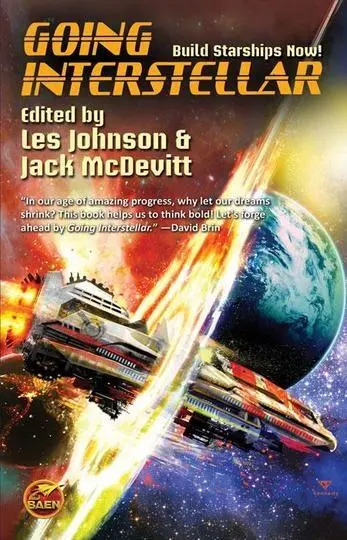
- Название:Going Interstellar
- Автор:
- Жанр:
- Год:неизвестен
- ISBN:нет данных
- Рейтинг книги:5 / 5. Голосов: 1
-
Избранное:Добавить в избранное
- Отзывы:
-
Ваша оценка:
Going Interstellar: краткое содержание, описание и аннотация
Предлагаем к чтению аннотацию, описание, краткое содержание или предисловие (зависит от того, что написал сам автор книги «Going Interstellar»). Если вы не нашли необходимую информацию о книге — напишите в комментариях, мы постараемся отыскать её.
Going Interstellar — читать онлайн бесплатно полную книгу (весь текст) целиком
Ниже представлен текст книги, разбитый по страницам. Система сохранения места последней прочитанной страницы, позволяет с удобством читать онлайн бесплатно книгу «Going Interstellar», без необходимости каждый раз заново искать на чём Вы остановились. Поставьте закладку, и сможете в любой момент перейти на страницу, на которой закончили чтение.
Интервал:
Закладка:
“We’re a long way from the sun,” Isabet said. She felt a faint disappointment that Ginger didn’t share her admiration for the magnificence of the alien world. “Wait till you see Starhold ,” she said. “You won’t think that’s dim.” She yearned to see the inside of the habitat, but she didn’t say so. There wasn’t much chance of that happening, and the others wouldn’t understand.
A half hour passed, with Ginger gulping nausea, and even Skunk groaning once or twice. Isabet felt the acceleration as the ship changed its trajectory, but her stomach didn’t react. She clung to the bar beneath the window, and waited with gleeful anticipation for her first glimpse of Starhold One .
“There it is!” She pressed as close to the icy plexiglass as she could, peering out into the layered darkness. It was tiny at first, a star among stars, only discernible because she knew it had to be there. The North America rolled as it aligned with the docking ports. Isabet fastened her gaze on the habitat’s yellow and amber lights. She could pick out the lighted column of the vacuum elevator, revealed in fragments by the myriad windows. The habitat, silver and ovoid, shone dully against the backdrop of space. Layers of fuel cells spiraled around it, making it look like a gigantic seashell.
“Is that it?” Ginger asked. “That egg-shaped thing?”
“Yes,” Isabet said. “That’s it. Starhold One .”
“Why One?”
“Because there will be others, as we go further out,” Isabet said. “Space Service already has plans for two more. They’re mining Ganymede, and building an antimatter plant.”
“Why?” Ginger asked.
Isabet, startled, glanced across at her friend. Ginger stared vaguely at the habitat, but without real interest. “Why what?”
“Why build others? What good are they?”
“What good ?” Isabet’s voice squeaked with surprise. “We need them if we’re going to explore space, get out into the universe!”
Ginger shrugged as if the whole idea were of no interest.
“Ginger!” Isabet said. Suddenly it seemed vital that her friend understand the immensity of the achievement. “We’re building an interstellar ship, you know. It’s going to be five times the size of North America , and carry a crew outside the solar system! It’s the most amazing thing human beings have ever done, the biggest ship ever built—and to power it, we need lots of antimatter.”
“Geez,” Happy said. “That’s gotta be one really big containment ring.”
“Enormous,” Isabet said with satisfaction. “Imagine working on that ship, Happy! Going out into real space, instead of just between Ganymede and Earth.”
“Naw,” he said. “They’ll fix the monitor design by then. They won’t take us.”
“I’m going to find a way to go,” Isabet insisted.
“I don’t know.” Ginger sighed, leaning against the frame of the window. “We have enough problems at home, don’t you think?”
“Don’t worry about it, Ginger,” Skunk said. “We’ll never live to see it, anyway.”
“Come on, Skunk!” Happy cried. “Why so dour?”
“Because it’ll take decades, and ring techs don’t live that long.”
“We’re tested all the time,” Isabet said absently. “We’re fine.”
“Tested!” Skunk said bitterly. “You realize the norms for us are twice what they are for the rest of the crew?”
“Are they?” Ginger said, pulling back from the window as if it were the source of the poisonous rays.
“Skunk’s exaggerating,” Happy said.
Isabet turned her head to her friends. “No, Skunk’s right. They say, though, that when we’re Earthside our readings return to normal levels.”
“Do you believe them?” Ginger said, her voice rising.
Isabet shrugged. “I guess.”
“Believe if you want to,” Skunk said. “But don’t have babies.”
“None of us are having babies.” Isabet turned back to the window to watch Starhold grow. It was both massive and graceful, with a halo of light that faded the stars. She had studied the diagrams of its construction, pored over the blueprints of its hydroponic level and command deck with its crown of communication and power arrays. She had seen the cubbies and the gallery level in the video, and the men and women smiling into the camera. They looked friendly and smart. Starhold , to Isabet, looked like a home, the home she had never had. She thought she would willingly take a blast of G-rays if she could go in and see it for herself.
Isabet pushed off the inner surface of the maintenance tube, keeping her feet and hands free to maintain her momentum. She shot out into Engineering so that her feet bounced on the floor, grabbing the gravity borrowed from the habitat. Laughing, she straightened with a little hop. It felt good to have weight, even though it was only half gravity. She turned, bouncing on her toes, and found Tie Dye standing with a scowling woman Isabet hadn’t met before.
Isabet unclipped her remote and held it out to Tie Dye. She grinned up at the woman. “Hiya. Looking for me?”
The woman wore the insignia of a supply officer on her utility suit. She folded her arms, as if to discourage familiarity. Like the rest of the crew, she looked as if she had never lacked for nutrition in her life. She was tall, her skin smooth, her hair thick and shining. Isabet resisted the urge to touch her own ragged mop. She cut it herself, keeping it short to hide how coarse and dry it was.
Tie Dye said, “That’s Isabet, but she’s too small.”
“They’re all small, aren’t they?”
“Yeah, but she’s the smallest.”
“Let’s find the rest of them, then.” The woman turned toward the hatch that led to the ring techs’ quarters, Tie Dye behind her.
Isabet said, “Wait! At least tell me what it’s for.”
Tie Dye snapped, “Mind your own business, Itty Bit.”
At that, the supply officer stopped. She glanced briefly in Isabet’s direction, then directed her scowl at Tie Dye. “I thought you said her name was Isabet.”
He shrugged. “Yeah. Itty Bit’s a nickname.”
“Which I loathe,” Isabet murmured.
The woman’s eyelids flickered in acknowledgment. Her scowl deepened. “You want to watch yourself, Dykens. You’re a topnotch engineer, but you’re getting a reputation.”
Isabet chewed on the inside of her cheek, trying not to laugh as Tie Dye’s half-bald scalp reddened. When the officer turned back to her, she stood very straight, trying to look as tall as she could. “What’s up?” she asked brightly.
The officer measured Isabet with her eyes. “You are a bit small,” she said. “But we need to replace one of our warehousemen. He wrenched his back.”
“What’s the job?”
“Moving supplies into Starhold . There’s a lot of them, and some of them are heavy.”
“They’re on dollies, though, aren’t they? I can manage.”
Tie Dye opened his mouth, but Isabet hastened to speak again before he could make some pronouncement on her abilities. “I’m strong, ma’am,” she said, ignoring the roll of Tie Dye’s eyes at her sudden courtesy.
The officer’s hard gaze swept over Isabet. “You want to do this?” she said. “It’s going to be hard. It’s a year’s worth of supplies.”
Isabet nodded. “Yes, ma’am. I do want to. Nice to do something that’s not squeezing through the maintenance tube.”
The faintest twitch of the officer’s lips greeted this confession, disappearing almost before it registered. Tie Dye grunted, and started to say something, but the officer put up one admonishing finger, and he subsided. “Report to the supply deck in half an hour, Tech,” she said. “Thanks for volunteering.” And as Tie Dye heaved an exasperated sigh, the officer said in a dry tone, “You get to volunteer, too, Dykens. It’s a big job.”
Читать дальшеИнтервал:
Закладка:
Похожие книги на «Going Interstellar»
Представляем Вашему вниманию похожие книги на «Going Interstellar» списком для выбора. Мы отобрали схожую по названию и смыслу литературу в надежде предоставить читателям больше вариантов отыскать новые, интересные, ещё непрочитанные произведения.











Обсуждение, отзывы о книге «Going Interstellar» и просто собственные мнения читателей. Оставьте ваши комментарии, напишите, что Вы думаете о произведении, его смысле или главных героях. Укажите что конкретно понравилось, а что нет, и почему Вы так считаете.