Les Johnson - Going Interstellar
Здесь есть возможность читать онлайн «Les Johnson - Going Interstellar» весь текст электронной книги совершенно бесплатно (целиком полную версию без сокращений). В некоторых случаях можно слушать аудио, скачать через торрент в формате fb2 и присутствует краткое содержание. Жанр: Фантастика и фэнтези, Прочая научная литература, Прочая документальная литература, на английском языке. Описание произведения, (предисловие) а так же отзывы посетителей доступны на портале библиотеки ЛибКат.
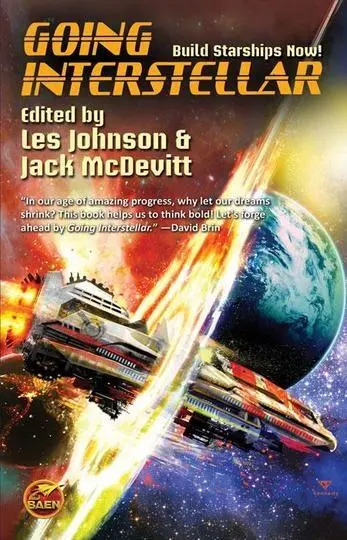
- Название:Going Interstellar
- Автор:
- Жанр:
- Год:неизвестен
- ISBN:нет данных
- Рейтинг книги:5 / 5. Голосов: 1
-
Избранное:Добавить в избранное
- Отзывы:
-
Ваша оценка:
Going Interstellar: краткое содержание, описание и аннотация
Предлагаем к чтению аннотацию, описание, краткое содержание или предисловие (зависит от того, что написал сам автор книги «Going Interstellar»). Если вы не нашли необходимую информацию о книге — напишите в комментариях, мы постараемся отыскать её.
Going Interstellar — читать онлайн бесплатно полную книгу (весь текст) целиком
Ниже представлен текст книги, разбитый по страницам. Система сохранения места последней прочитанной страницы, позволяет с удобством читать онлайн бесплатно книгу «Going Interstellar», без необходимости каждый раз заново искать на чём Вы остановились. Поставьте закладку, и сможете в любой момент перейти на страницу, на которой закончили чтение.
Интервал:
Закладка:
Named for Icarus, Daedalus’ son who flew too close to the Sun and fell to his death, Obousy’s international team is designing a craft that will hopefully avoid its namesake’s mistakes and harness the power of the sun to someday give us the stars—Project Icarus .
Kepler , launched in 2009,is the first NASA mission designed explicitly to search for planets orbiting other stars. On Saturday 19th February 2011, the project scientist for Kepler , Dr. William Borucki, estimated that there are at least fifty billion exoplanets in our galaxy. Perhaps more tantalizing is the probability that five hundred million of these alien worlds are inside the habitable zones of their parent stars. So just how many of these exoplanets contain life? Unfortunately, there’s no good answer to that question, but given such vast numbers of potentially habitable worlds, the question is, Where is ET?
This is, of course, the famous Fermi Paradox, an apparent contradiction between the high estimates of the probable existence of extraterrestrial civilizations and the disconcerting lack of evidence for such civilizations.
Many assumptions regarding the ability of an alien civilization to effectively colonize other solar systems are based on the premise that interstellar travel is, in fact, technologically possible. However, one early proposed solution to the Fermi Paradox was that interstellar travel on timescales of tens, or hundreds, of years is impossible. Project Daedalus , a study conducted in the 1970s by members of The British Interplanetary Society, was a bold effort to examine this very question. The project was essentially a feasibility study for an interstellar mission, using capabilities appropriate to the era, with credible extrapolations for near-future technology.
One of the major objectives was to establish whether interstellar flight could be realized within established science and technology. The conclusion was that it is feasible. Although our current understanding of the laws of physics rules out the possibility of superluminal travel, it does appear that there are no major theoretical barriers to the construction of rapid, sublight, interstellar ships.
The final Daedalus design had a total dry mass of greater than 2600 hundred tons, of which 450 tons was the science payload. The propellant mass was fifty thousand tons of Deuterium and Helium-3. The latter component of the fuel is incredibly rare on Earth. However, it is found in abundance on the gas giants of the solar system. Thus, a component to the Daedalus project entailed mining Helium-3 from Jupiter. Because of the huge mass of the spacecraft, and the necessary Jovian mining aspect of the mission, the Project Daedalus study group determined that such a spacecraft could probably only be constructed as part of a solar-system-wide economy with abundant resources at its disposal. Daedalus , from the perspective of 1970s science, was deemed to be effectively unavailable in the near-term future.
This would place its earliest likely construction date somewhere circa 2200. However, numerous technologies have advanced since the 1970s, including microprocessor technology, materials science, nanotechnology, fusion research and also our knowledge of the local interstellar neighborhood. It seemed timely then to revisit the Project Daedalus study, and the successor initiative, Project Icarus , officially began in September 2009 at a meeting in London at the headquarters of the British Interplanetary Society (BIS). This theoretical engineering design study is a project under the umbrella of the Tau Zero Foundation and The BIS.
Project Icarus has its origins in late 2008 during discussions between Kelvin Long and NASA physicist Marc Millis, who left NASA to become President of the Tau Zero Foundation. These discussions led to a proposal for a study based upon a redesign of Daedalus . The study was to include an examination of the fundamental assumptions, for example, of whether Daedalus should be strictly a flyby mission, or should participate in mining Jupiter for Helium-3.
In 2008, several members of the original Daedalus Study Group were approached and asked to participate in a new study. Project Icarus was born. To increase the visibility of Project Icarus , a presentation was given by Long at a special session on interstellar flight at the Charterhouse Space Conference during 2009. After several months of recruitment, over a dozen volunteer designers and consultants joined the project.
The official launch of Project Icarus was recorded in Spaceflight magazine, and a number of the original Project Daedalus study group were in attendance. These included Alan Bond, Bob Parkinson, Penny Wright, Geoff Richards, Jerry Webb and Tony Wight. The founding members of Project Icarus at this event also included Martyn Fogg, Richard Obousy, Andreas Tziolas and Richard Osborne. Others present who were later recruited to the team included Pat Galea, Ian Crawford, Rob Swinney and Jardine Barrington-Cook. The membership continues to grow.
Icarus was a character from ancient Greek mythology. In an attempt to escape the labyrinth prison of King Minos, his father Daedalus fashioned a pair of wings made of feathers and wax for both himself and his son. Icarus, so the story goes, flew too close to the Sun and the wax on his wings melted. He fell into the sea and died after having touched the sky.
To paraphrase Sir Arthur Eddington from Stars and Atoms , the standard interpretation of the Icarus myth is that he was a man performing a stunt who met his ill-fated doom due to his antics. However, an alternative interpretation of the myth is that he is the man who illuminated a serious constructional deficiency in the flying machines of his era. Perhaps there is also a lesson for science here. A more cautious Daedalus applies his theories only where he feels confident they will succeed; but by his overindulgent caution, their veiled faults remain undiscovered. Conversely, Icarus will drive his theories to the threshold of collapse, and we may at least hope to learn from his flight how to construct a better machine.
Project Icarus , as the successor to Project Daedalus , is a theoretical engineering design study for an unmanned interstellar craft. Its overall purpose can be summarized as follows:
• To design a credible interstellar probe that embodies the essential concepts for a successful mission in the coming centuries.• To allow a direct technology comparison with Daedalus and provide an assessment of the maturity of fusion-based space propulsion for future precursor missions.• To generate greater interest in the real term prospects for interstellar precursor missions that are based on credible science.• To motivate a new generation of scientists to be interested in designing space missions that go beyond our solar system.
Using these four purposes as a guide, the collective scope of the project is codified in the Icarus Terms of Reference:
1. To design an unmanned probe that is capable of delivering useful scientific data about the target star, associated planetary bodies, solar environment and the interstellar medium.2. The spacecraft must use current or near-future technology and be designed to be launched as soon as is credibly determined.3. The spacecraft must reach its stellar destination within as short a time as possible, not exceeding a century and ideally much sooner.4. The spacecraft must be designed to visit any one of a variety of target stars.5. The spacecraft propulsion must be mainly fusion based (e.g. Daedalus ).6. The spacecraft mission must be designed so as to allow some deceleration for increased encounter time at the destination.
Читать дальшеИнтервал:
Закладка:
Похожие книги на «Going Interstellar»
Представляем Вашему вниманию похожие книги на «Going Interstellar» списком для выбора. Мы отобрали схожую по названию и смыслу литературу в надежде предоставить читателям больше вариантов отыскать новые, интересные, ещё непрочитанные произведения.











Обсуждение, отзывы о книге «Going Interstellar» и просто собственные мнения читателей. Оставьте ваши комментарии, напишите, что Вы думаете о произведении, его смысле или главных героях. Укажите что конкретно понравилось, а что нет, и почему Вы так считаете.