Les Johnson - Going Interstellar
Здесь есть возможность читать онлайн «Les Johnson - Going Interstellar» весь текст электронной книги совершенно бесплатно (целиком полную версию без сокращений). В некоторых случаях можно слушать аудио, скачать через торрент в формате fb2 и присутствует краткое содержание. Жанр: Фантастика и фэнтези, Прочая научная литература, Прочая документальная литература, на английском языке. Описание произведения, (предисловие) а так же отзывы посетителей доступны на портале библиотеки ЛибКат.
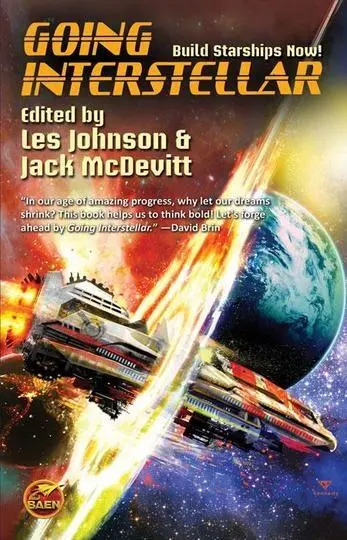
- Название:Going Interstellar
- Автор:
- Жанр:
- Год:неизвестен
- ISBN:нет данных
- Рейтинг книги:5 / 5. Голосов: 1
-
Избранное:Добавить в избранное
- Отзывы:
-
Ваша оценка:
Going Interstellar: краткое содержание, описание и аннотация
Предлагаем к чтению аннотацию, описание, краткое содержание или предисловие (зависит от того, что написал сам автор книги «Going Interstellar»). Если вы не нашли необходимую информацию о книге — напишите в комментариях, мы постараемся отыскать её.
Going Interstellar — читать онлайн бесплатно полную книгу (весь текст) целиком
Ниже представлен текст книги, разбитый по страницам. Система сохранения места последней прочитанной страницы, позволяет с удобством читать онлайн бесплатно книгу «Going Interstellar», без необходимости каждый раз заново искать на чём Вы остановились. Поставьте закладку, и сможете в любой момент перейти на страницу, на которой закончили чтение.
Интервал:
Закладка:
“In contrast, the islands of the north lay scattered across the many weather bands of that more moderate hemisphere. If we discover that our first site there is not optimal, relocation is quite feasible, using local means. Also, since there are many separate islands, it will be possible to establish widely-separated communities and so ensure that they could not all fall victim to any one disastrous event, such as a tidal wave or sequence of hurricanes. In establishing multiple, smaller communities, we ensure the survival of our race.”
And as he said it, he knew the Evolved executive collective before him had already dismissed his concerns. They would no doubt tell themselves that Intendant Harrod was unduly obsessed with mishaps, was prone to worrying about risks that were phantoms of his imagination, rather than actual dangers.
But the real reason they dismissed his analysis was because Evolveds were not merely given to contention, but sought it out. It was how they exhibited and lived their mandate to dominate. Set down in small, separated settlements, they would have no arena in which to highlight their personal prowess, no neighbors against which to pit their wills. In short, they would insist upon settling together: an eternally bickering pack of would-be tyrants.
Bikrut raised his chin. “A most adequate presentation, Intendant. We will not detain you from your preparation of the next wave of helot settlers. The landing craft are nearing readiness?”
“They are all fully operational, my Overlord. Several are already shuttling down advance supplies for the settlement. Intendant Ackley is organizing that labor most effectively.”
“And so he assures his continued survival. I want you and him to coordinate the dismantling of the command hull’s escape pods beginning next week: their fuel and subsystems will be urgently needed planetside. You may leave.”
And so Harrod did, first exiting the sleek bridge module, then the much bulkier command hull to which it was attached, and heading aft fifty meters along the keel-way of the Ark. Here he slipped through a hatchway coupling cube and emerged into a zero-gee habitation module, reserved for the recently decanted helots. They stood as he entered.
“Intendant,” said their leader with a deep bow. When he straightened, Harrod saw that it was the same one who had helped him up after his scourging. The helot smiled; Harrod returned it reflexively—and thought: Bikrut is right. I lack the domineering hauteur of the Evolved; I can’t be one of them.
He motioned for the helots to gather around; this day would be their first spent under a full gee in the spinning habitation modules. They would be cramped there, but it was essential to ready as many of them as possible for—
A sound that Harrod had only heard once before—during the Ark’s first systems test, seventy-five years ago—stunned him now: the emergency klaxon. Without a word to the helots, he turned to rush out of the big, boxy hab module—but the door to the coupler autosealed with a breathy hiss.
Stunned, Harrod stared at the closed hatchway for a moment, then paged the bridge—only to find that there was already a line paging him. Not recognizing the code, he answered, curious and cautious: “Hello?”
“Hello, Harrod.” The voice was Ackley’s. “Where are you?”
“In the zerogee hab modules. With the helots.”
“Excellent. Stay there. You’ll be safe.”
“What do you mean, ‘I’ll be safe?’ Safe from what?”
“It will be over very soon.”
“What will?”
Ackley paused as if startled at Harrod’s naiveté. “The destruction of House Mellis, of course.”
There was a muffled blast, a heavy impact that sent Harrod and the helots reeling aft, and the faint squeal of deforming metal near the module coupler hatch. “What—what in the name of the Death Fathers are you doing, Ackley?”
“Killing those who killed us—before they can finish the job. The jolt you felt was one of the cryogenic hive-modules being blown free of the Courser .”
“But—-how?”
“Simple, really. We doubled each coupler cube’s separator charges when Bikrut had us run a systems check. Put in radio-operated triggers. We guessed that would be enough to tear each module free of the main hull. Seems we were right.”
“How many—how many are you ‘jettisoning’?”
“Intendant: what a question. Why, all of them, of course. They killed almost four hundred of us. Now we’re killing twenty-eight hundred of them. Since one of us is worth ten of them, they’ve still got the better part of the deal. But not for long.” His voice lowered. “Harrod, give me the access codes for the bridge module.” In the background, Harrod now heard faint gunshots, two screams, the hissing rattle of a machine pistol.
“I don’t know the access codes,” Harrod lied.
“Of course you do.” Ackley didn’t even sound moderately annoyed.
And Harrod thought: am I so predictable, then? Well yes, I suppose I am. “No, I really don’t know the codes.”
“Harrod, we have already tortured one of these curs—and he insisted that you do know the codes. Insisted quite emphatically.”
“He must be mistaken, then.”
“Really? I wasn’t under the impression that Overlord Bikrut’s second son would be so terribly misinformed.” Ackley’s tone became more intimate. “Listen, Harrod: you don’t understand. You are being offered a signal honor: cooperate now, and the new Overlord Shaddock will Raise you up. A full integration of your seed in the House’s First Line. You are the only creature bearing the name Mellis who will survive this day— if you cooperate.”
Harrod felt the whip upon his back, tasted the broken promises of his Raising, but also saw the slaughter that would ensue if the vengeful survivors of House Shaddock entered the bridge module, which was probably where the women and children of House Mellis had taken shelter. “I—I cannot give you the codes. I cannot be the instrument of so much senseless killing.”
“Killing, yes; senseless, no.” Ackley’s tone was chillingly casual. “It makes quite a lot of sense to kill people who have already proven that they would cheerfully kill all of us in our cryocells—if they didn’t need some of our pilots to fly their away-craft. Speaking of which, this is your last chance—because if we don’t get the codes, we’re leaving.”
Harrod felt that, although he was motionless, the world around him was spinning furiously. “Leaving?”
“Of course. If we can’t seize the Courser , then we will take the away-craft. And I’m sorry, but we’ll have to harm your pretty ship a bit as we leave. Harrod, this is your last chance.” A moment of silent waiting; then another sputter of gunfire. “Very well, Harrod. Your death—and only yours—is a waste. Your skills will be missed.”
And the circuit went dead. At the same moment, explosions rocked the ship, first pushing strongly from aft—the engines, no doubt—and then light but irregular buffeting from the other three points of the compass.
“What was that?” asked the leader of the helots.
Harrod moved to inspect the coupler. “The first jolt was the engines being sabotaged. The next was our electromagnetic shielding pods being blasted free. Without them, the radiation levels in this hull will climb rapidly. And without our engines …” House Shaddock had crippled the Ark itself. At first it seemed madness, but then Harrod perceived—and conceded—the canny inspiration behind that madness. Since House Shaddock could not hold the ship—and therefore, the high ground—it was necessary that the enemy’s seat of power be rendered useless. And that is what they had done to Photrek Courser : damaged engines and an absence of radiation shielding made this once mighty Ark a death ship. Whether it spiraled in toward the seas of Senrefer Tertius Seven, or was sucked in years later by the gas giant itself was hardly worthy of debate: in the end, the great Ark, the enabler of any further Rites of Exile, was gone. In its place was only the unremitting contention and enmity of the rival Houses.
Читать дальшеИнтервал:
Закладка:
Похожие книги на «Going Interstellar»
Представляем Вашему вниманию похожие книги на «Going Interstellar» списком для выбора. Мы отобрали схожую по названию и смыслу литературу в надежде предоставить читателям больше вариантов отыскать новые, интересные, ещё непрочитанные произведения.











Обсуждение, отзывы о книге «Going Interstellar» и просто собственные мнения читателей. Оставьте ваши комментарии, напишите, что Вы думаете о произведении, его смысле или главных героях. Укажите что конкретно понравилось, а что нет, и почему Вы так считаете.