Les Johnson - Going Interstellar
Здесь есть возможность читать онлайн «Les Johnson - Going Interstellar» весь текст электронной книги совершенно бесплатно (целиком полную версию без сокращений). В некоторых случаях можно слушать аудио, скачать через торрент в формате fb2 и присутствует краткое содержание. Жанр: Фантастика и фэнтези, Прочая научная литература, Прочая документальная литература, на английском языке. Описание произведения, (предисловие) а так же отзывы посетителей доступны на портале библиотеки ЛибКат.
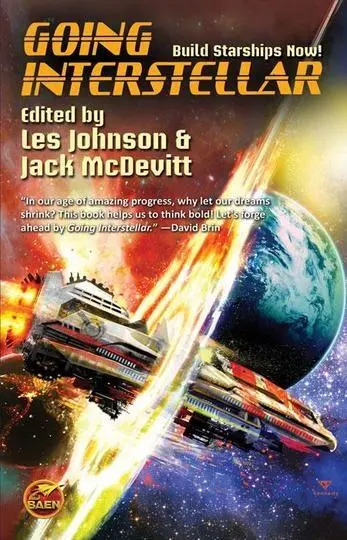
- Название:Going Interstellar
- Автор:
- Жанр:
- Год:неизвестен
- ISBN:нет данных
- Рейтинг книги:5 / 5. Голосов: 1
-
Избранное:Добавить в избранное
- Отзывы:
-
Ваша оценка:
Going Interstellar: краткое содержание, описание и аннотация
Предлагаем к чтению аннотацию, описание, краткое содержание или предисловие (зависит от того, что написал сам автор книги «Going Interstellar»). Если вы не нашли необходимую информацию о книге — напишите в комментариях, мы постараемся отыскать её.
Going Interstellar — читать онлайн бесплатно полную книгу (весь текст) целиком
Ниже представлен текст книги, разбитый по страницам. Система сохранения места последней прочитанной страницы, позволяет с удобством читать онлайн бесплатно книгу «Going Interstellar», без необходимости каждый раз заново искать на чём Вы остановились. Поставьте закладку, и сможете в любой момент перейти на страницу, на которой закончили чтение.
Интервал:
Закладка:
The good news from these sensors was that a bit of new data had finally emerged from the spectral minutiae. The bad news was that the data were not particularly encouraging. At least, Harrod reflected, Bikrut was not around to receive the report: his next awakening was still some years off.
The computer was now able to construct a graphic of the system’s six planets, but the one in the second, habitable orbit was flagged red. A small world with a thick atmosphere, the greatest fears regarding its suitability had been the possibilities that the atmosphere was comprised of lethal gases or that its proximity to the primary would produce a runaway greenhouse effect.
Unfortunately, according to the data, the news was worse than either alternative—because it indicated that both conditions existed. The atmosphere was largely carbon dioxide, with a heavy mix of sulfur compounds, and a planetside equatorial temperature of about 290 degrees centigrade, plus or minus thirty degrees.
So now all their hopes centered on the rather scant possibility that the smallish gas giant in the third position would have a suitable satellite. However, at this distance, even the main arrays of the Photrek Courser would have been unable to acquire reliable data on a moon. Perhaps its mass and period could be discerned, if they were very lucky. But the typical profusion of satellites about a gas giant made gravimetric, and therefore orbital, data suspect, so focused observation upon any one of those worldlets would remain impossible until they got considerably closer.
Harrod turned off the computer and stared at the dim, orange-lit controls. Now the debates would begin: with the first vat-born crewmen to be decanted within the decade, the old plans for a small generation of helots had to be revisited. Although originally envisioned as the first settlement wave, there was clearly need of a contingency plan if it turned out that there were no habitable moons. In that case, there would be no need for settlers, but an urgent need for a workforce which could ready the ship for a further voyage to another promising star. So, what mix of ready embryos should be fertilized for the autowombs and ultimately, the growth-acceleration vats? Would the Exodate need strong backs or strong brains?
Harrod looked out the small porthole at the stars, and marveled at them: they were so sure in their places, so serene in their existence.
So unlike humans.
— 8 —
Now within two light years of their new home, Harrod slept through the loud rejoicing on the bridge of the Photrek Courser . In part, this might have been due to his social class as an Intendant: no one would have thought to include him in the celebration. However, the real reason he missed the celebration was that he was asleep: deeply, dreamlessly, cryogenically asleep.
Harrod hur-Mellis lay in a white sarcophagus, his body maintained at approximately two degrees centigrade. Intubated, catheterized, infused with various stabilizing agents, his bodily functions were either terminated or almost so. Even his sluggish blood was not his own, but a synthetic substance laced with glycerine compounds not unlike those which still flowed in the veins of Arctic fish on the world of his race’s origin. And he would sleep on until eighteen months before they were to arrive in the Senrefer system and take up orbit about the strange moon that had, just this day, been confirmed as their new home.
Senrefer Tertius Seven showed the orange spectrographic line that meant an abundance of free oxygen in the atmosphere. Closer analysis suggested a fair amount of water vapor and, although it was still too distant to make a definitive conjecture on surface temperature, it seemed likely that there would be at least shallow seas. Weather, tectonics, oceans, continents, arable soil, edible plants: none of these were discernible. But the odds were good that a colony could be established on this strange satellite, which was quite distant from the gas giant, and evidently, molten-cored and rotating, since it had a reasonable magnetic field of its own.
Before the spontaneous party on the bridge devolved into the randomized—and rather kinetic—matings that were the carefully timed privilege of the Evolved, initial course adjustments were plotted and entered. Low on deuterium, the Photrek Courser would now edge toward the dust and molecular volatiles of the outer traces of Senrefer’s planetary accretion disk. The Ark would counter-boost for several weeks, and then tumble over to gather more hydrogen with its ram scoop. Having to gather enough fuel to complete their own deceleration would extend the last leg of their journey, turning what had been an eighteen-month acceleration process into a staggered braking regimen that would extend over five years.
In that time, the vat-born helot settlers would be decanted and receive their rudimentary educations. The away-craft—almost never used during the long journey—would be checked and run through shake-down flights. And security precautions would be taken to ensure the compliance of the survivors of House Shaddock when they were awakened to help shuttle the rest of the Exodate down to their new home.
— 9 —
Upon rousing from cold sleep, Ackley sul-Shaddock’s eyes opened, but took a long time to clear and start focusing. So, knowing he had no time to waste, Harrod leaned over where the Raised Intendant could see him. “I’m sorry for what happened to your House,” Harrod said. “I didn’t know.”
Ackley’s eyes swam in the direction of Harrod’s voice, then found his face. “I know,” he rasped. And let his head fall back.
A moment later, the door opened and two big helots—one grasping either arm—dragged Harrod roughly from the cryocell chamber.
Harrod was surprised when the eight and ninth lash came in quick sequence—one-two. He managed to turn what might have been a sob into a gargling cough. And he waited.
Overlord Bikrut Mellis had been most inventive: although there were no whips aboard the Photrek Courser , he had improvised a braided length of wire coating. With the wires themselves stripped out, the plastic and latex sheathes were remarkably flexible. And felt very much like a hide whip to Harrod’s largely undiscriminating back.
The tenth lash landed with a savagery—and sharp crack—that dwarfed any of the other blows. Harrod bit his tongue—literally—and slumped in the cuffs which hung from the ceiling. Perhaps if the ship had not been under full-thrust deceleration, a whipping might have been impossible: gravity or its analog was pretty much a prerequisite. But on second thought, forced to innovate beyond the bounds of tradition, Bikrut might have arrived at something far more novel—and painful.
The Overlord’s voice was in his ear. “Why have you been punished, Intendant?”
Harrod tried to raise his head, but felt darkness close in and the cross-hatched weals on his back burn like a cooking grill.
“Answer. I command it.”
“I …I showed sympathy to a person of House Shaddock.”
“Excellent. You understand your transgression. And I know you understood your punishment. I presume you understand that the first caused the second. And that another transgression will result in a more extensive punishment.”
“Yes, my Overlord.”
Bikrut turned to the helots. “Remove his restraints.”
They complied: Harrod almost fell, but swaying, dropped to a knee and managed to steady himself.
“An appropriate position for you.”
Harrod looked up. Bikrut was staring down at him: the words had not been uttered in an unkind tone. They had simply been weighty, determined—like a pronouncement. Harrod watched Bikrut’s eyes, not knowing what might happen next.
Читать дальшеИнтервал:
Закладка:
Похожие книги на «Going Interstellar»
Представляем Вашему вниманию похожие книги на «Going Interstellar» списком для выбора. Мы отобрали схожую по названию и смыслу литературу в надежде предоставить читателям больше вариантов отыскать новые, интересные, ещё непрочитанные произведения.











Обсуждение, отзывы о книге «Going Interstellar» и просто собственные мнения читателей. Оставьте ваши комментарии, напишите, что Вы думаете о произведении, его смысле или главных героях. Укажите что конкретно понравилось, а что нет, и почему Вы так считаете.