Les Johnson - Going Interstellar
Здесь есть возможность читать онлайн «Les Johnson - Going Interstellar» весь текст электронной книги совершенно бесплатно (целиком полную версию без сокращений). В некоторых случаях можно слушать аудио, скачать через торрент в формате fb2 и присутствует краткое содержание. Жанр: Фантастика и фэнтези, Прочая научная литература, Прочая документальная литература, на английском языке. Описание произведения, (предисловие) а так же отзывы посетителей доступны на портале библиотеки ЛибКат.
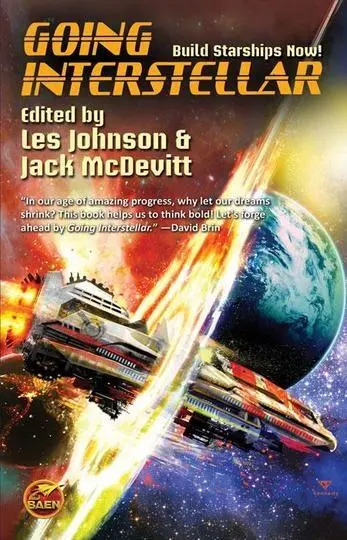
- Название:Going Interstellar
- Автор:
- Жанр:
- Год:неизвестен
- ISBN:нет данных
- Рейтинг книги:5 / 5. Голосов: 1
-
Избранное:Добавить в избранное
- Отзывы:
-
Ваша оценка:
Going Interstellar: краткое содержание, описание и аннотация
Предлагаем к чтению аннотацию, описание, краткое содержание или предисловие (зависит от того, что написал сам автор книги «Going Interstellar»). Если вы не нашли необходимую информацию о книге — напишите в комментариях, мы постараемся отыскать её.
Going Interstellar — читать онлайн бесплатно полную книгу (весь текст) целиком
Ниже представлен текст книги, разбитый по страницам. Система сохранения места последней прочитанной страницы, позволяет с удобством читать онлайн бесплатно книгу «Going Interstellar», без необходимости каждый раз заново искать на чём Вы остановились. Поставьте закладку, и сможете в любой момент перейти на страницу, на которой закончили чтение.
Интервал:
Закладка:
“The refurbished originals did not achieve break-even as quickly as the new units, but once they did, they have routinely out-performed our modern copies. We will achieve maximum rated output within three months, unless something dire occurs.”
“Make sure nothing ‘dire’ occurs, then, Intendant. Or you could experience your own dire occurrence.”
Bikrut, Harrod reflected, was ever the voice of boundless encouragement. “As you command, my Overlord.”
“Let us turn to the problems, then.” He fixed dead eyes upon Ackley hur-Shaddock. “You still do not have enough away-craft: what is the delay?”
To his credit, Ackley did not flinch under that lethal stare. “The delay is caused by the intransigence of the HouseMoot, Overlord Mellis. We can only use away-craft secured for House Shaddock’s exclusive access, but the Moot is slow in supplying these vehicles.”
“The Moot’s lethargy is no excuse for your failure: you should have explained that the biometric security requirements stipulated by Verone must be rescinded.”
“I did so; Overlord Verone will not relent.”
—To your relief, thought Harrod. Without the security protocols that require the pilots to be of House Shaddock, the Evolved of House Mellis would kill them in their cold sleep.
Bikrut’s withering stare did not waver. “I have also learned that House Shaddock disapproves of the energy we have allotted for our magnetic shielding.”
Ackley remained calm. “Our dispute arises out of hard physics, not House politics, Overlord Mellis. Your House’s scientists assert that doubling the field strength of our electromagnetic protection grid will enable it to repel cosmic rays. This is a fallacy.”
Bikrut looked at Harrod, who took the cue. “Ackley, we are quite aware that the field emitters cannot ‘stop’ cosmic rays. However, if the shielding is produced by generators tethered to the ship at a range of four kilometers or more, the fields can be biased to slightly alter the trajectory of the rays. Exposure levels in the protected sections of the ship will decrease by over eighty percent—perhaps more. The efficacy of this deflection strategy is well-documented by the surviving accounts of two prior Exodates.”
If Ackley had heard Harrod’s explanation, he gave no sign of it. “Overlord Mellis, there is a further issue I must raise. Just today, the HouseMoot rejected our third request for uranium. Without fuel for our nuclear back-up plant, how do they expect us to reinitiate fusion if the capacitors lose their charge?”
Bikrut glanced at Harrod, who shrugged. “It is hardly surprising that our enemies are slow to furnish us with materials from which we could make more weapons of retribution. Particularly given our present possession of an orbital launch platform.”
Overlord Bikrut frowned. “And yet we cannot relinquish the failsafe codes for our ground based-nuclear arsenal until we have passed into the outer system. Once there, we can allow them to disarm our missiles—but not before. Harrod?”
“Yes, my Overlord?”
“Recontact Verone. He seems to—favor—you. Make a personal appeal; explain our need for nuclear fuel rods, and also for the removal of the biometric security protocols on the away-craft. I make it your responsibility to solve these problems.”
Well, Harrod thought, now I’ll have more gray hairs to join the ones that just started coming in. But what he said was: “Yes, my Overlord.”
— 5 —
Harrod hur-Mellis held himself steady with a hand-rung located beside the aft-facing observation port. Back at the stern, the last of the Ark’s four tug-tenders was making its hard dock. Once attached, the tugs would both provide fuel to the on-board fusion engines, as well as adding their own considerable thrust. One hundred and sixty days from now, their assist-fuel expended, the robot ships would detach and return home.
Home. Within a few minutes, Kalsor Tertius would no longer qualify as ‘home.’ When the as-yet-unrenamed Ark started underway, the Exodate’s last connection with the planet would end. And the Exiles would mark the official commencement of their separate history from the moment Overlord Mellis revealed the name of the ship that would carry them almost sixteen light years to their new homeworld.
Unfortunately, that new homeworld was as uncertain as their old one was hostile. The HouseMoot had always discouraged any interest in stellar observation, fearing it would stimulate a desire to rediscover the fabled FTL technology of the Death Fathers. Consequently, the only telescopes available for locating a suitable destination star were those on board the Ark itself. Fortunately, they proved to be excellent instruments—once they were thoroughly refurbished. After inspecting a wide array of nearby stars, a midsized yellow star—halfway in its aging to orange—was proven to have a world at the inner edge of the habitable zone, and a smallish gas giant toward the outer edge. Inferential data suggested the inner world had a slightly heavier atmosphere, whereas the small gas giant was suspected of having atypically large moons. Taken in aggregate, they offered the best chance of a world with a biosphere, a place the Exodate could settle at the end of its long journey.
But the presence of a green world was only a possibility, not a certainty. Consequently, observations would continue throughout the journey—which was why Harrod was scheduled to be roused from cold sleep no less than three times before finally beholding the growing glare of their new sun, some seventy-one years hence. Spending a year awake on each occasion, he would complete the journey only slightly older than he was now—and ready to be Raised to the name sul-Mellis: the title of an Intendant whose seed has been wedded to one of the House’s Lines. Not fully an Evolved, he nonetheless would receive most of their honors and prerogatives, if not power. But his children would be born as fully Evolved—albeit of a hybrid line—and live without limits, without the need to learn how to avert their eyes, or make a deep bow. On the other hand, as Evolveds, they would learn to conquer, to compete, to domineer. Sadly, they would have little in common with their father, for their own world would be—
“Contemplating the world we leave behind, Intendant hur-Mellis?” The voice was that of Ackley, who, upon the naming of the Ark, was to be Raised up to become sul-Shaddock—and so, over Harrod.
“My thoughts are more upon the world toward which we journey, Ackley.”
Whose tone—and smile—hovered in some strange limbo between mockery and congenial jocularity: “Then you are looking the wrong way.”
“No, I don’t think so. Our future will grow from the roots of this world, you know. We had best remember that, even as we count down these final minutes of our old lives and identities.”
“Perhaps. And your insight might even be pertinent, for a change.” Ackley had, over the years, become almost amiable—largely because Harrod never rose to his confrontational goads. “For instance, although we go to a new world, we are still creatures of our old Houses. But,”—and his tone changed in a way that Harrod had never heard before—“that doesn’t mean that our old allegiances must endure. A new era opens before us. So, too, do new opportunities—if only we are bold enough to seize them.”
Harrod turned and stared at Ackley. The tone had been conspiratorial. So: Ackley had been sent to woo Harrod secretly into the ranks of House Shaddock. “Surely you jest.”
“Overlord Shaddock has been most impressed by you, and he has noted your own Overlord’s unwillingness to Raise you up in a timely fashion. Also, as the two senior space technology specialists, we could cooperatively achieve much.”
Читать дальшеИнтервал:
Закладка:
Похожие книги на «Going Interstellar»
Представляем Вашему вниманию похожие книги на «Going Interstellar» списком для выбора. Мы отобрали схожую по названию и смыслу литературу в надежде предоставить читателям больше вариантов отыскать новые, интересные, ещё непрочитанные произведения.





Обсуждение, отзывы о книге «Going Interstellar» и просто собственные мнения читателей. Оставьте ваши комментарии, напишите, что Вы думаете о произведении, его смысле или главных героях. Укажите что конкретно понравилось, а что нет, и почему Вы так считаете.