Rachel Maddow - Drift
Здесь есть возможность читать онлайн «Rachel Maddow - Drift» весь текст электронной книги совершенно бесплатно (целиком полную версию без сокращений). В некоторых случаях можно слушать аудио, скачать через торрент в формате fb2 и присутствует краткое содержание. Город: New York, Год выпуска: 2012, ISBN: 2012, Издательство: Crown Publishers, Жанр: Публицистика, на английском языке. Описание произведения, (предисловие) а так же отзывы посетителей доступны на портале библиотеки ЛибКат.
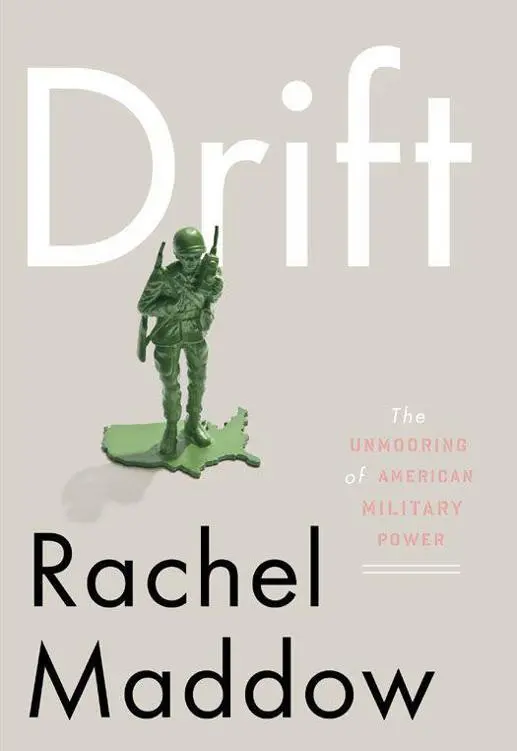
- Название:Drift
- Автор:
- Издательство:Crown Publishers
- Жанр:
- Год:2012
- Город:New York
- ISBN:978-0-307-46100-1
- Рейтинг книги:4 / 5. Голосов: 1
-
Избранное:Добавить в избранное
- Отзывы:
-
Ваша оценка:
Drift: краткое содержание, описание и аннотация
Предлагаем к чтению аннотацию, описание, краткое содержание или предисловие (зависит от того, что написал сам автор книги «Drift»). Если вы не нашли необходимую информацию о книге — напишите в комментариях, мы постараемся отыскать её.
Written with bracing wit and intelligence, Rachel Maddow’s
argues that we’ve drifted away from America’s original ideals and become a nation weirdly at peace with perpetual war, with all the financial and human costs that entails. To understand how we’ve arrived at such a dangerous place, Maddow takes us from the Vietnam War to today’s war in Afghanistan, along the way exploring the disturbing rise of executive authority, the gradual outsourcing of our war-making capabilities to private companies, the plummeting percentage of American families whose children fight our constant wars for us, and even the changing fortunes of G.I. Joe. She offers up a fresh, unsparing appraisal of Reagan’s radical presidency. Ultimately, she shows us just how much we stand to lose by allowing the priorities of the national security state to overpower our political discourse.
Sensible yet provocative, dead serious yet seriously funny,
will reinvigorate a “loud and jangly” political debate about how, when, and where to apply America’s strength and power—and who gets to make those decisions.
http://www.youtube.com/watch?v=Y9xoM7TMiTA
Drift — читать онлайн бесплатно полную книгу (весь текст) целиком
Ниже представлен текст книги, разбитый по страницам. Система сохранения места последней прочитанной страницы, позволяет с удобством читать онлайн бесплатно книгу «Drift», без необходимости каждый раз заново искать на чём Вы остановились. Поставьте закладку, и сможете в любой момент перейти на страницу, на которой закончили чтение.
Интервал:
Закладка:
Reagan’s deal violated the Arms Export Control Act by permitting Israel to secretly transfer US-supplied arms to a third country and failing to report the transfer to the proper officials in the US legislature. And the CIA, in providing access to the jet that flew the Hawk antiaircraft missiles to Iran in November, had violated a post-Vietnam amendment to the Foreign Assistance Act that forbade the agency from undertaking covert operations in a foreign country unless a president issued a finding that the operation is “important to the national security of the United States.”
At a White House meeting three weeks after the disastrous and illegal-on-two-counts shipment of the TOW missiles, most of the president’s top advisers tried to pull him out of the arms-for-hostages racket. A CIA deputy director explained that the notion of an independent moderate faction in the Iranian Army was a fiction, which meant that, even if Casey’s deputy didn’t say it aloud, selling weapons to Iran meant selling weapons directly to Khomeini. George Shultz and Caspar Weinberger, who rarely agreed on anything, were agreed on the benighted nature of the Ghorbanifar operation. Secretary of State Shultz had never bought Reagan’s argument that because we put Israel between ourselves and Iran, and then put some unknown and unidentified “Iranian moderates” between ourselves and Hezbollah, this was not an arms-for-hostages deal. Those were a couple of strands of hair too fine to split. And Secretary of Defense Weinberger pointedly reminded Reagan of the violations of both the embargo on selling arms to Iran and the Arms Export Control Act. The president was visibly annoyed with both Shultz and Weinberger, Shultz later said, and “very concerned about the hostages, as well as very much interested in the Iran initiative…. Fully engaged.” Despite the vocal in-house opposition to the operation, the Iranian arms deal remained on the table for the next month, largely because Reagan himself would not let it be extinguished.
In the meantime, by the reckoning of the White House’s NSC staff, one good thing had come from this mess of an arms deal: a smallish but quite useful windfall had dropped into the Swiss bank account of a private American company set up almost exclusively to further President Reagan’s foreign policy agenda. That first arms-for-hostages profit didn’t happen by design. The logistics of the third weapons shipment—the Hawks shipment—became so knotty that Israel had to pay a retired US Air Force general to deliver to Iran their four separate planeloads of twenty antiaircraft missiles. They advanced Gen. Richard V. Secord and his partners at Lake Resources, a key subsidiary of what came to be called “the Enterprise,” a million dollars for the job. Only one of the four shipments was actually made. The Enterprise spent $150,000 of the $1 million making that one flight to Tehran, but what would become of the remaining $850,000?
As it turned out, the Enterprise, this web of shady little offshore companies, had another client in real need. That extra money became what Secord—and perhaps his contact inside the Reagan White House, Col. Oliver North—called a “Contra-bution.” And this is where Iran-Contra, the scandal that almost destroyed the Reagan presidency, earned its hyphen.
By the time General Secord got his unexpected windfall, the White House had been for a year secretly running a public-private partnership to keep the Contras in what the many Marines on Reagan’s team liked to call “beans, boots, Band-Aids, and bullets.” The privatization of the Contra aid operation was an idea first promoted in the highest circle of the Reagan administration in the summer of 1984, when it started to become clear that Congress was going to stop the US government from aiding the Contra military effort directly. According to now-declassified minutes, much of the June 25, 1984, National Security Planning Group meeting in the White House Situation Room was about funding the Contras. And everybody in the room understood they were edging up against legally questionable measures.
“If we can’t get the money for the [Contras],” said UN ambassador Jeane Kirkpatrick at the meeting that afternoon, “then we should make the maximum effort to find the money elsewhere.”
“I would like to get the money for the Contras also,” Secretary of State George Shultz countered, “but another lawyer, Jim Baker, said that if we go out and try to get money from third countries, it is an impeachable offense.”
“I am entitled to complete the record,” CIA Director Casey chimed in, to remind everybody of the presidential finding on Nicaragua that Reagan had signed. “Jim Baker said that if we tried to get money from third countries without notifying the oversight committees, it could be a problem and he was informed that the [presidential] finding does provide for the participation and cooperation of third countries. Once he learned that the finding does encourage cooperation from third countries, Jim Baker immediately dropped his view that this could be an impeachable offense.”
“I think,” Shultz suggested, “we need to get an opinion from the attorney general on whether we can help the Contras obtain money from third sources. It would be the prudent thing to do.”
After a brief argument about the feeble prospects of a diplomatic push in Central America, Casey circled the conversation back to finding money for the Contras. “It is essential that we tell the Congress what will happen if they fail to provide the funding for the [Contras]. At the same time, we can go ahead in trying to help obtain funding for the [Contras] from other sources; the finding does say explicitly ‘the United States should cooperate with other governments and seek support of other governments.’ ”
“As another nonpracticing lawyer,” offered Ed Meese, a longtime presidential counselor, who was then more or less auditioning for the role of attorney general, “I want to emphasize that it’s important to tell the Department of Justice that we want them to find the proper and legal basis which will permit the United States to assist in obtaining third party resources for the anti-Sandinistas. You have to give lawyers guidance when asking them a question.”
A few minutes later, Casey seconded Meese: “We need the legal opinion which makes clear that the US has the authority to facilitate third country funding for the [Contras].”
As the meeting finally wound down, Vice President George Bush made a rare interjection, a tepid endorsement for the plan, with a tepid caveat: “How can anyone object to the US encouraging third parties to provide help to [Contras] under the finding? The only problem that might come up is if the United States were to promise to give these third parties something in return so that some people could interpret this as some kind of an exchange.”
National Security Adviser Bud McFarlane, clearly concerned about a discussion that had led off with the specter of impeachment, suggested extreme caution. “I propose that there be no authority for anyone to seek third-party support for the [Contras] until we have the information we need,” he told the group, “and I certainly hope none of this discussion will be made public in any way.”
Reagan agreed wholeheartedly with his national security adviser’s assertion of the need for absolute discretion. It was clear that he expected his team to keep their traps shut about this plan: “If such a story gets out,” the president said to close the meeting, “we’ll all be hanging by our thumbs in front of the White House until we found out who did it.”
Four months after that meeting, when Congress did cut off money for the US government to carry on with the Contras, the White House did not pause to consider the legal niceties of making its (covert) push for funding from third countries. Good news was that King Fahd bin Abdul Aziz of Saudi Arabia was already on board to the tune of a million dollars a month in direct aid to the Contras; the king was probably most appreciative for the 450 Stinger missiles Reagan had expressed to Saudi Arabia under the guise of presidential emergency powers, and for the US president’s promise to ask Congress for more. During Fahd’s visit to Washington in February 1985, the king capped a delightful private breakfast with the president with a promise to double his monthly donation. In all, Saudi Arabia would give about $32 million in aid to the Contras, or more precisely to the Enterprise. The only real disappointment for the president in his relations with Fahd was when the king tried to give Reagan a gift of four Arabian horses. He complained in his diary, “I couldn’t accept them as a gift—due to our stupid regulations.”
Читать дальшеИнтервал:
Закладка:
Похожие книги на «Drift»
Представляем Вашему вниманию похожие книги на «Drift» списком для выбора. Мы отобрали схожую по названию и смыслу литературу в надежде предоставить читателям больше вариантов отыскать новые, интересные, ещё непрочитанные произведения.








Обсуждение, отзывы о книге «Drift» и просто собственные мнения читателей. Оставьте ваши комментарии, напишите, что Вы думаете о произведении, его смысле или главных героях. Укажите что конкретно понравилось, а что нет, и почему Вы так считаете.