Rachel Maddow - Drift
Здесь есть возможность читать онлайн «Rachel Maddow - Drift» весь текст электронной книги совершенно бесплатно (целиком полную версию без сокращений). В некоторых случаях можно слушать аудио, скачать через торрент в формате fb2 и присутствует краткое содержание. Город: New York, Год выпуска: 2012, ISBN: 2012, Издательство: Crown Publishers, Жанр: Публицистика, на английском языке. Описание произведения, (предисловие) а так же отзывы посетителей доступны на портале библиотеки ЛибКат.
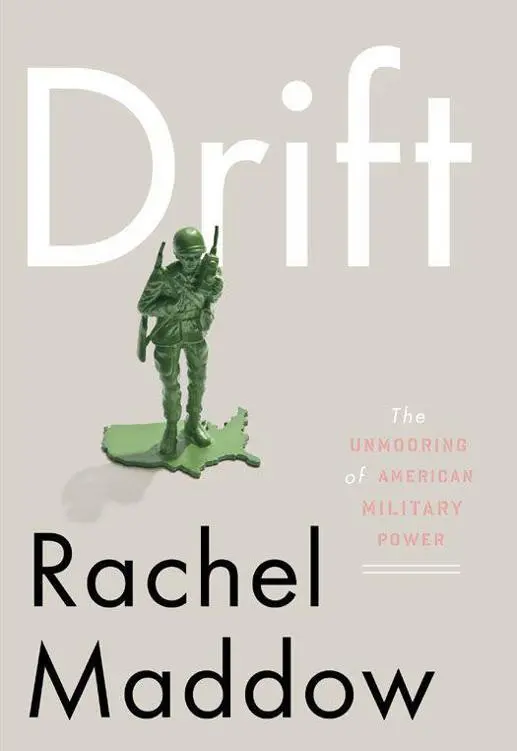
- Название:Drift
- Автор:
- Издательство:Crown Publishers
- Жанр:
- Год:2012
- Город:New York
- ISBN:978-0-307-46100-1
- Рейтинг книги:4 / 5. Голосов: 1
-
Избранное:Добавить в избранное
- Отзывы:
-
Ваша оценка:
Drift: краткое содержание, описание и аннотация
Предлагаем к чтению аннотацию, описание, краткое содержание или предисловие (зависит от того, что написал сам автор книги «Drift»). Если вы не нашли необходимую информацию о книге — напишите в комментариях, мы постараемся отыскать её.
Written with bracing wit and intelligence, Rachel Maddow’s
argues that we’ve drifted away from America’s original ideals and become a nation weirdly at peace with perpetual war, with all the financial and human costs that entails. To understand how we’ve arrived at such a dangerous place, Maddow takes us from the Vietnam War to today’s war in Afghanistan, along the way exploring the disturbing rise of executive authority, the gradual outsourcing of our war-making capabilities to private companies, the plummeting percentage of American families whose children fight our constant wars for us, and even the changing fortunes of G.I. Joe. She offers up a fresh, unsparing appraisal of Reagan’s radical presidency. Ultimately, she shows us just how much we stand to lose by allowing the priorities of the national security state to overpower our political discourse.
Sensible yet provocative, dead serious yet seriously funny,
will reinvigorate a “loud and jangly” political debate about how, when, and where to apply America’s strength and power—and who gets to make those decisions.
http://www.youtube.com/watch?v=Y9xoM7TMiTA
Drift — читать онлайн бесплатно полную книгу (весь текст) целиком
Ниже представлен текст книги, разбитый по страницам. Система сохранения места последней прочитанной страницы, позволяет с удобством читать онлайн бесплатно книгу «Drift», без необходимости каждый раз заново искать на чём Вы остановились. Поставьте закладку, и сможете в любой момент перейти на страницу, на которой закончили чтение.
Интервал:
Закладка:
The White House floated mostly above the fray. When asked what he thought of a hundred nations at the UN voting for the resolution deploring the US invasion of Grenada, Reagan waved it off, saying, “It didn’t upset my breakfast at all.” Team Reagan had the footage of the rescued medical student kissing the Carolina tarmac to rely on. They had unnamed “senior administration” sources out leaking to reporters that US soldiers had found smoking-gun evidence that the Grenadians and their Cuban advisers had been planning to grab Americans. The senior officials wished they could release the details and specifics of this plan, but of course all enemy correspondence had to be translated and analyzed first. They were happy, however, to characterize what they’d found. “It is clear from these documents and other information we now have that serious consideration was being given to seizing Americans as hostages and holding them for reasons that are not entirely clear, but seem to involve an effort to embarrass the United States and, more immediately, to forestall American military action in Grenada,” one senior official said.
Reagan himself remained adamant about the size of the danger averted: “Grenada, we were told, was a friendly island paradise for tourism. Well, it wasn’t. It was a Soviet-Cuban colony, being readied as a major military bastion to export terror and undermine democracy. We got there just in time.” This statement became a Spice Island touchstone for other White House officials: “It appears we got there just in time to prevent a tragedy.”
After about ten days of postgame back-and-forth, O’Neill and the other skeptics on both sides of the congressional aisle were beating what one of them admitted was “a strategic retreat.” Reagan had bested them. He knew he still had that old Fum-Poo flair, and that if he could get the American public behind him, he could roll Tip O’Neill and Congress on just about any issue he wished. The night of his Grenada speech, Reagan had noted in his diary, with obvious pleasure, that he’d “hit a few nerves…. ABC News polled 250 people before the speech, the majority were against us. They polled the same right after the speech & there had been a complete turnaround. 1000s of phone calls & wires from all over the country flooded us, more than on any speech or issue since we’ve been here—10 to 1 in our favor.” Not for nothing was Ronald Reagan known as the Great Communicator. The country’s overall approval ratings for the Grenada invasion soared to nearly 90 percent. And however much Congress disagreed, they knew that there wasn’t much margin in arguing the merits of the case against the invasion when more than eight in ten Americans were for it. “Public opinion is what’s behind things,” Democratic congressman Robert Torricelli told reporters. “I hardly get a call in my office about Grenada where people don’t mention the Iranian hostage situation. So people feel their frustration relieved and members of Congress sense that.”
What was the connection between the Iranian hostage situation and Grenada? None, exactly. But if the people were erasing a bad memory and replacing it with a better one, who was to argue? The point was, as Ronald Reagan would say at his next State of the Union address: “America is back—standing tall.”
CHAPTER 5
Stupid Regulations
THE THING TO DO IN NICARAGUA SEEMED SO GLARINGLY OBVIOUS to President Reagan that it almost didn’t need explaining (“It seems to me that the issue was so plain,” he was still saying years later. “We were talking about preventing the presence of a Soviet satellite in the Americas!”). “The Sandinista rule is a Communist reign of terror,” he implored in a May 1984 address to the nation. “If the Soviet Union can aid and abet subversion in our hemisphere, then the United States has a legal right and a moral duty to help resist it.”
But the more he explained it, the more clear it became that he would not be able to move the public to his way of thinking; on this one question, the nation would not dance to his tune. It didn’t matter how hard the president beat the drum about the frightening prospect of a Central American country being sucked into the sphere of Soviet influence. (Remember, we got there just in time in Grenada! Might not be so lucky in Managua.) Didn’t matter how hard the president beat the drum about the need to forestall what he described in his diary as “another Cuba on the American mainland.” Didn’t matter how adoringly he extolled the virtues of the brave Nicaraguan resistance. (“They are our brothers, these freedom fighters, and we owe them our help,” he’d offered. “They are the moral equal of our Founding Fathers and the brave men and women of the French Resistance. We cannot turn away from them.”) Didn’t matter what he said, it seemed to him, he could not get traction on the issue.
“Dick Wirthlin’s poll figures were interesting & holding up well—except for the Nicaragua issue,” Reagan wrote in his diary in the spring of 1985. “We have to do a job of education with the people—they just don’t understand.” It was a failure he stewed over again and again in that diary: “Our communications on Nicaragua have been a failure, 90% of the people know it is a communist country but almost as many don’t want us to give the [anti-Communists] $14 million for weapons. I have to believe it is the old Vietnam syndrome.” After meetings with members of Congress on Nicaragua, Reagan wrote, “The meetings went well & I think I answered some of their worries. It’s apparent though that the lack of support on the part of the people due to the drum beat of propaganda ‘a la Vietnam’ is influencing some of them.”
When Reagan wrote about the “Vietnam syndrome,” what he meant was that the American body politic suffered from a real pathology. He was sure that his failure to rally the country on Nicaragua, that all the impediments he found to making war on the Commies in Central America (or even to doing just a little energetic saber rattling)—the public’s disinclination to call up our troops to fight on foreign soil, the press asking questions about it, Congress asserting its power to stop war or limit it—were symptoms of this dread disease.
“In the last ten years,” Reagan complained at one press conference near the end of his first term, “the Congress has imposed about 150 restrictions on the President’s power in international diplomacy. And I think that the Constitution made it pretty plain way back in the beginning as to how diplomacy was to be conducted. And I just don’t think that a committee of 535 individuals, no matter how well intentioned, can offer what is needed in actions of this kind or where there’s a necessity. Do you know that prior to the Vietnamese War, while this country had four declared wars, Presidents of this country had found it necessary to use military forces 125 times in our history?”
But the “Vietnamese War” didn’t break anything. America’s structural disinclination toward war is not a sign that something’s gone wrong. It’s not a bug in the system. It is the system. It’s the way the founders set us up—to ensure our continuing national health. Every Congress is meddlesome, disinclined toward war, and obstructive of a president’s desire for it—on purpose. On Nicaragua, Congress was doing its constitutional duty, and what the founders expected.
In the run-up to the 1984 election, Congress had stayed late and built a big wall the president could not easily scale where his Nicaragua policy was concerned. After being told and not asked about the Grenada invasion, Tip O’Neill was not going to be gone around on this one. The lesson of Grenada (and Lebanon) for Speaker O’Neill was that passivity didn’t pay. Against a president who seemed bent on war, Congress needed to vigorously (and sometimes preemptively) assert its own authority.
Читать дальшеИнтервал:
Закладка:
Похожие книги на «Drift»
Представляем Вашему вниманию похожие книги на «Drift» списком для выбора. Мы отобрали схожую по названию и смыслу литературу в надежде предоставить читателям больше вариантов отыскать новые, интересные, ещё непрочитанные произведения.








Обсуждение, отзывы о книге «Drift» и просто собственные мнения читателей. Оставьте ваши комментарии, напишите, что Вы думаете о произведении, его смысле или главных героях. Укажите что конкретно понравилось, а что нет, и почему Вы так считаете.