Rachel Maddow - Drift
Здесь есть возможность читать онлайн «Rachel Maddow - Drift» весь текст электронной книги совершенно бесплатно (целиком полную версию без сокращений). В некоторых случаях можно слушать аудио, скачать через торрент в формате fb2 и присутствует краткое содержание. Город: New York, Год выпуска: 2012, ISBN: 2012, Издательство: Crown Publishers, Жанр: Публицистика, на английском языке. Описание произведения, (предисловие) а так же отзывы посетителей доступны на портале библиотеки ЛибКат.
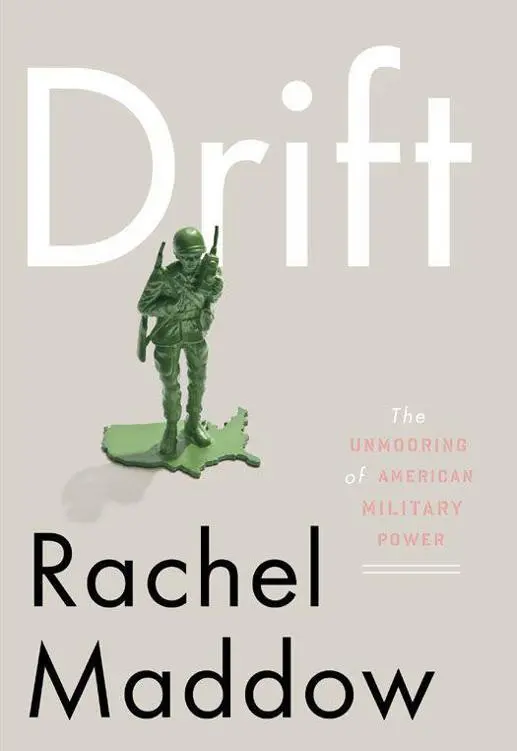
- Название:Drift
- Автор:
- Издательство:Crown Publishers
- Жанр:
- Год:2012
- Город:New York
- ISBN:978-0-307-46100-1
- Рейтинг книги:4 / 5. Голосов: 1
-
Избранное:Добавить в избранное
- Отзывы:
-
Ваша оценка:
Drift: краткое содержание, описание и аннотация
Предлагаем к чтению аннотацию, описание, краткое содержание или предисловие (зависит от того, что написал сам автор книги «Drift»). Если вы не нашли необходимую информацию о книге — напишите в комментариях, мы постараемся отыскать её.
Written with bracing wit and intelligence, Rachel Maddow’s
argues that we’ve drifted away from America’s original ideals and become a nation weirdly at peace with perpetual war, with all the financial and human costs that entails. To understand how we’ve arrived at such a dangerous place, Maddow takes us from the Vietnam War to today’s war in Afghanistan, along the way exploring the disturbing rise of executive authority, the gradual outsourcing of our war-making capabilities to private companies, the plummeting percentage of American families whose children fight our constant wars for us, and even the changing fortunes of G.I. Joe. She offers up a fresh, unsparing appraisal of Reagan’s radical presidency. Ultimately, she shows us just how much we stand to lose by allowing the priorities of the national security state to overpower our political discourse.
Sensible yet provocative, dead serious yet seriously funny,
will reinvigorate a “loud and jangly” political debate about how, when, and where to apply America’s strength and power—and who gets to make those decisions.
http://www.youtube.com/watch?v=Y9xoM7TMiTA
Drift — читать онлайн бесплатно полную книгу (весь текст) целиком
Ниже представлен текст книги, разбитый по страницам. Система сохранения места последней прочитанной страницы, позволяет с удобством читать онлайн бесплатно книгу «Drift», без необходимости каждый раз заново искать на чём Вы остановились. Поставьте закладку, и сможете в любой момент перейти на страницу, на которой закончили чтение.
Интервал:
Закладка:
Reagan reminded the congressional leaders that the rush of events had simply overtaken constitutional prerogatives. The safety of the American students was paramount; there was no time to lose. And then, prompted by something his national security adviser said, Reagan told the congressional leaders a story about how the Filipino people had cheered American soldiers after their liberation in World War II. “I can see the day, not too many weeks from now,” Reagan told the group, “when the Lebanese people will be standing at the shore, waving and cheering our Marines when they depart.”
O’Neill grew increasingly uncomfortable as Reagan kept going on about Lebanon in the middle of a meeting about Grenada. The Speaker began to suspect that part of the rationale for the invasion of Grenada was to use a quick-and-easy triumph as a distraction from the hideousness of the Beirut bombing.
Tip O’Neill was old-school. He worked hard to find common ground with the president, no matter how divergent their political philosophies. He’d always given the president the benefit of the doubt when White House factotums grabbed for a little extra on every deal the two men made—give a little, get a little was how O’Neill’s politics worked. Just three weeks earlier the Speaker had gone to bat for the president on the mission in Beirut, convincing skeptical House Democrats to vote for an eighteen-month extension of the 1,200-Marine US presence in the multinational peacekeeping force there. Reagan’s team had assured the Speaker that things were improving; that they could get Israeli and Syrian military units out of Lebanon, stand up a viable coalition government in Beirut, and train and equip a Lebanese Army capable of defending the country without an American presence. They just needed a little time.
Grenada was a tougher mission to back, but Tip O’Neill was also convinced that partisanship ended at the water’s edge in wartime. Even in a war against a tiny, poorly armed island military, he was not going to criticize the president while American troops were in a fight, and he would implore the House Democratic Caucus to do the same. On the way out of the meeting, O’Neill wished Reagan good luck, sincerely. He wasn’t interested in seeing American boys die. But he privately worried that Reagan’s insistence on making war in Grenada would start our own country down a dangerous new road.
The United States military might have been facing one of the weakest foes on the planet, but Operation Urgent Fury was no cakewalk. The Grenadian soldiers put up more of a fight than intelligence had suggested they would, but still, resistance melted away pretty quickly. Most of the damage the United States suffered in the invasion was self-inflicted. The lack of intelligence and basic tactical maps along with the inability of the various services to communicate with one another led to results ranging from comic to mortal. The SEALs sent to rescue Governor-General Scoon had to be rescued themselves. They had to use the house phone to call Fort Bragg to request fire from the US naval ships off the coast. The radio station selected to be used for Scoon’s address to the people of Grenada turned out to be nothing more than a remote transmission tower. Navy Corsair pilots accidentally blew up a mental hospital, killing eighteen patients. A US Marine liaison team mistakenly called in a naval air raid on a nearby US Army command post, wounding seventeen American soldiers and killing one. Helicopters were lost to small-arms fire, to the rotors from another chopper, and to a confrontation with a palm tree.
When word of the invasion began to reach home that first day, the early results were a cold slap in the face for Team Reagan. Members of the United Nations Security Council immediately began debating a resolution “deeply deploring” the US invasion of Grenada as a “flagrant violation of international law.” (The vote would go 11–1, with the United States exercising its veto power.) Prime Minister Margaret Thatcher called to register her anger with Reagan. Democrats and Republicans alike in Congress were not happy about being kept in the dark about this multimillion-dollar military adventure. “I was the designated person on the day of the beginning of the action when it became public to go to the Congress,” Secretary of State George Shultz told an audience a few years ago. “I spent all day long and there was hardly a good word said.” Sen. Lawton Chiles told reporters: “One day we’ve got the numbers of Marines’ deaths, which shocked us all, the next day we find we’re invading Grenada. Are we looking for a war we can win?”
The press corps, meanwhile, was apoplectic that they had not been brought along on the combat mission, and that a White House official had flat-out lied (“Preposterous!”) when asked in advance about the operation. The executive vice president of the National Newspaper Publishers Association called for a full-on congressional investigation into Reagan’s “policy of secret wars hidden from the American people.” Four years later, the conservative columnist and Republican defender William Safire was still pitching into Reagan’s national security team. “The United States Government may on rare occasion fall silent for a time, but it must not deliberately lie; only the presence of reporters pledged to temporary secrecy can help justify a news blackout. By breaching the democratic precedent, and by issuing a lie, the Reagan Administration engaged in self-corruption far more important than one victory in the Caribbean.”
Meanwhile, on Grenada, the way operations were unfolding did not exactly bolster the administration’s case that the point of Urgent Fury was saving the St. George’s University medical students. The plan to pluck the students from what was called the True Blue campus just a short hop north from the Point Salines airfield was executed to perfection. The Army Rangers swept in and secured all the students living on the campus without a serious hitch on the first day. But the Rangers found fewer than a third of the six hundred American students they’d been expecting on the campus. That’s because, the students explained, most of the students lived at the Grand Anse campus a few miles north.
Oops. In the full week after the crisis came to a head, nobody in the Pentagon or the White House made an effort to contact the school to see where everybody lived. Nobody picked up the telephone and called the dorms. Nobody checked the student-loan records to get actual addresses for the Americans studying at St. George’s. There was no plan to rescue students at the Grand Anse campus because nobody in the United States government knew there was a Grand Anse campus . Now the Army Rangers picked up the phone and called Grand Anse, and the students told them they thought a small group of Grenadian and Cuban soldiers had dug in around the campus. Whether they were to protect the American students or to hold them was anybody’s guess. But it must be noted that those Grenadians and Cubans had more than thirty-six hours after the first American troops landed to do as they pleased with the students. And they did them no harm.
While the Ranger commandos made plans for a new assault/rescue on the Grand Anse campus, the military kept reporters at bay, in Barbados. The last thing they needed now was reporters crawling around, which meant the media missed the most seamless operation of Urgent Fury. Firepower from the USS Independence took out a couple of hotels near the campus (part deux ), and then three waves of helicopters came roaring in over the Atlantic, blasting their .50-caliber guns into the smoke and haze and off-loading dozens of Army Rangers. In a matter of half an hour, another 224 American students had been freed from their beachside apartments and shipped off to safety in military helicopters.
Читать дальшеИнтервал:
Закладка:
Похожие книги на «Drift»
Представляем Вашему вниманию похожие книги на «Drift» списком для выбора. Мы отобрали схожую по названию и смыслу литературу в надежде предоставить читателям больше вариантов отыскать новые, интересные, ещё непрочитанные произведения.









Обсуждение, отзывы о книге «Drift» и просто собственные мнения читателей. Оставьте ваши комментарии, напишите, что Вы думаете о произведении, его смысле или главных героях. Укажите что конкретно понравилось, а что нет, и почему Вы так считаете.