Rachel Maddow - Drift
Здесь есть возможность читать онлайн «Rachel Maddow - Drift» весь текст электронной книги совершенно бесплатно (целиком полную версию без сокращений). В некоторых случаях можно слушать аудио, скачать через торрент в формате fb2 и присутствует краткое содержание. Город: New York, Год выпуска: 2012, ISBN: 2012, Издательство: Crown Publishers, Жанр: Публицистика, на английском языке. Описание произведения, (предисловие) а так же отзывы посетителей доступны на портале библиотеки ЛибКат.
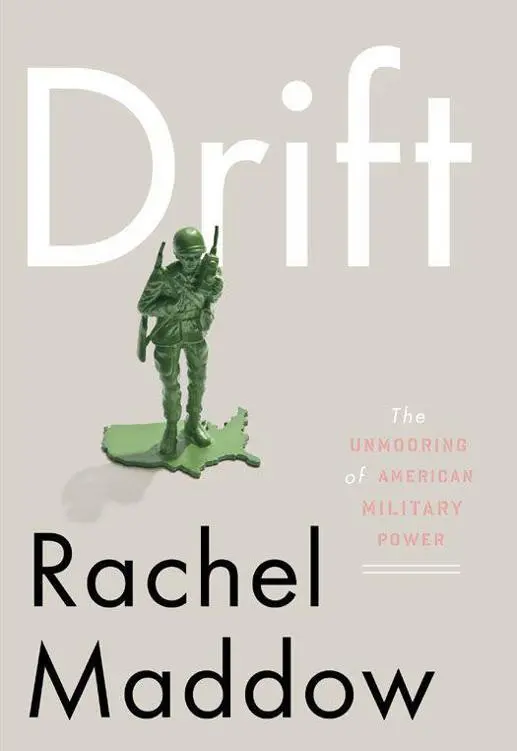
- Название:Drift
- Автор:
- Издательство:Crown Publishers
- Жанр:
- Год:2012
- Город:New York
- ISBN:978-0-307-46100-1
- Рейтинг книги:4 / 5. Голосов: 1
-
Избранное:Добавить в избранное
- Отзывы:
-
Ваша оценка:
Drift: краткое содержание, описание и аннотация
Предлагаем к чтению аннотацию, описание, краткое содержание или предисловие (зависит от того, что написал сам автор книги «Drift»). Если вы не нашли необходимую информацию о книге — напишите в комментариях, мы постараемся отыскать её.
Written with bracing wit and intelligence, Rachel Maddow’s
argues that we’ve drifted away from America’s original ideals and become a nation weirdly at peace with perpetual war, with all the financial and human costs that entails. To understand how we’ve arrived at such a dangerous place, Maddow takes us from the Vietnam War to today’s war in Afghanistan, along the way exploring the disturbing rise of executive authority, the gradual outsourcing of our war-making capabilities to private companies, the plummeting percentage of American families whose children fight our constant wars for us, and even the changing fortunes of G.I. Joe. She offers up a fresh, unsparing appraisal of Reagan’s radical presidency. Ultimately, she shows us just how much we stand to lose by allowing the priorities of the national security state to overpower our political discourse.
Sensible yet provocative, dead serious yet seriously funny,
will reinvigorate a “loud and jangly” political debate about how, when, and where to apply America’s strength and power—and who gets to make those decisions.
http://www.youtube.com/watch?v=Y9xoM7TMiTA
Drift — читать онлайн бесплатно полную книгу (весь текст) целиком
Ниже представлен текст книги, разбитый по страницам. Система сохранения места последней прочитанной страницы, позволяет с удобством читать онлайн бесплатно книгу «Drift», без необходимости каждый раз заново искать на чём Вы остановились. Поставьте закладку, и сможете в любой момент перейти на страницу, на которой закончили чтение.
Интервал:
Закладка:
When word reached the Pentagon planners that the SEALs failed to reach land as scheduled—and that they were determined to try again later that evening—the Joint Chiefs suggested a prudent twenty-four-hour delay in the operation, but a State Department liaison surprised the military brass by shooting down that idea. The coalition of Caribbean states that had agreed to back the US overthrow of the Grenadian government, he admitted, was already coming apart at the seams. It might not hold together for another twenty-four hours. If the US military was going to effect this coup, they had to go at the appointed hour. “Besides,” the State Department aide told the military chieftains, “how could the world’s strongest military power need any more time against what is probably the world’s weakest?”
The avowed reason for the urgency of Urgent Fury—planned from scratch in about seventy-two hours—was that American citizens were in grave danger on the island of Grenada. And they had to be rescued in a flash. An intramural scrap inside the island’s Marxist-Leninist government had left the prime minister and a number of his supporters dead and sent his number two and rival into hiding. Power had devolved to a military council and a somewhat rattled general who announced a four-day curfew enforced by armed soldiers. “No one is to leave their house,” the general said. “Anyone violating this curfew will be shot on sight.”
The Reagan administration’s diplomat in the region, the ambassador to Barbados, was a former Nebraska highway commissioner with no experience in foreign affairs. He’d been so offended by the Communists in Grenada that he forbade anybody from his diplomatic team from visiting the island or having contact with its leaders. The advantage of this strategy: it sure looked tough. The disadvantage: it ensured that America had no active Grenadian contacts, no one in-country, no way to make real-time observations on this island we were so concerned with. As best the Reagan national security team could determine (lacking actual on-the-ground information), law and order had completely broken down, leaving more than five hundred US students attending the American-owned and -operated St. George’s University School of Medicine cowering in their rooms, potential hostages. The administration’s draft decision memorandum, written in the main by a Marine lieutenant colonel named Oliver North, called first and foremost for “ensuring the safety of American citizens on Grenada,” but also for standing up a new democratic (aka pro-American) government in Grenada and ridding the island of the biggest Bolsheviks in the baño , the Cubans and their Soviet friends. When Vice President George Herbert Walker Bush questioned the (probably illegal) objective of a regime change by force, Reagan barely blinked: “Well, if we’ve got to go there, we might as well do everything that needs to be done.” Those med students had just become an important hook for a grand American scheme.
By October 1983, the time of the invasion, Reagan had been beating the presidential tom-toms about the Central America peril for more than two years, and he was growing ever more frustrated that he had been unable to get Congress to fall in step. When the House Intelligence Committee chairman learned from press reports in November 1982 that Reagan’s ambassador in Honduras was secretly training rebels to overthrow the popular but Marxist-leaning government in Nicaragua, he pointedly introduced legislation (which passed) that specifically prohibited the Department of Defense or the CIA from allocating any of their approved budgets to assist and foment a coup in Nicaragua. The usually unflappable Reagan was visibly angered by what he thought was congressional interference. “The Sandinistas have openly proclaimed Communism in their country and their support of Marxist revolutions throughout Central America,” he blurted in evident exasperation in a meeting with Democratic Speaker of the House Thomas P. “Tip” O’Neill. “They’re killing and torturing people! Now, what the hell does Congress expect me to do about that?”
Reagan went on one of his signature public relations offensives. In a speech to the nation from the Oval Office in March 1983, wherein the president warned that his record-breaking defense budget had been “trimmed to the limits of safety” by the soft-on-Communism Congress, Reagan revealed some hazy satellite photos of an airfield under construction. “On the small island of Grenada, at the southern end of the Caribbean chain,” he’d said, “the Cubans, with Soviet financing and backing, are in the process of building an airfield with a ten-thousand-foot runway. Grenada doesn’t even have an air force. Who is it intended for?”
Reagan meant this as an ominous rhetorical question, but it did have rather less ominous empirical answers. To wit: there were airfields of similar size and capacity already dotting the Caribbean; the Grenadian government wanted to build a new modern airport to increase tourism, which was their only source of income outside nutmeg, bananas, and servicing those medical students at St. George’s University. The Grenadian government had asked the United States for money to help build it so they could bring in big jetfuls of tourists directly from Miami and New York and Dallas; the tourists wouldn’t have to wait around Bridgetown, Barbados, to catch a puddle-jumper connection. The United States had said no to the aid request, but Great Britain and Canada had been happy to help. The main contractor for construction of the Point Salines airfield was a British company underwritten by a grant from the British government. None of this was secret. But according to Reagan there was a much more nefarious plot afoot. The president said he wanted to reveal more to the American people on TV that night, but, alas, he claimed, the stakes were too high. “These pictures only tell a small part of the story. I wish I could show you more without compromising our most sensitive intelligence sources and methods.”
Here’s what he could say: “The Soviet-Cuban militarization of Grenada, in short, can only be seen as power projection into the region. And it is in this important economic and strategic area that we’re trying to help the governments of El Salvador, Costa Rica, Honduras, and others in their struggles for democracy against guerrillas supported through Cuba and Nicaragua.
“This is why I’m speaking to you tonight—to urge you to tell your senators and congressmen that you know we must continue to restore our military strength. If we stop in midstream, we will send a signal of decline, of lessened will, to friends and adversaries alike.”
Reagan’s national plea did not shake loose the cash he’d desired from the legislature, so a month later he called a rare and dramatic joint session of Congress to ask members to stop resisting his budget requests for fighting the Commies in Central America. “The national security of all the Americas is at stake in Central America. If we cannot defend ourselves there, we cannot expect to prevail elsewhere. Our credibility would collapse, our alliances would crumble, and the safety of the homeland would be put in jeopardy.”
But Congress kept whittling away at funding for El Salvador, and for the Contra rebels in Nicaragua. The Senate blocked a specific request to have the CIA actively undermine the Communist-friendly runway-happy Grenadian government—effectively a slow-motion coup. But when Congress said no on Grenada, Reagan simply prepared an end run. On October 4, 1983, the president signed National Security Decision Directive 105, which ordered his own national security team to draw up plans for destabilizing the economy and the institutions of Grenada (among other Central American countries), to overthrow its Socialist government, and to rid the island once and for all of Cuban and Soviet influence. Senate be damned.
Читать дальшеИнтервал:
Закладка:
Похожие книги на «Drift»
Представляем Вашему вниманию похожие книги на «Drift» списком для выбора. Мы отобрали схожую по названию и смыслу литературу в надежде предоставить читателям больше вариантов отыскать новые, интересные, ещё непрочитанные произведения.








Обсуждение, отзывы о книге «Drift» и просто собственные мнения читателей. Оставьте ваши комментарии, напишите, что Вы думаете о произведении, его смысле или главных героях. Укажите что конкретно понравилось, а что нет, и почему Вы так считаете.